

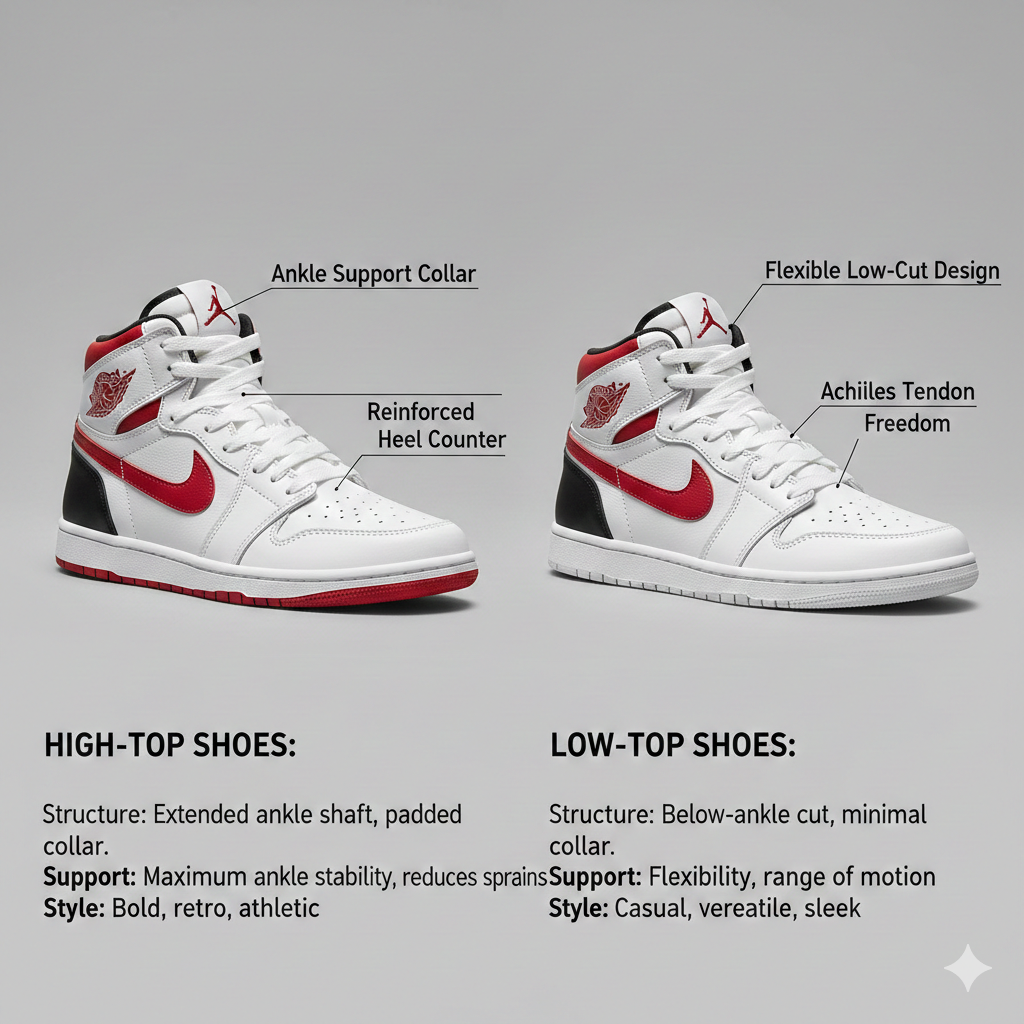
The silhouette of a shoe is its most defining characteristic. It is the first thing the eye registers, the primary factor in how a pant leg falls, and a crucial element in the mechanics of movement. While colorways and materials often dominate the conversation in sneaker culture, the structural height of a shoe—whether it extends above the ankle bone or sits below it—fundamentally alters both the aesthetic and the function of footwear.
The debate between high-tops and low-tops is not merely a question of preference; it is a conversation about physics, history, and sociology. High-tops, with their roots deeply embedded in athletic performance and ankle support, offer a sense of security and a bold visual statement. Low-tops, conversely, champion freedom of movement, lightness, and a casual versatility that has made them ubiquitous in modern wardrobes.
Understanding the distinction between these two primary silhouettes requires looking beyond the surface. It involves examining the evolution of athletic needs, the shifting tides of fashion trends, and the anatomical requirements of the human foot. This guide explores the structural, functional, and cultural nuances that separate the high-top from the low-top, helping you navigate the choice between support and freedom.
See also: Running Shoe Vs Lifestyle Silhouette Performance Vs Style Explained
Introduction: Why Shoe Height Changes Everything
At its core, the difference between a high-top and a low-top shoe is a matter of inches, yet these inches dictate the entire architecture of the footwear. The “collar” height—the point where the shoe opening sits relative to the ankle—serves as the dividing line.
In design terms, raising the collar height changes the shoe’s center of gravity and visual mass. A high-top demands attention; it interrupts the line of the leg and creates a distinct boundary between foot and limb. A low-top extends the leg line, exposing the ankle bone (the malleolus) and creating a seamless transition from leg to foot.
Functionally, this difference is even more profound. The collar height influences the range of motion of the talocrural joint (the ankle joint). High-tops are historically engineered to restrict excessive inversion and eversion—the rolling movements that lead to sprains. Low-tops are designed to free the ankle, allowing for maximum velocity and agility. Whether you are a basketball player needing stability in the paint or a commuter needing comfort on the subway, the height of your shoe changes the mechanics of your day.
What Are High-Top Shoes?
A high-top shoe is defined by a collar that extends significantly above the ankle bone. This silhouette encases the entire foot and the lower portion of the ankle, often featuring a lacing system that climbs higher up the leg to secure the fit.
Design Characteristics
The architecture of a high-top is built on containment. The “quarter” panels of the shoe extend upward, often padded heavily around the collar to provide cushioning against the shin and Achilles tendon. The tongue is elongated to match the height of the collar, ensuring that the laces do not bite into the skin when tightened.
Historically, this design required sturdier materials. Canvas and leather became the standards because they could maintain their structure vertically without collapsing. The lacing system in a high-top is critical; it acts as a splint, binding the shoe to the lower leg to create a unified lever. This integration means the foot and the shoe move as one cohesive unit, reducing the likelihood of the foot sliding inside the shoe during lateral movements.
Support and Stability
The primary functional argument for the high-top is proprioception and mechanical support. Proprioception is the body’s ability to sense movement, action, and location. High-tops provide continuous sensory feedback to the ankle; when the ankle begins to roll, the pressure of the collar alerts the wearer, potentially allowing for a subconscious muscular correction before an injury occurs.
While modern sports science debates whether high-tops physically prevent sprains more effectively than low-tops (studies suggest the difference is marginal compared to internal taping or bracing), the perception of stability is undeniable. For athletes who jump and land frequently, the high-top offers a psychological safety net, a feeling of being “locked in” that allows for more aggressive play.
Cultural Influence in Sneaker History
Culturally, the high-top is the aristocrat of sneaker history. Its lineage is traced directly to the Converse All Star, released in 1917. Originally designed for the burgeoning sport of basketball, the high-top became synonymous with athleticism.
In the 1980s, the high-top transcended sport to become a pillar of streetwear and hip-hop culture. The Nike Air Jordan 1 and the Reebok Pump turned the high-top silhouette into a billboard for personal expression. The sheer surface area of a high-top provided a larger canvas for designers to experiment with color blocking, straps, and logos. Wearing high-tops became a way to occupy space, to be seen. They were not just shoes; they were armor for the urban environment.
What Are Low-Top Shoes?
Low-top shoes are defined by a collar that sits below the ankle bone. This silhouette leaves the malleolus exposed and offers no restriction to the ankle’s range of motion. It is the footwear of agility, ease, and minimalism.
Lightweight Structure
Without the extra material required to cover the ankle, low-tops are inherently lighter. In footwear design, every ounce matters. For a runner or a pedestrian covering long distances, the reduction in weight translates to less energy expenditure with every step.
The construction of a low-top is often stripped back. The heel counter—the rigid cup that holds the heel in place—becomes the primary source of stability since there is no upper collar to rely on. This places a premium on fit; a low-top must grip the foot perfectly around the instep and heel to prevent slipping (heel lift).
Flexibility and Movement
The absence of an ankle collar allows for complete dorsiflexion (pulling toes up) and plantarflexion (pointing toes down). This freedom is essential for activities that require speed and sudden changes of direction, such as soccer or running.
In a low-top, the ankle acts as a multidirectional hinge without interference. This allows the foot to adapt quickly to uneven terrain or complex athletic maneuvers. The trade-off is that the stabilizing muscles of the lower leg must work harder to control the joint, but the reward is an unencumbered, natural range of motion.
Everyday Lifestyle Appeal
If the high-top is a statement, the low-top is a sentence—clear, concise, and adaptable. The rise of the “lifestyle” sneaker owes much to the low-top silhouette. Shoes like the Adidas Stan Smith or the Vans Era became icons not because of their technical prowess, but because of their democratic design.
Low-tops are easier to put on and take off. They are less prone to overheating because heat can escape easily from the ankle area. They pair effortlessly with shorts, cuffed chinos, or skirts without shortening the visual length of the leg. In the evolution of casual wear, the low-top became the default setting for global footwear because it prioritized convenience and comfort above all else.
High-Top vs Low-Top: Key Differences
When choosing between these silhouettes, several distinct factors come into play. It is rarely a case of one being objectively “better” than the other; rather, it is about matching the tool to the task.
Ankle Support
This is the most contested differentiator. High-tops offer passive support. The material acts as an external skeleton. However, if the material is soft (like a knit or canvas), the actual mechanical resistance to rolling is minimal. Low-tops offer zero external ankle support, relying entirely on the internal structure of the heel cup and the width of the sole to provide a stable base.
Comfort and Breathability
High-tops trap heat. The enclosed ankle acts as an insulator, which can be beneficial in cooler climates but detrimental in summer heat or during high-intensity activity. Low-tops are superior in breathability. The exposed ankle allows for efficient thermoregulation. Furthermore, high-tops can sometimes cause chafing or irritation around the shin or Achilles if not worn with socks of appropriate height, whereas low-tops generally minimize skin contact points.
Style Versatility
High-tops are inherently bolder and can be harder to style. They often bunch up the hem of pant legs, requiring a specific cut of trousers (tapered or cropped) to look clean. They dominate an outfit. Low-tops are the chameleons of fashion. They slide under jeans, pair cleanly with suits, and look natural with swimwear. Their visual footprint is smaller, making them easier to integrate into diverse wardrobes.
Performance Use Cases
- Basketball: Traditionally high-top domain, though modern players like Kobe Bryant popularized low-tops for better ankle mobility.
- Running: Exclusively low-top domain. The ankle restriction of a high-top is counterproductive to the mechanics of running gait.
- Skateboarding: A split decision. High-tops protect the ankles from board impact (the “shark bite”), while low-tops offer better board feel and ankle flick.
- Weightlifting: High-tops (like Converse Chuck Taylors) are often preferred for squats and deadlifts because they allow the wearer to push outward against the shoe wall for stability without the foot rolling over.
See also: Classic Sneaker Silhouettes That Changed Fashion History
How Construction Influences High-Top and Low-Top Design
The silhouette dictates the construction methods used by the manufacturer. A shoe is not just cut lower or higher; it is engineered differently from the lasting board up.
Cushioning Systems
In high-tops, cushioning systems are often more robust. Because the shoe is heavier and often used for high-impact sports like basketball, manufacturers frequently embed larger air units or thicker foam stacks in the midsole. The assumption is that the high-top wearer is landing from a height.
In low-tops, particularly running or lifestyle models, the cushioning is often tuned for responsiveness and energy return. The goal is propulsion, not just impact absorption. This leads to the use of lighter, springier foams that compliment the shoe’s overall lightweight philosophy.
Lasting and Structure
The “last” is the 3D mold upon which a shoe is constructed. High-top lasts must account for the volume of the ankle and the lower calf. This is a complex anatomical area that swells throughout the day. Designers must curve the collar shape to accommodate the Achilles tendon notch to prevent blistering.
Low-top lasts focus intensely on the “cone” of the heel. Because there is no upper lacing to hold the shoe on, the heel curve must be aggressive enough to lock the calcaneus (heel bone) into the back of the shoe. If a low-top is poorly lasted, the heel slips out with every step—a structural failure that is less catastrophic in a high-top where the laces secure the ankle.
Materials Used
High-tops require materials with tensile strength. Leather, suede, and rigid synthetics are common because they need to stand upright. A floppy high-top collar is functionally useless and aesthetically unpleasing.
Low-tops have championed the use of knit technologies (like Nike Flyknit or Adidas Primeknit). Because the shoe doesn’t need to support the ankle, the upper can be sock-like, flexible, and completely unstructured. This material innovation has driven the popularity of modern low-tops, creating shoes that feel like a second skin rather than a protective boot.
Cultural Meaning Behind High-Top vs Low-Top Sneakers
Shoes are artifacts of culture. The choice between high and low carries semiotic weight—it signals identity, tribe, and intent.
Identity and Personal Style
The high-top is often associated with rebellion and youth culture. From the greasers of the 1950s in their Converse to the b-boys of the 80s in their Adidas Forums, the high-top is a counter-culture symbol. It suggests a readiness for action, a connection to the street. It is a silhouette that says, “I am here.”
The low-top is associated with leisure, preppiness, and athleticism. The tennis shoe, the deck shoe, the runner—these are low-top staples that signal a life of recreation or efficiency. In the modern tech world, the luxury minimalist low-top (like the Common Projects Achilles) has become the new corporate uniform, replacing the brogue as a symbol of status and smart-casual competence.
Athletic Heritage vs Casual Lifestyle
We still view high-tops through the lens of the court. Even a luxury high-top from a fashion house like Balenciaga retains the DNA of a basketball boot. It implies athleticism, even if the wearer never touches a ball.
Low-tops carry the DNA of the track and the deck. They imply movement and ease. The cultural shift towards “athleisure”—wearing athletic gear in non-athletic settings—has heavily favored the low-top runner because it aligns with the modern value of being constantly on the move, optimized, and comfortable.
Choosing Between High-Top and Low-Top for Your Lifestyle
Making the right choice depends on identifying your primary need state. Are you prioritizing protection, style, or ease?
Casual Everyday Wear
For the majority of people, the low-top is the superior daily driver. It is easier to pack for travel, quicker to put on for errands, and more adaptable to changing weather conditions. If your daily life involves office environments, commuting, or general urban walking, the low-top offers the best balance of comfort and versatility.
Sports and Performance
If your sport involves lateral cutting, jumping, and physical contact (basketball, aggressive tennis), a high-top or a mid-top provides valuable sensory feedback and impact protection for the ankle bone.
If your sport involves linear movement, endurance, or speed (running, cross-training), a low-top is non-negotiable. The weight savings and range of motion are critical for performance.
Fashion Expression
If you want your footwear to be the focal point of your outfit, choose a high-top. A high-top sneaker like an Air Jordan 1 is a statement piece that anchors a look. It pairs best with streetwear aesthetics: hoodies, joggers, oversized tees, and denim.
If you want your footwear to compliment your outfit without dominating it, choose a low-top. A clean white low-top leather sneaker is the universal donor of the fashion world—it works with everything from a summer dress to a charcoal suit.
The Future of Sneaker Silhouettes
Evolution does not stop. The binary distinction between high and low is already being blurred by technology and new design philosophies.
Hybrid Ankle-Height Designs
We are seeing the rise of the “mid-top”—a silhouette that hits right at the ankle bone, attempting to offer the best of both worlds. Furthermore, “sock-shoes” with integrated knit collars that extend up the calf are redefining what a high-top is. These provide the visual of a high-top but the flexibility of a low-top.
Sustainable Lightweight Structures
As sustainability becomes paramount, materials are changing. We may see high-tops constructed from bio-based, self-supporting meshes that offer the structure of leather without the weight or environmental impact. This could spark a renaissance for the high-top, removing its primary drawback (weight/heat) and making it a viable option for summer wear.
AI-Driven Shape Evolution
Artificial Intelligence is beginning to design shoe soles and uppers based on performance data. It is likely that AI will eventually dictate silhouette heights that are not strictly “high” or “low” but asymmetrical—perhaps higher on the medial side for support and lower on the lateral side for mobility. The future silhouette will be defined by anatomy, not tradition.
Read Here: Shoe Silhouettes Explained Understanding Shape Structure Style
Conclusion: Support vs Freedom — Finding Your Ideal Silhouette
The evolution of shoe silhouettes from the primitive sandal to the high-tech sneaker is a history of humans trying to balance two opposing desires: the need for protection and the desire for freedom.
High-tops represent our need for armor. They are structured, supportive, and bold. They honor the history of sport and the culture of the street. Low-tops represent our need for speed. They are light, flexible, and adaptable. They honor the mechanics of the foot and the pace of modern life.
Your ideal silhouette depends on which of these values you prioritize today. Are you locking in for a battle on the court, or are you stepping out for a day of unencumbered movement? Understanding the architecture of your footwear ensures that whatever you choose, you are standing on a solid foundation.
Leave a Reply