

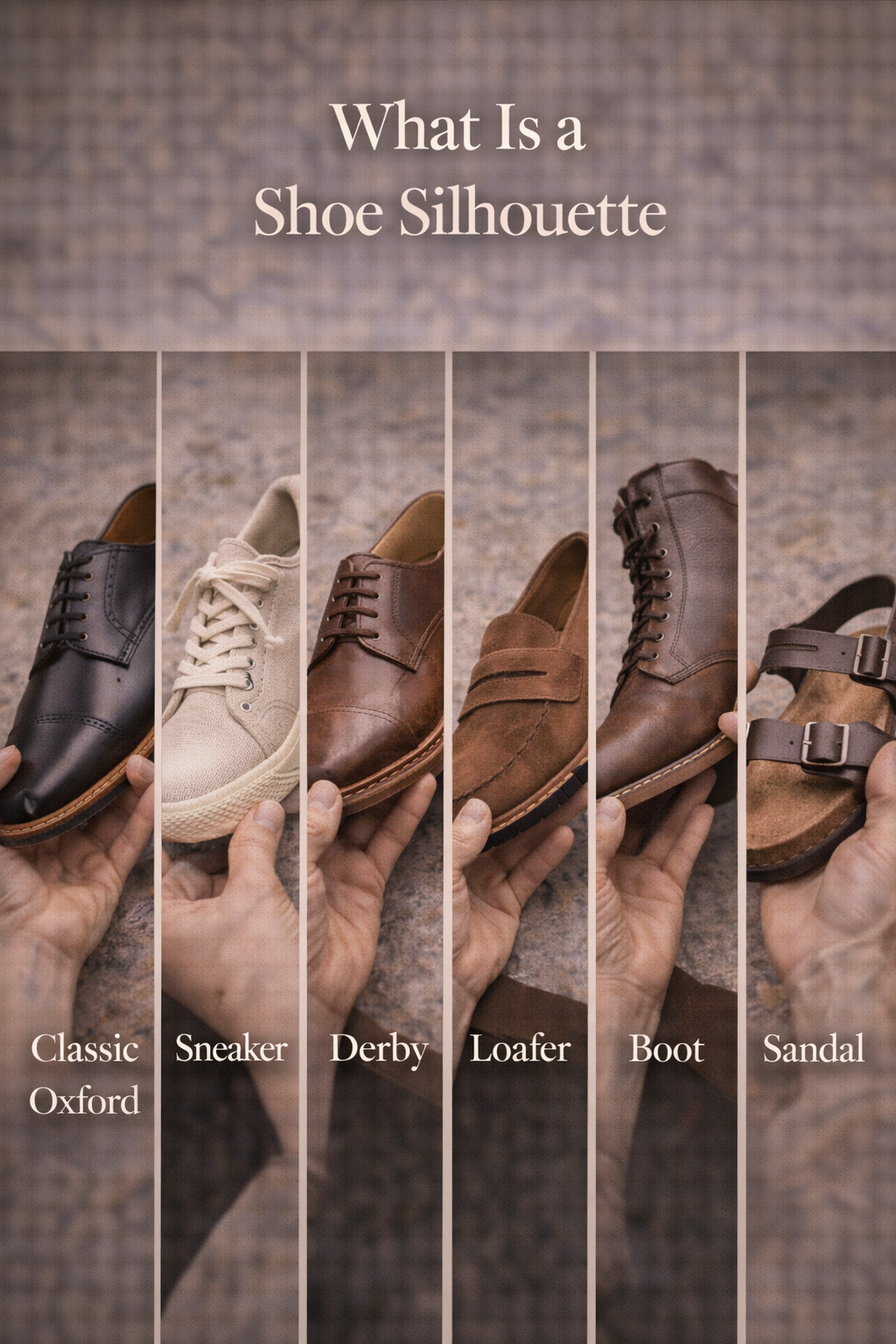
When a footwear designer sits down to create a new shoe, they do not start with the laces, the logo, or the colorway. They start with a single, sweeping line. This line defines the object’s boundary against empty space. Before a shoe has texture, material, or function, it has a silhouette.
In the simplest terms, a shoe silhouette is its outline—the solid shape it casts as a shadow. But in the world of fashion history and technical design, it is much more than a shadow. The silhouette is the architectural framework of footwear. It dictates how a shoe interacts with the human body, how it alters the wearer’s posture, and the cultural message it conveys to the world.
Whether it is the sharp, aggressive point of a stiletto or the bulbous, organic curve of a modern foam runner, the silhouette is the primary language of footwear design. This guide explores the anatomy of that language, dissecting how shape, structure, and history come together to define what we wear on our feet.
The Meaning of Silhouette in Footwear
To understand footwear, one must first understand the concept of the “last.” In shoemaking, the last is the 3D mold upon which a shoe is constructed. The silhouette is essentially the visual manifestation of that last, combined with the volume of the upper and the sole unit.
Designers prioritize silhouette because it is the most recognizable element of a shoe from a distance. Long before you can see the brand logo or the quality of the leather, you register the shape. Is it chunky and grounded? Is it sleek and aerodynamic? Is it tall and protective?
This outline serves two primary functions: identity and aesthetics.
In terms of identity, the silhouette categorizes the footwear. A heavy, lug-sole outline signals utility and ruggedness. A low-profile, thin-soled outline signals agility or formality. Aesthetics, however, are where the artistry lies. A successful silhouette balances visual weight against the human leg. It can elongate the limb, ground the outfit, or create a deliberate disruption in the body’s natural line.
[See also: Evolution of Shoes ]
[See also: Why Humans Care About Shoes ]
Key Elements That Define a Shoe Silhouette
A silhouette is not a singular entity; it is the sum of several anatomical parts working in harmony. If you alter just one of these elements, the entire character of the shoe shifts.
Height (High-Top vs. Low-Top)
The “collar” height is perhaps the most defining vertical aspect of a shoe’s silhouette.
- Low-Top: Cuts below the ankle bone (malleolus). This silhouette creates a visual separation between the foot and the leg, offering the illusion of a longer limb and greater range of motion.
- Mid-Top: Hits right at the ankle. This is a transitional silhouette often used in basketball or casual boots, providing a balance of support and mobility.
- High-Top/Boot: Extends up the calf. This adds visual mass and integrates the foot more fully with the leg, often shortening the appearance of the limb but adding a sense of stability and power.
Toe Shape and Profile
The “toe box” is the face of the shoe. It is the leading edge of the silhouette and sets the tone for the entire design.
- Pointed: Aggressive, dynamic, and often formal. It extends the line of the foot forward.
- Round: Soft, approachable, and anatomical. This is the standard for workwear and casual sneakers.
- Square/Chiseled: abrupt and structural. Historically controversial but often returning in fashion cycles to denote a break from tradition.
Sole Thickness and Proportion
The “stack height” or sole unit determines the shoe’s relationship with the ground.
- Low Profile: Thin soles (like ballet flats or driving loafers) keep the silhouette intimate with the ground, suggesting sensitivity and grace.
- Platform/Chunky: Thick midsoles add verticality and visual weight. In the context of the “Dad Shoe” trend or platform boots, this creates a “bottom-heavy” silhouette that anchors an outfit.
Overall Structure
This refers to the volume of the upper. Is the shoe padded and puffy (like a skate shoe), or is it unstructured and sock-like? The structure determines how much space the silhouette occupies in 3D space, regardless of its 2D outline.
[See also: Parts of a Shoe Explained ]
Types of Shoe Silhouettes
While there are infinite variations, most footwear falls into a few archetypal silhouettes that have evolved over centuries.
Sneaker Silhouettes
The sneaker world offers the most diversity in modern silhouettes.
- ** The Plimsoll:** The original sneaker. A simple canvas upper on a rubber sole. The silhouette is almost non-existent, mirroring the foot exactly.
- The Court: Defined by the Jordan 1 or the Air Force 1. These feature a distinct cupsole and a structured upper that stands away from the foot, creating a boxier, more architectural shape.
- The Runner: Wedge-shaped. The silhouette is higher at the heel and tapers down to the toe, creating a sense of forward momentum even when standing still.
Boot Silhouettes
- The Chelsea: Characterized by a close fit and an unbroken line (no laces). The elastic gusset allows for a sleek, aerodynamic silhouette that hugs the ankle.
- The Combat: Defined by the aggressive tread and the lace-up shaft. The silhouette is jagged and heavy, disrupting the smooth line of the leg.
Loafer and Formal Silhouettes
- The Oxford: The “closed lacing” system creates a seamless, smooth profile across the top of the foot. It is the silhouette of restriction and refinement.
- The Loafer: The absence of laces and the lower vamp (the top part of the shoe) exposes more of the foot, creating a relaxed, horizontal silhouette.
[Internal Link: Complete Guide to Types of Shoes]
How Construction Influences Silhouette
A silhouette is not just drawn; it is engineered. The method used to assemble the shoe dictates what shapes are physically possible.
Lasting Methods
“Lasting” is the process of pulling the upper material over the mold.
- Board Lasting: Makes the shoe stiff and stable, resulting in a rigid silhouette that holds its shape (common in boots).
- Slip Lasting: The upper is sewn into a sock shape before being attached to the sole. This creates a soft, unstructured silhouette that collapses when not worn (common in running shoes).
Stitching Techniques
The way the sole attaches to the upper changes the outline’s width.
- Cementing: Glueing the sole directly to the upper. This allows for the sleekest, tightest silhouette, as there is no need for a stitching edge.
- Goodyear Welt: A strip of leather is stitched to both the upper and the sole. This creates a visible “ledge” or extension around the base of the shoe, making the footprint wider and the silhouette heavier.
Cushioning and Sole Design
Modern technology has drastically altered silhouettes. The invention of EVA foam and air-bubble technology allowed soles to become massive without becoming too heavy to walk in. The “oversized” sneaker silhouette of the 2010s was only possible because lightweight foam permitted such volume.
[Read Here: Lasting Process in Shoemaking]
[See also: Cushioning Technologies Explained]
The Evolution of Shoe Silhouettes Through History
The history of the shoe silhouette is a pendulum swinging between minimalism and exaggeration.
Ancient Minimal Forms
For thousands of years, the silhouette was dictated by necessity. Roman sandals and Egyptian papyrus shoes added almost no bulk to the foot. The silhouette was essentially the foot itself, protected by a thin layer.
Industrial Era Designs
With the Industrial Revolution came the standardized heel. This changed the posture of the wearer and the silhouette of the shoe, creating a distinct arch and a separation between the heel and the forefoot. The silhouette became a tool for altering the body’s presentation—making the wearer taller and the foot appear smaller.
Modern Chunky vs. Minimal Trends
In the late 20th and early 21st centuries, silhouettes became cultural statements.
- The 1970s: Slim, low-profile joggers (Cortez).
- The 1990s: Massive, tech-heavy basketball shoes (Jordans, Pumps). The silhouette expanded to match the baggy clothing trends.
- The 2010s: The sock-shoe (Yeezy, Flyknit). The silhouette collapsed back to the shape of the foot.
- The 2020s: The return of maximalism. Crocs, Balenciaga, and “gorpcore” hiking boots emphasize a distorted, large-scale silhouette.
[Internal Link: Classic Sneaker Silhouettes That Changed Fashion History]
How Silhouettes Influence Style and Identity
We choose our silhouettes based on how we want to be perceived. This is the psychology of shape.
A sharp, sleek silhouette (like a pointed boot or a dress shoe) implies precision, speed, and professionalism. It suggests a person who is agile and refined. It fits into the corporate world or high-fashion aesthetics where lines are clean and controlled.
A round, bulbous silhouette (like a clog or a retro sneaker) implies comfort, approachability, and non-conformity. It rejects the “sharpness” of traditional status symbols in favor of softness.
A heavy, structured silhouette (like a Doc Marten or a timberland) implies groundedness, rebellion, and durability. It adds physical weight to the wearer’s step, changing how they walk and how they occupy space in a room.
[Internal Link: The Psychology of Sneaker Culture and Modern Identity]
Choosing the Right Silhouette for Your Lifestyle
While fashion dictates trends, utility dictates your daily choice.
Casual Wear
For everyday use, versatile silhouettes are key. A “low-top court” silhouette (like a Stan Smith) is considered a staple because its clean lines and moderate volume work with both slim and wide trousers. It is the “neutral” silhouette of the modern wardrobe.
Professional Settings
Here, the silhouette must usually align with the leg line of the trousers. A slim suit pant requires a slim, low-profile shoe silhouette to avoid looking clownish. However, modern “business casual” is allowing for hybrid silhouettes, like dress-sneakers, which blend a formal upper with a comfortable, slightly chunkier sole.
Athletic Performance
In sports, silhouette follows physics. A marathon runner needs a curved, rocker-bottom silhouette to propel them forward. A weightlifter needs a flat, wide, zero-drop silhouette for maximum stability. Here, the aesthetic is secondary to the biomechanics.
[See also: How to Choose the Right Shoes for Your Lifestyle]
The Future of Shoe Silhouettes
We are currently witnessing the biggest shift in shoe silhouettes since the invention of the rubber sole.
AI-Generated Designs: Computers can now generate structural shapes that humans never would have conceived. We are seeing organic, alien-like silhouettes that look like coral reefs or skeletal structures, optimized by algorithms for perfect weight distribution.
Sustainable Shapes: As we move toward circular manufacturing, silhouettes are becoming simpler. “Monobloc” shoes (made of a single piece of foam or material) are easier to recycle. This is leading to a future of seamless, fluid silhouettes that lack the traditional panels and stitching of the past.
Hybrid Footwear: The lines are blurring. We are seeing sneaker-boots, sandal-sneakers, and formal-hybrids. The silhouette of the future is likely to be a shapeshifter, refusing to fit into the strict categories of the 20th century.
[Read Here: The Future of Shoes: Technology & Innovation]
Silhouette as the Language of Footwear Design
The silhouette is the first thing you see and the last thing you remember about a shoe. It is the boundary between the person and the environment. Understanding silhouette is the key to understanding not just footwear design, but how humans have chosen to walk through history. From the flat sandals of antiquity to the towering platforms of the modern runway, the shape of our shoes shapes our lives.
[Read Here: Shoe Silhouettes Explained: Shape, Structure & Style]
Leave a Reply