

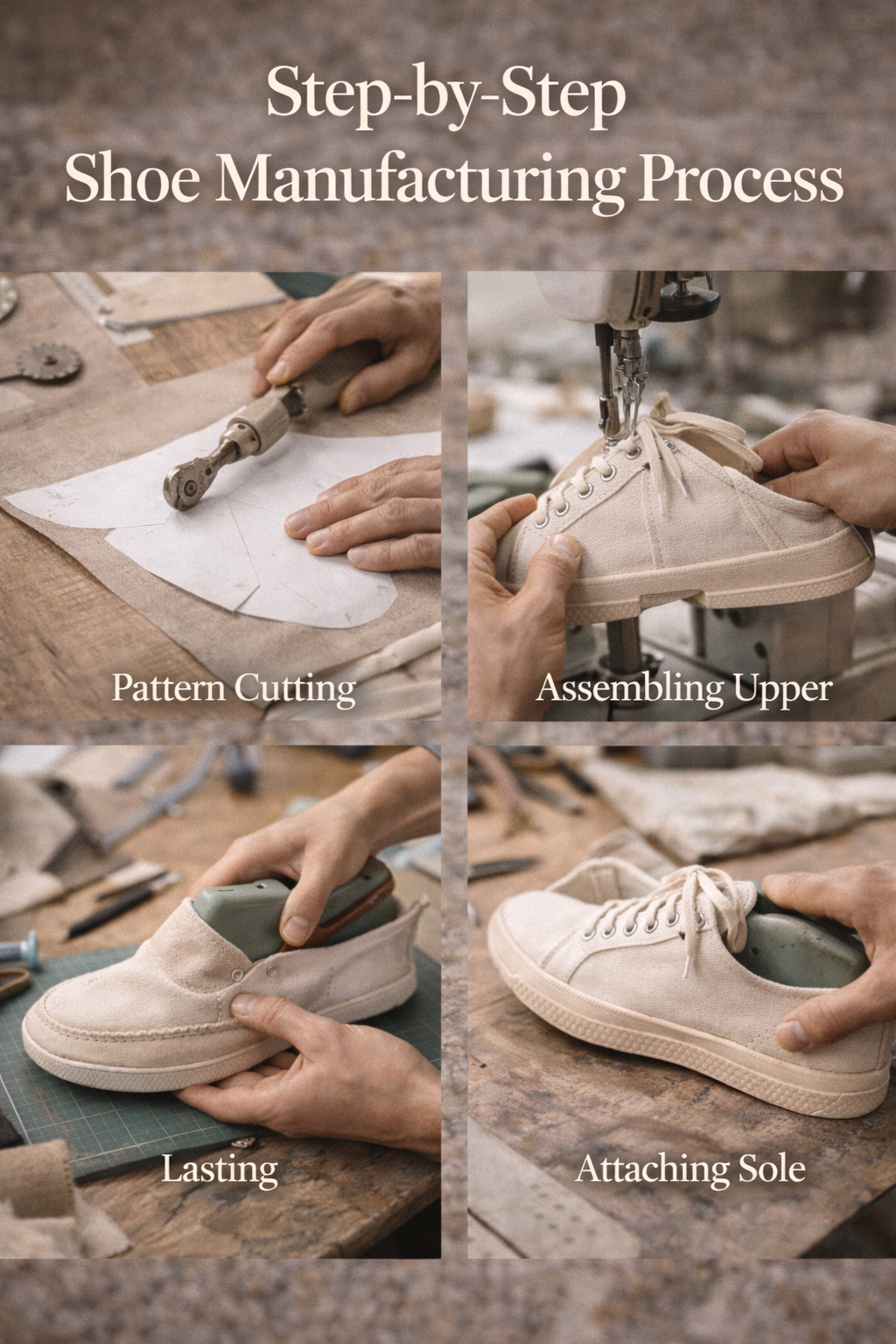
When we look at a finished shoe—whether it’s a sleek Italian leather oxford or a high-performance running sneaker—we often only see the aesthetic result. We see the branding, the silhouette, and the colorway. What remains invisible is the complex, almost symphonic coordination of engineering, craftsmanship, and industrial mechanics required to get that product onto a shelf.
Shoe manufacturing is a unique intersection of disciplines. It is where ancient traditions of leatherworking collide with futuristic robotics. It is where the soft, organic variability of natural materials meets the rigid precision of metal molds. Understanding this process does not just explain how a shoe is built; it explains why shoes look, feel, and perform the way they do.
Also See: How Shoes Are Made
The journey from a two-dimensional design sketch to a three-dimensional object involves hundreds of steps, dozens of skilled hands, and specialized machinery. This guide breaks down that journey, offering an expert look into the anatomy of production.
The Journey From Design to Production
Before a single piece of leather is cut or a sole is molded, the shoe exists as a concept. The manufacturing process is the bridge between the ethereal world of design and the physical world of utility.
In the early days of footwear history, the designer and the manufacturer were the same person—the cobbler. They would measure the foot, cut the hide, and stitch the sole. Today, these roles are distinct but deeply intertwined. A footwear designer must understand manufacturing constraints to create a viable product. If a designer sketches a silhouette with impossible curves or material combinations that cannot be bonded, the manufacturing line will come to a halt.
Modern manufacturing is a game of logistics as much as construction. It involves sourcing materials from different continents, creating molds (tooling) that cost thousands of dollars, and setting up assembly lines where timing is measured in seconds. Yet, despite the heavy automation in modern factories, shoemaking remains surprisingly labor-intensive. There is a “human touch” required in pulling leather tight against a last or guiding a stitch line around a complex curve that robots still struggle to replicate perfectly.
Step 1: Material Selection and Preparation
The life of a shoe begins in the stockroom. This is where raw materials are received, inspected, and prepped for the assembly line. The quality of the final product is almost entirely dependent on the quality of the inputs here.
Leather and Synthetic Materials
For traditional footwear, this stage involves handling large hides of leather. Leather is a natural material, meaning it is imperfect. It has scars, stretch marks, and variations in thickness. Skilled technicians (or increasingly, optical scanners) inspect these hides to mark defects. The goal is to maximize the “cutting yield”—getting as many usable pieces as possible out of a single hide while avoiding the flawed areas.
In the world of athletic footwear, the materials are vastly different. Here, we see rolls of engineered mesh, synthetic leathers (PU/PVC), knits, and thermoplastic polyurethanes (TPU). These materials offer consistency that leather does not, allowing for higher speed and automation.
Cutting Patterns
Once materials are approved, they move to the cutting department. This is often called the “Clicking” room in traditional shoemaking—named after the clicking sound the metal die makes when the hydraulic press strikes it.
- Die Cutting: This is the traditional method. Sharp metal molds, shaped like the various pattern pieces of the shoe (the vamp, the quarter, the tongue), are placed on the material. A press stamps them out like a cookie cutter.
- Laser and Computer Cutting: For modern synthetics and complex designs, factories use computer-controlled (CNC) knives or lasers. This allows for intricate shapes that metal dies cannot achieve and reduces waste significantly.
Quality Inspection and Skiving
After cutting, the pieces are not yet ready for sewing. Leather edges are often too thick to be stitched together without creating bulky, uncomfortable seams. This leads to a process called “skiving,” where the edges of the leather pieces are shaved down to a taper. This ensures that when two pieces are layered, the overlap is seamless and smooth against the foot.
At this stage, logos might also be embossed, or decorative perforations (like the broguing on a dress shoe) are punched into the flat pieces.
Step 2: Upper Assembly and Stitching
The “upper” is the part of the shoe that covers the foot. Assembling it is often the most labor-intensive part of the entire manufacturing process because it involves stitching flat pieces of material into a 3D shape. This department is often referred to as the “Closing Room.”
Sewing Panels Together
A single sneaker upper can consist of 30 to 40 different pieces. These must be stitched together in a precise order. It’s a puzzle that must be assembled in reverse; you start with the smallest details and build outward.
First, the non-structural elements are added. This includes stitching on the iconic “swoosh” or stripes, adding decorative overlays, and attaching eyelet stays. Then, the main structural panels—the vamp (front), the quarters (sides), and the counter (heel)—are joined.
The precision required here is immense. A variance of just two millimeters can ruin the fit of the shoe or make it look crooked. This is why, despite robotic advancements, rows of skilled sewing machine operators still dominate this phase.
Adding Linings and Padding
A shoe isn’t just a shell; it needs an interior. The lining is stitched to the inside of the upper. This creates a pocket where foam padding can be inserted, particularly around the collar (the ankle area) and the tongue.
This step is critical for comfort. If the lining is bunched or the foam is uneven, the wearer will feel hot spots and blisters. In waterproof shoes, a membrane like Gore-Tex is inserted between the outer material and the inner lining during this stage, forming a bootie construction.
Branding and Thermo-Molding
For modern athletic shoes, stitching is sometimes replaced or augmented by heat bonding. Logos and protective toe caps made of TPU are “welded” onto the mesh upper using heat and pressure. This reduces weight and creates a seamless, aerodynamic look.
Once the upper is fully stitched, it looks somewhat like a deflated balloon. It has the visual features of a shoe, but it lacks the shape.
Step 3: Lasting — Giving Shape to the Shoe
“Lasting” is perhaps the most important concept in footwear manufacturing. The “last” is a mechanical form that mimics the human foot. It determines the shoe’s size, width, toe shape, and heel height.
Without the last, a shoe is just a bag of material. Lasting is the process of pulling the stitched upper over this physical form to give it structure and volume.
Strobel Lasting
This is the most common method for athletic shoes and sneakers because it is flexible and lightweight. The bottom edge of the upper is stitched to a fabric sheet (the strobel board) creating a sock-like enclosure. The last is then pushed inside this sock, forcing the material to take shape. If you remove the insole of your running shoes and see stitching running around the perimeter of the bottom, that is Strobel lasting.
Board Lasting
Used for hiking boots and stiffer dress shoes, board lasting provides stability. Here, a rigid fiberboard insole is temporarily tacked to the bottom of the last. The upper is pulled over the last and glued or stapled tightly to the underside of that board. This creates a much stiffer, more supportive structure than Strobel lasting.
Slip Lasting
Common in moccasins and some lightweight loafers, slip lasting involves sewing the upper into a complete bag and then forcing the last into it. It offers almost no structural rigidity but provides maximum flexibility and a glove-like feel.
Once the shoe is lasted, it often goes through a heat tunnel. The heat softens the materials, allowing them to relax and mold tightly to the shape of the last. As it cools, the materials “memorize” this shape.
Read Here: Parts of a Shoe Explained (Full Anatomy Guide)
Step 4: Sole Attachment and Assembly
With the upper shaped and structured, it needs a foundation. The “Bottoming” department is where the upper meets the sole unit. This stage varies wildly depending on the type of shoe being made.
Midsole Installation
For athletic footwear, the midsole is the heart of the shoe. This is the layer of foam (EVA, PU, or proprietary foams like Boost or React) that provides cushioning.
The midsole is usually injection-molded or compression-molded separately. In the assembly line, the bottom of the lasted upper is primed with adhesive, as is the top of the midsole. They are heated to activate the glue and then pressed together using a hydraulic press that applies pressure from the top, bottom, and sides simultaneously to ensure a perfect bond.
Outsole Bonding
The outsole is the rubber layer that touches the ground. In many cases, the outsole is bonded to the midsole before the midsole is attached to the upper. However, in classic vulcanized sneakers (like Converse or Vans), the process is different.
For vulcanized shoes, the rubber foxing tape is wrapped around the shoe, and the entire assembly is baked in an oven. This chemical process fuses the rubber and fabric together, creating an incredibly durable, albeit heavy, bond.
Stitching vs. Cement Construction
While sneakers rely on cement (glue), high-end dress shoes and boots rely on stitching.
- Goodyear Welt: A strip of leather (the welt) is stitched to the upper and insole. The outsole is then stitched to the welt. This double-stitch method makes the shoe water-resistant and easy to resole.
- Blake Stitch: The upper is wrapped under the insole, and a single stitch goes straight through the insole, upper, and outsole. It is sleeker and more flexible but less water-resistant.
Step 5: Finishing and Quality Control
The shoe is now physically complete, but it is not yet a consumer product. The finishing stage involves cleaning, polishing, and prepping the shoe for the “unboxing experience.”
Cleaning and Polishing
During manufacturing, shoes get dirty. They pick up guide marks, excess glue, and dust. In the finishing room, workers use specialized solvents to clean the rubber sidewalls and uppers.
For leather shoes, this is where the artistry returns. Shoes may be hand-burnished, polished, or “antiqued” to give the leather depth and character. A pair of high-end dress shoes might spend 30 minutes in the hands of a finisher just to get the toe shine perfect.
Fit Inspection and Delasting
Once clean, the last is finally removed from the shoe. This is a crucial moment—the shoe must hold its shape without the internal support.
Quality control (QC) inspectors check every pair. They look for loose threads, asymmetry between the left and right shoe, glue stains, or material defects. In high-quality factories, metal detectors are used to ensure no broken needles were left inside the material—a critical safety step.
Packaging
The final step involves inserting the footbed (insole), stuffing the shoe with tissue paper to maintain the toe shape, and lacing it up. The shoes are placed into their box, tagged with barcodes, and packed into master cartons for shipping.
Read Here: Quality Control in Shoe Production
How Manufacturing Influences Shoe Silhouettes and Design
It is impossible to separate the look of a shoe from the way it is made. Fashion trends often follow manufacturing capabilities.
The rise of the “chunky sneaker” or “dad shoe” trend, for example, was driven partly by advancements in injection molding that allowed for massive, oversized midsoles that were still lightweight. In the past, a midsole that size made of solid rubber would have been too heavy to wear.
Conversely, the trend toward minimalist, sock-like sneakers (like the Nike Flyknit or Adidas Primeknit) was born directly from a new manufacturing technique: circular knitting. This allowed designers to create a single-piece upper that reduced waste and eliminated the need for heavy stitching and overlays.
When you understand the limitations of the machinery—what shapes a mold can release, how tight a radius a sewing machine can turn—you begin to understand why shoes look the way they do. The silhouette is a diagram of its own construction.
The Future of Shoe Manufacturing
The shoe factory of the future looks very different from the factory of the past. We are currently in a transition period often called “Industry 4.0.”
Automation and Robotics
Robots are getting better at handling soft materials. “Bot” arms can now spray adhesive with millimeter precision, and automated sewing machines can recognize patterns using cameras. This is moving production closer to the consumer (near-shoring), as automation reduces the reliance on low-cost labor markets.
Sustainable Production Methods
The biggest shift is in sustainability. Traditional shoemaking is chemically intensive and wasteful. The future involves “glueless” assembly, where shoes are designed to be disassembled and recycled. 3D printing is also moving from prototyping to mass production, allowing for lattice structures that provide cushioning without the need for chemical foams.
Conclusion: Understanding the Craft Behind Everyday Shoes
The next time you tie your laces, take a moment to look at the stitching on the eyestay. Look at the bond line where the sole meets the upper. These are not random features; they are the evidence of a complex journey.
Shoe manufacturing is a testament to human ingenuity. It is the process of taking a hide from a cow or a pellet of plastic and transforming it into a tool that allows us to run faster, jump higher, or walk with confidence. Understanding this process deepens our appreciation not just for the shoe, but for the history and technology wrapped around our feet.
Leave a Reply