

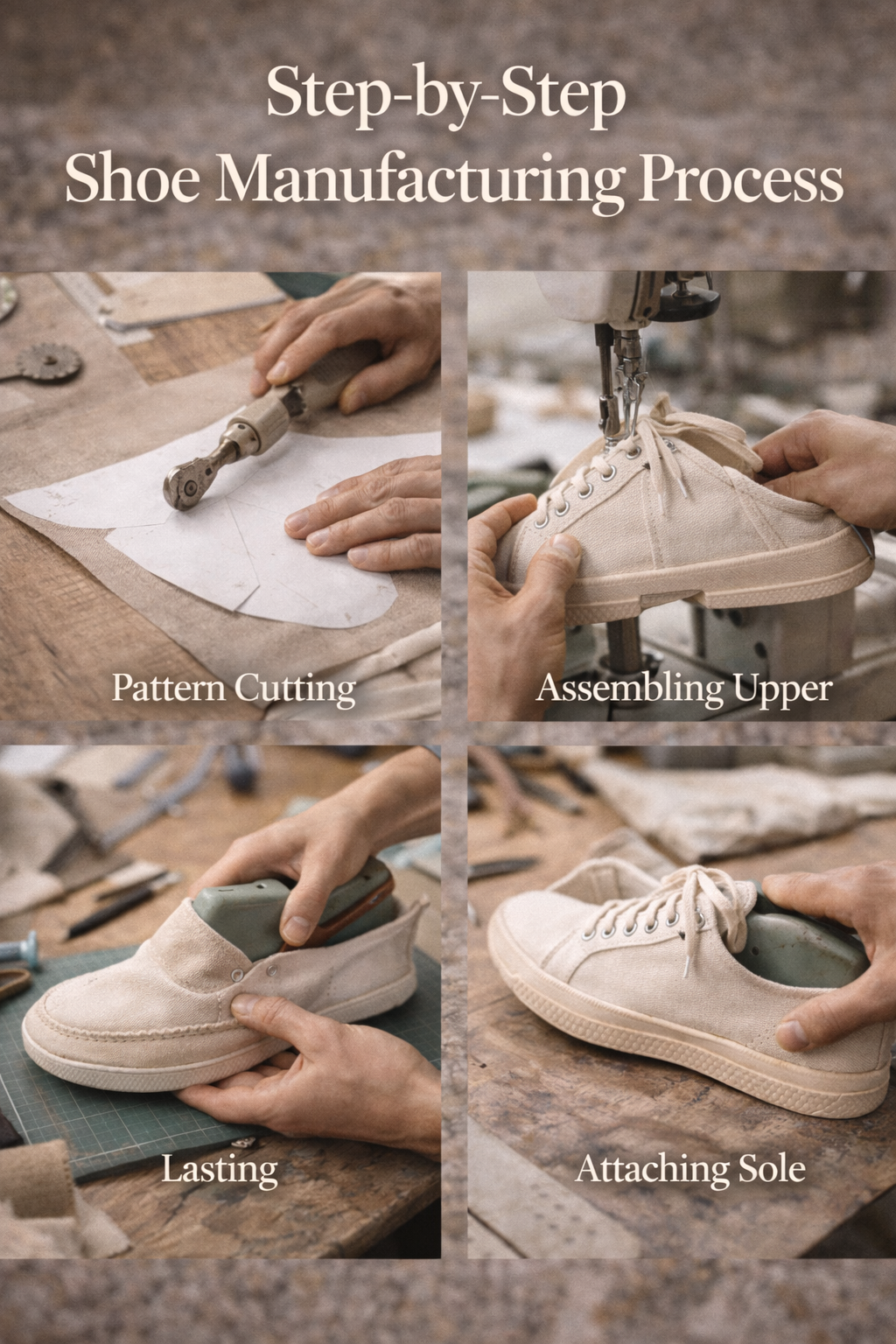
There is no single assembly line that makes every kind of shoe. A knitted sneaker, a stitched leather shoe and a moulded design can follow different processes. A stage-by-stage overview is useful as long as those differences remain visible.
The sequence below introduces common tasks rather than claiming every factory uses the same order, machinery or number of operations. Model-specific information is needed to explain a particular pair.
Design, patterns and materials
The maker translates a proposed shape into components and a workable construction. Patterns describe pieces to cut or form, while material choices affect how those pieces can be joined and shaped. A photograph of the finished shoe does not reveal every internal component.
For the visible parts, see the sneaker anatomy guide. Keep appearance separate from claims about comfort or performance; both need more information than an outline.
Preparing and assembling the upper
An upper may be assembled from cut panels with stitching, lining and closures, while other designs use different forming methods. Leather, textile and synthetic components do not all behave identically in production.
The amount of hand work and machinery varies. Avoid treating handmade as a complete technical description or assuming an automated step determines the quality of an entire shoe. Ask what construction and inspection the maker actually describes.
Shaping around a last
A last is a form used in shaping a shoe. Crockett & Jones’s production guide describes lasting as pulling the upper over that form. Its account is a useful example of a particular maker’s process, not a description of every sneaker or sandal factory.
The last contributes to shape, but an external size label still does not guarantee personal fit. Materials, internal construction and the exact model also matter when assessing a finished pair.
Attaching the sole
The way the upper and sole are joined depends on the construction. Bonding, stitching and moulding are not interchangeable labels, and a shoe may use more than one technique. A visible stitch is not enough to identify every hidden attachment.
For repairs, ask about the actual construction and condition rather than assuming every stitched-looking shoe can be resoled. A making method alone does not establish a universal lifespan or environmental benefit.
Finishing and inspection
Finishing can include cleaning, edge work, fitting components and checking the completed pair. The tests and tolerances used depend on the maker and intended product. A generic list should not be presented as proof that every factory performs every possible safety or performance test.
The shoe buying guide connects these distinctions to a purchase. Check the supplied pair’s condition, fit and documentation as well as the production story.
For historical context, use the shoe-history overview. Knowing the stages makes a construction claim easier to question, but the useful final test remains whether the exact pair meets its intended use and fits you.



Leave a Reply