

Most outdoor enthusiasts have a story about “that one hike.” It usually isn’t memorable because of a breathtaking summit or a wildlife encounter, but because of the agonizing pain in their feet. A blister on mile three of a ten-mile loop can turn a glorious day in nature into a test of endurance.
Your feet are your primary mode of transport in the wilderness. While we often obsess over the weight of our tents or the warmth of our sleeping bags, footwear remains the most critical piece of gear in your arsenal. The wrong choice can lead to injuries, fatigue, and a miserable experience, while the right pair can make rugged terrain feel like a walk in the park.
Navigating the world of outdoor footwear can be overwhelming. You have ultra-light trail runners, burly leather boots, technical approach shoes, and hybrid hikers. Each serves a specific purpose, engineered for different terrains, loads, and weather conditions. Understanding the nuances between these categories is the first step toward comfortable, injury-free adventures.
Read Here: Types of Athletic Shoes Explained
This guide breaks down the anatomy of hiking footwear, exploring the specific types available and helping you match your shoe to your hiking style.
What Are Outdoor and Hiking Shoes?
At a glance, a hiking shoe might look like a sturdy sneaker, but the engineering under the hood is vastly different. Outdoor footwear is specifically designed to handle the rigors of unpaved surfaces. Unlike a road running shoe, which is built for forward motion on consistent asphalt, a hiking shoe is built for stability, traction, and protection on unpredictable ground.
Key Features of Trail Footwear
The primary difference lies in the construction. Trail footwear prioritizes torsional stability—the shoe’s resistance to twisting. When you step on a loose rock or a root, you want your shoe to support your foot rather than collapsing under the weight.
Another defining feature is the outsole. Hiking shoes utilize specialized rubber compounds that are softer and “stickier” than casual shoes, providing better grip on wet granite or slick mud. They also feature aggressive treads, known as lugs, which bite into soft dirt and gravel to prevent slipping.
Finally, there is the factor of protection. Reinforced toe caps (often called “rands”) protect your toes from stubbing against boulders, while durable upper materials resist abrasion from thorns and sharp rocks.
Hiking Shoes vs Hiking Boots
The debate between shoes and boots is one of the most common topics in the outdoor community. The distinction generally comes down to cut height and stiffness.
Hiking boots feature a high cut that wraps around the ankle. Traditionally, hikers believed this prevented ankle sprains, though modern sports science suggests that ankle strength plays a bigger role than the boot collar. However, the high cut excels at keeping debris, like pebbles and pine needles, out of your sock. Boots also tend to have stiffer midsoles, which provide a stable platform when carrying a heavy backpack.
Hiking shoes, on the other hand, are low-cut. They offer more freedom of movement and are significantly lighter. This weight reduction translates to less energy expenditure over long distances. They are generally more flexible, allowing for a more natural walking gait, but they offer less protection against deep mud or snake bites.
Why Specialized Outdoor Shoes Matter
Wearing gym sneakers on a rugged trail is a recipe for disaster. The soft foam of a gym shoe compresses unevenly on rocky terrain, forcing your foot muscles to work overtime to stabilize your body. This leads to premature fatigue. Furthermore, standard athletic mesh tears easily when scraped against granite, and smooth soles offer zero traction on loose scree. Specialized outdoor shoes are safety equipment; they provide the grip to stop a fall and the structural integrity to carry you home.
Main Types of Outdoor and Hiking Shoes
The market has evolved significantly from the days when heavy, stiff leather boots were the only option. Today, footwear is highly specialized.
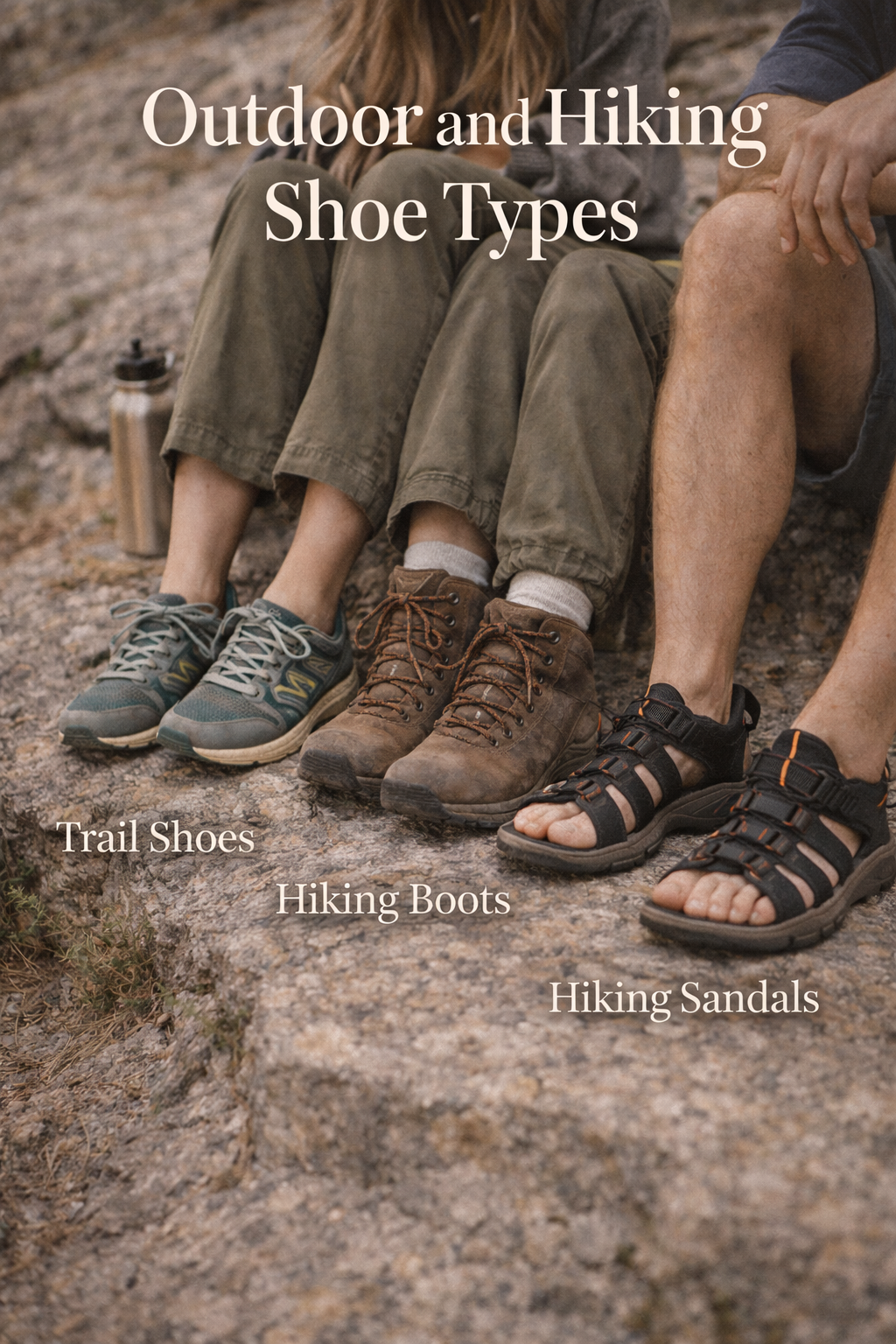
Trail Running Shoes
Trail runners have exploded in popularity among hikers, particularly through-hikers on long trails like the Pacific Crest Trail or Appalachian Trail. These are essentially beefed-up running shoes. They prioritize breathability and weight savings above all else.
Best For: Fast-paced day hikes, ultralight backpacking, and trail running.
Pros: Extremely lightweight, breathable (quick to dry if they get wet), and comfortable right out of the box with no break-in period.
Cons: Minimal durability compared to leather; less support for heavy packs; minimal protection for the tops of the feet.
Lightweight Hiking Shoes
These occupy the middle ground between a trail runner and a boot. They look like robust sneakers but are built with stiffer midsoles and more durable uppers, often leather or abrasion-resistant nylon. They provide a more planted feel than a trail runner but don’t feel as clunky as a boot.
Best For: Day hiking, weekend camping trips, and travelers who need a walking shoe that can handle a trail.
Pros: Good balance of durability and comfort; often available in waterproof versions; stiffer sole protects feet from sharp rocks.
Cons: Heavier than trail runners; low cut still allows debris inside.
Mid-Cut Hiking Boots
This is the most versatile category for the average outdoor enthusiast. These boots rise to just cover the ankle bone. They offer a significant step up in support and protection without the “Frankenstein” feel of a heavy mountaineering boot. They usually feature a waterproof liner (like Gore-Tex) and a sturdy toe cap.
Best For: Multi-day backpacking trips with moderate loads (20-40 lbs), rough terrain, and muddy conditions.
Pros: excellent ankle protection from scrapes; keeps mud and water out; supportive enough for most backpacking needs.
Cons: Heavier and hotter than shoes; requires a short break-in period.
Backpacking Boots
These are the traditional workhorses of the trail. Constructed often of full-grain leather, these high-cut boots are stiff and heavy. You usually cannot bend the sole of these boots with your hands. That stiffness acts as a platform, supporting your foot so your muscles don’t have to, which is vital when carrying a pack weighing 50 pounds or more.
Best For: extended expeditions, carrying heavy loads, off-trail bushwhacking, and winter hiking.
Pros: Incredible durability (can last decades); maximum support and stability; superior waterproofing.
Cons: Heavy; expensive; not breathable; requires a significant break-in period (weeks) to avoid blisters.
Approach Shoes for Rocky Terrain
Approach shoes are a niche hybrid between a hiking shoe and a rock climbing shoe. They are designed for climbers walking to the base of a cliff, often over technical, rocky terrain. They feature “sticky rubber” on the soles and a rubber rand that wraps around the entire shoe. They are tight-fitting and precise.
Best For: Scrambling (hiking that involves using hands), rocky peaks, and technical terrain.
Pros: Unmatched grip on rock; durable; precise toe control.
Cons: The flat soles are terrible in mud (they slip easily); usually not waterproof; minimal cushioning makes them uncomfortable for long, flat miles.
Read Here: Travel Shoes Guide
How to Choose the Right Hiking Shoe Type
Selecting footwear is not about finding the “best” shoe, but the best shoe for your specific adventure.
Terrain and Trail Conditions
Consider where you walk 80% of the time.
- Groomed Trails: If you stick to well-maintained paths with dirt or gravel, trail runners or lightweight hiking shoes are ideal. You don’t need the weight of a boot.
- Rugged/Technical: If your routes involve boulder fields, loose scree, roots, or off-trail navigation, you need the protection and stiffness of a mid-cut boot or approach shoe.
- Mud and Muck: In wet, boggy environments (like the Pacific Northwest or Scotland), a higher-cut boot is essential to keep the muck from pouring over the top of your shoe.
Weather and Waterproofing
The waterproof debate is contentious. Waterproof membranes (like Gore-Tex) are excellent at keeping rain and puddles out. However, they also keep sweat in.
- Hot and Dry: Avoid waterproof shoes. Your feet will sweat, the moisture will be trapped, and wet skin blisters easily. A breathable mesh shoe (non-waterproof) allows sweat to evaporate and dries quickly if you step in a stream.
- Cold and Wet: Waterproofing is essential. It acts as insulation and keeps freezing water away from your skin.
Comfort, Fit, and Ankle Support
Fit is subjective, but hiking fit is specific. You should have about a thumb’s width of space between your longest toe and the end of the shoe. When you hike, your feet swell—sometimes up to a full size. If your shoes are tight in the store, they will be torture devices on the trail.
Heel slippage is another factor. Your heel should be locked in place. If it slides up and down with every step, you will develop blisters on your heel. Test this by walking up an incline ramp in the store.
Outdoor Shoe Features to Look For
When reading product descriptions, look for these three specifications to judge quality.
Grip and Outsole Design
Look for established rubber brands like Vibram or proprietary rubber known for traction (like Salomon’s Contagrip). Inspect the lugs. Deep, widely spaced lugs are designed to shed mud and dig into soft soil. Shallow, tight lugs are better for smooth rock and hard-packed trails. Some boots feature a “heel brake,” a distinct section of lugs on the heel designed to prevent sliding during steep descents.
Cushioning and Stability
The midsole provides the cushioning. It is usually made of EVA (Ethylene Vinyl Acetate) or PU (Polyurethane).
- EVA: Lighter, softer, and cheaper. It feels cushy immediately but compresses over time, losing its bounce. Common in trail runners.
- PU: Heavier, firmer, and more durable. It doesn’t compress easily, making it better for heavy backpacking boots that need to last for years.
Shanks are internal stiffeners sandwiched between the midsole and outsole. A full-length shank creates a very stiff boot for rocky terrain, while a partial shank allows for some flex, which is more comfortable for day hiking.
Breathability vs Protection
There is always a trade-off. Mesh uppers offer maximum breathability but tear easily on thorns. Leather uppers are virtually bombproof and naturally water-resistant but can be hot and heavy. Synthetic leather offers a middle ground, drying faster than real leather but offering more protection than mesh.
Common Mistakes When Buying Hiking Shoes
Even experienced hikers fall into these traps. Avoid these errors to save your feet and your wallet.
Choosing heavy boots for light trails
There is an old saying: “One pound on your feet equals five pounds on your back.” Wearing heavy, stiff mountaineering boots for a casual walk on a flat nature trail is overkill. It will exhaust your legs unnecessarily. Match the weight of the shoe to the difficulty of the objective.
Ignoring proper sizing
Many people buy their standard street shoe size. Hiking socks are thicker than dress socks, and as mentioned, feet swell during activity. Always try on hiking shoes at the end of the day when your feet are naturally at their largest, and bring the specific socks you intend to hike in.
Skipping break-in time
Modern synthetic shoes require less break-in time than the leather boots of the past, but they still need it. Never take a brand-new pair of shoes out of the box and directly onto a long hike. Wear them around the house, then on short neighborhood walks, then on a short trail. This softens the materials and allows you to identify “hot spots” (rubbing points) before they become blisters in the backcountry.
Read Here: Walking Shoes vs Running Shoes
FAQ – Outdoor and Hiking Shoe Types
Are trail running shoes good for hiking?
Yes, absolutely. For day hikes and hikers carrying light packs (under 20 lbs), trail runners are excellent. They reduce fatigue and allow for agile movement. However, they offer less ankle support and underfoot protection than boots, so they require stronger ankles and careful foot placement.
Do I need waterproof hiking shoes?
Not always. Waterproof shoes are great for winter, snow, and constantly wet mud. However, for summer hiking or desert environments, they can cause feet to overheat and sweat excessively, leading to blisters. Non-waterproof shoes breathe better and dry out much faster if they do get submerged.
What is the difference between hiking boots and hiking shoes?
The main differences are the cut height and the stiffness. Hiking boots cover the ankle and usually have stiffer soles for carrying weight. Hiking shoes are cut below the ankle and are more flexible, prioritizing comfort and speed over load-bearing support.
How long do hiking shoes last?
Trail runners and lightweight hiking shoes typically last between 300 to 500 miles before the cushioning packs out or the tread wears down. Heavier leather backpacking boots can last 1,000+ miles and can often be resoled, extending their life significantly.
Which hiking shoes are best for beginners?
For most beginners, a “mid-cut” lightweight hiking boot is the sweet spot. It offers the ankle support and protection that beginners need while their stabilizing muscles develop, but isn’t as heavy or expensive as a full backpacking boot. Look for brands like Merrell, Keen, or Oboz for comfortable entry-level options.
Hit the Trail with Confidence
The right pair of shoes acts as an extension of your body, allowing you to forget about your feet and focus on the horizon. Whether you choose a nimble trail runner for speed or a sturdy leather boot for support, the key is understanding your needs and the terrain you wish to conquer.
Take the time to get fitted properly, break your shoes in gradually, and prioritize comfort above aesthetics. The mountains are calling, and with the right foundation, you’ll be ready to answer.
Leave a Reply