

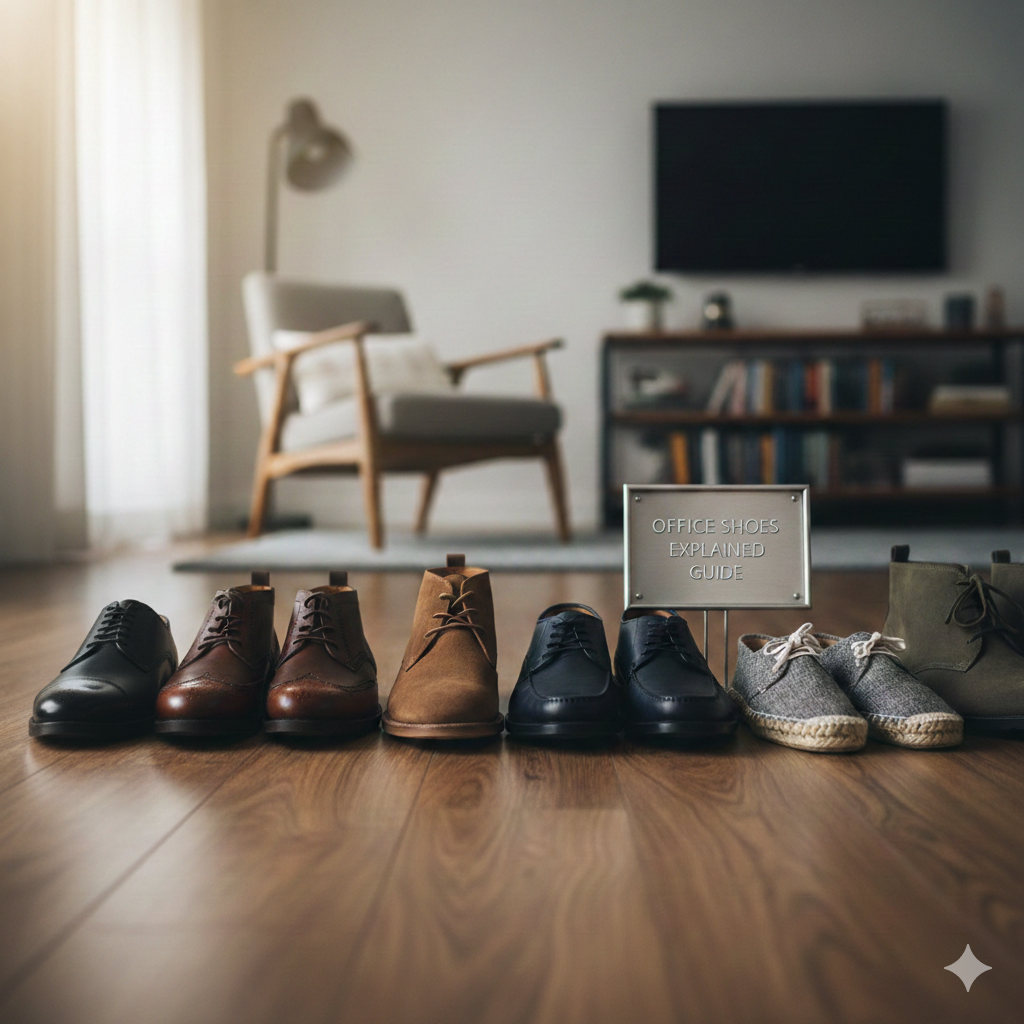
The modern office is a theatre of subtle signals, and few elements of a wardrobe speak as loudly as shoes. For centuries, footwear has served as a marker of status, profession, and intent. In the context of the workplace, the shoe is not merely a protective covering for the foot; it is a foundation of professional identity.
To understand office shoes is to understand the history of work itself. From the rigid, polished Oxfords of the early 20th-century banking halls to the pristine, minimalist leather sneakers of today’s tech campuses, the evolution of “work shoes” mirrors the shifting landscape of corporate culture. We have moved from an era of strict uniformity to one of expressive functionality.
This guide explores the anatomy, history, and modern application of office footwear. It is designed not just to help you purchase a pair of shoes, but to understand the architectural and cultural significance of what you wear to work.
What Are Office Shoes?
Defining “office shoes” in the 21st century is a complex task. Historically, the definition was rigid: leather, laced, and dark. Today, the category has expanded to include a spectrum of silhouettes that bridge the gap between traditional formality and contemporary comfort.
At its core, an office shoe is footwear designed to bridge professionalism with endurance. Unlike evening wear, which prioritizes aesthetics over utility, or athletic wear, which prioritizes performance over polish, the office shoe must conquer the middle ground. It must survive the commute, withstand eight to ten hours of wear, and project an image of competence.
Read Here: Casual Shoes vs Formal Shoes
Formal vs. Business Casual Footwear
The dichotomy of the modern workplace lies in the tension between “Formal” and “Business Casual.”
Formal footwear relies on closed-lacing systems, sleek profiles, and high-shine leathers. It is the domain of the Oxford and the Balmoral boot. These shoes are reductive in design; they seek to minimize bulk and distraction, creating a seamless line from the trouser hem to the toe. They are the uniform of law, finance, and high-level corporate negotiation.
Business Casual footwear, conversely, embraces texture and relaxation. This category includes Derbies (open-lacing), loafers, chukka boots, and Brogues. Here, we see decorative perforations, suede materials, and thicker soles. These shoes suggest a professional who is at work, but perhaps not at war. They signal approachability and adaptability—traits highly valued in modern collaborative workspaces.
Why Office Shoes Matter for Professional Style
Psychologically, footwear is often the first thing noticed and the last thing forgotten. In a professional setting, shoes act as an anchor. A well-tailored suit can be undone by scuffed, ill-fitting shoes, whereas a simple outfit of chinos and a button-down can be elevated significantly by a pair of pristine, Goodyear-welted loafers.
Beyond aesthetics, the “enclothed cognition” theory suggests that what we wear affects how we think. Wearing structured, professional footwear can induce a mindset of focus and authority. The literal act of tying laces can serve as a ritualistic transition from leisure to labor.
Key Features of Good Work Shoes
Regardless of the specific style, high-quality office shoes share architectural DNA:
- Construction: Superior office shoes often utilize Goodyear welting or Blake stitching. These construction methods allow for resoling, extending the lifespan of the shoe from months to decades.
- Material: Full-grain leather is the gold standard. It breathes, molds to the foot over time, and develops a patina—a unique sheen that improves with age. Corrected grain or synthetic leathers may look pristine initially but will crack and peel, offering poor breathability.
- The Last: The “last” is the wooden form upon which a shoe is molded. A refined office shoe will have a last that mimics the natural curve of the foot while providing a sleek silhouette, avoiding the boxy “square toe” look that plagued the late 1990s.
Types of Office Shoes Explained
To navigate the market, one must understand the distinct taxonomy of dress shoes. Each style carries a specific historical weight and formality level.
Oxford Shoes
The Oxford is the quintessential dress shoe. Its defining characteristic is the closed lacing system, where the eyelet tabs are stitched underneath the vamp (the front section of the shoe). This creates a smooth, unbroken silhouette that hugs the foot.
Originating from the “Oxonian” half-boot worn by students at Oxford University around 1825, this style rebelled against the knee-high boots of the 18th century. Today, the Black Cap-Toe Oxford is the non-negotiable standard for formal business attire. It is the shoe of the boardroom and the job interview.
Style Tip: Oxfords should only be worn with suits or formal trousers. Their sleek profile often looks disproportionately small when paired with denim or chinos.
Derby Shoes
Often confused with the Oxford, the Derby is defined by its open lacing system. The eyelet tabs are stitched on top of the vamp. This construction allows for a wider fit and easier adjustment, making the Derby a more comfortable option for those with high insteps.
The Derby has roots in sport and hunting (originally popularized by the 14th Earl of Derby). Consequently, it is inherently less formal than the Oxford. It is the workhorse of the office shoe world—versatile enough to wear with a suit, yet rugged enough to pair with heavy cotton trousers or dark denim.
Loafers for Business Casual
The Loafer represents the intersection of luxury and leisure. Laceless and slip-on, loafers gained traction in the US in the 1930s, evolving from Norwegian distinct “aurlandskoen” moccasins.
For the office, two main variations dominate:
- The Penny Loafer: Characterized by a leather strap across the vamp with a diamond cutout. It is the standard-bearer of “Ivy League” style and fits perfectly in business casual environments.
- The Tassel Loafer: Considered slightly more sophisticated and European in flair. Tassel loafers in dark calfskin can rival the formality of a Derby, making them suitable for suit separation looks (e.g., a blazer and odd trousers).
Minimal Leather Sneakers
We are currently witnessing a significant shift in footwear history: the acceptance of the sneaker in the C-suite. However, not all sneakers qualify. The “Office Sneaker” is a specific sub-genre.
These shoes strip away logos, athletic mesh, and neon colors. They feature high-quality leather uppers (often white, black, or navy), low-profile rubber cup-soles, and waxed cotton laces. They borrow the silhouette of a tennis shoe but apply the materials of a dress shoe. In creative industries, tech, and startups, these are now the primary footwear choice, signaling a focus on innovation and agility rather than tradition.
Low-Heel and Comfort Office Shoes
For women’s office footwear, the evolution has moved away from the mandatory high stiletto toward grounded power. The Block Heel Pump and the Pointed Flat have emerged as dominant styles.
The modern comfort office shoe utilizes technology once reserved for orthopedics—memory foam insoles, arch support, and flexible rubber soles—hidden within elegant leather uppers. The “Almond Toe” shape is a popular choice here, offering the elongation of a pointed toe without the compressive discomfort.
Read Here: Smart Casual Footwear Guide
How to Choose the Right Office Shoes
Selecting the right pair is an exercise in balancing your environment with your anatomy.
Dress Code and Workplace Culture
Context is king. To choose the right shoe, you must read the room.
- Corporate/Finance/Law: Stick to the classics. Black or dark brown Oxfords are safe. Avoid excessive broguing (decorative holes) or light tan leathers.
- Creative/Marketing/Media: Texture is encouraged. Suede Derbies, Chelsea boots, or high-end loafers work well.
- Start-up/Tech: The rules are rewritten here, but quality still matters. A pristine leather sneaker or a desert boot commands more respect than a dirty running shoe.
Comfort, Cushioning, and Support
The “break-in” period is a romanticized concept that often just means “pain.” While a Goodyear-welted shoe will be stiff initially, it should not be excruciating. When trying on shoes:
- Check the Flex Point: The shoe should bend where your foot bends (at the ball of the foot). If it bends in the middle of the arch, the shank is weak, and you will lack support.
- Heel Slip: A small amount of slippage in a new loafer is normal, but in a laced shoe, your heel should be locked in.
- Width: Many people buy shoes that are too long because they need the width. If your toes are pinched, do not size up—look for a brand that offers “E” (wide) or “EE” (extra wide) widths.
Materials and Durability
Invest in Full-Grain or Top-Grain leather.
- Full-Grain: The entire hide is used. It is tough, water-resistant, and develops character.
- Top-Grain: The surface is sanded to remove imperfections. It is softer and more stain-resistant but less durable than full-grain.
Avoid Bonded Leather (leather scraps glued together) and Patent Leather (plastic-coated) for daily office wear, as they do not breathe, leading to foot odor and discomfort.
Styling Office Shoes for Modern Workwear
Formal Office Outfits
- The Power Suit (Navy or Charcoal): Pair with Black Cap-Toe Oxfords. This is the highest level of formality.
- The Grey Suit: Dark Brown Oxfords or Quarter-Brogues add warmth to the cool tone of the grey.
Smart Casual Office Looks
- Chinos and a Blazer: This is ideal territory for Brown Suede Loafers or Leather Derbies. The texture of the suede complements the matte finish of the cotton chinos.
- Dark Denim and a Button-down: A Chelsea Boot or a Minimalist Leather Sneaker works best here. The boot adds a sleek, rock-and-roll edge, while the sneaker keeps it approachable.
Travel-Friendly Work Shoes
For the traveling professional, the Chelsea Boot is unrivaled. Its elastic side panel allows for easy removal at airport security. It covers the ankle, providing warmth on drafty planes, and its clean, unadorned vamp looks sharp enough for a client dinner straight from the tarmac.
Common Mistakes When Buying Office Shoes
Choosing Style Over Comfort
Fashion should never cripple you. Buying a shoe purely for its silhouette, ignoring a narrow toe box or a lack of arch support, will impact your posture and productivity. If your feet hurt, your focus drifts.
Ignoring Proper Sizing
Feet change size over time, often flattening and widening with age. Relying on the size you wore in college is a mistake. Furthermore, sizing is not standardized across brands. A size 10 in a sneaker is often a size 9 in a dress shoe. Always measure your foot on a Brannock device when possible.
Wearing Overly Casual Footwear
There is a distinct line between “casual” and “sloppy.” Running shoes (designed for track), flip-flops, and hiking sandals have no place in a professional office. They signal a lack of situational awareness. Even in a casual office, footwear should look intentional, not accidental.
The Future of the Office Shoe
As we look toward the future of footwear, the lines continue to blur. Hybrid footwear—soles derived from athletic technology fused with traditional leather uppers—is the fastest-growing segment in the industry. We are moving toward a “post-formal” world where utility and aesthetics are no longer enemies, but partners.
Ultimately, the right office shoe is one that respects the history of the craft while embracing the reality of your daily life. It is a tool for the trade, a foundation for your style, and the vehicle that carries you through your career.
Read Here: How to Choose the Right Shoes for Your Lifestyle
FAQ – Office Shoes Explained
Are sneakers acceptable as office shoes?
Yes, but with caveats. They must be “dress sneakers”—minimalist, typically leather or high-end suede, and free of athletic logos or neon colors. They are generally acceptable in creative, tech, and business casual environments, but rarely in formal corporate finance or law settings.
What color office shoes are most versatile?
Dark Brown (often called espresso or chocolate) is arguably more versatile than black. Dark brown pairs effortlessly with navy, grey, olive, and tan trousers, as well as denim. Black is strictly for charcoal, black, and very dark navy suits.
How many office shoes should you own?
Ideally, a rotation of three pairs. Leather needs at least 24 hours to dry out and recover after a day of wear. Rotating your shoes prevents premature creasing and bacterial growth. A solid starter rotation is: one pair of Black Oxfords (for formal days), one pair of Brown Derbies or Loafers (for daily wear), and one pair of boots or dress sneakers (for Fridays/weather).
Are loafers formal enough for work?
In the United States, yes. A high-shine horsebit or tassel loafer is accepted in almost all boardrooms. In strict European corporate environments (like London banking), lace-up shoes are still preferred for formal meetings, though this is changing.
How long should office shoes last?
A cheap, cemented (glued) shoe may last 6 to 12 months. A high-quality, stitched (Goodyear or Blake) shoe, if properly cared for (polished, stored with shoe trees, and resoled when necessary), can last 10 to 20 years.
Leave a Reply