

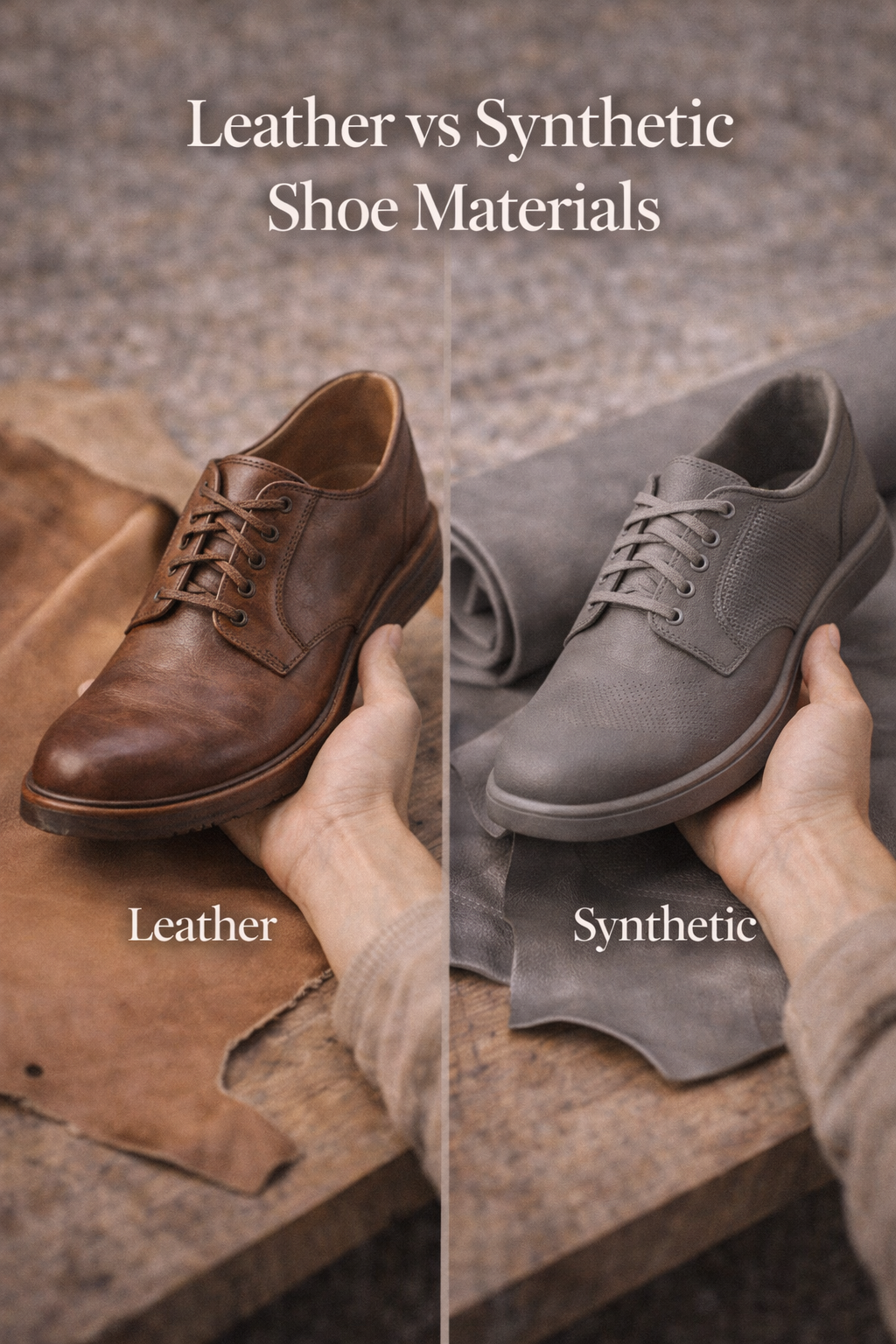
For thousands of years, the relationship between human feet and the ground has been mediated by a single, dominant material: leather. From the frozen Alps where Ötzi the Iceman walked in bearskin soles to the cobblestones of Victorian London, animal hide was the undisputed king of footwear. It was durable, protective, and available.
But the 20th century brought a revolution. As chemistry advanced and mass production exploded, synthetic materials entered the fray. Rubber, plastic, polyurethane (PU), and advanced technical meshes challenged the supremacy of leather, offering new possibilities in weight, cost, and performance.
Today, the choice between leather and synthetic isn’t just about utility; it’s about identity, ethics, and performance. Are you looking for the molding comfort of a heritage boot or the lightweight breathability of a marathon runner? Do you value the patina of age or the pristine look of technical fabric?
Understanding the materials that wrap your feet is crucial not just for comfort, but for understanding the history and future of human movement. In this guide, we will dissect the properties of leather and synthetics, exploring their construction, their environmental impact, and how they shape the very silhouettes we wear today.
Read Here: Understanding Shoe Soles and Midsoles
Introduction: Why Shoe Materials Matter
When we talk about the anatomy of a shoe, we often focus on the style or the brand. Yet, the fundamental character of footwear is dictated by what it is made of. The material determines how a shoe breathes, how it ages, how it responds to water, and ultimately, how long it survives.
Historically, footwear was an investment. A pair of leather boots was expected to last years, perhaps even decades with proper resoling and care. The material itself was alive in a sense—it possessed a grain structure that could be conditioned and repaired.
The introduction of modern synthetics shifted this paradigm. Shoes became lighter, cheaper, and often disposable. While this democratized fashion, making varied styles accessible to the masses, it also changed our expectations of durability. A synthetic sneaker does not “break in” the way a leather oxford does; it remains static until the materials eventually fatigue and fail.
Understanding construction requires us to look at these materials not as competitors, but as distinct tools for different purposes. A hiking boot needs the rigid protection of leather or high-denier nylon. A sprinter’s spike needs the featherweight structure of synthetic mesh. By analyzing these materials, we gain a deeper appreciation for the engineering marvel that is the modern shoe.
What Is Leather in Footwear?
Leather is, at its core, processed animal skin. It is a natural fiber matrix composed of collagen protein bundles, which gives it unique properties of strength and flexibility. To prevent decay and make it usable, hides undergo tanning—a chemical process that stabilizes the proteins.
While cowhide is the most common, footwear has historically utilized everything from cordovan (horse) to kangaroo, pigskin, and exotics like alligator.
Types of Leather Used in Shoes
Not all leather is created equal. The quality and performance depend heavily on which layer of the hide is used and how it is finished.
- Full-Grain Leather: This is the highest quality grade. It utilizes the entire grain layer of the hide, including the dense, outer surface. Because the fibers are intact, it is incredibly strong and breathable. Importantly, it develops a “patina”—a soft sheen that develops through use and exposure—making the shoe more beautiful with age.
- Top-Grain Leather: To create a more uniform appearance, the very top layer of the hide is sanded or buffed away to remove imperfections (like scars or bug bites). It is thinner and more pliable than full-grain but less durable and won’t develop the same rich patina.
- Suede and Nubuck: These are created by buffing the hide. Suede is made from the underside (the flesh side), resulting in a soft, napped finish. Nubuck is top-grain leather that has been sanded on the grain side. While aesthetically pleasing and soft to the touch, these open fibers make the material highly susceptible to water and staining.
- Bonded Leather: Often found in fast fashion, this is the “particle board” of leather. Scraps and dust are bonded together with polyurethane glue. It lacks the structural integrity of natural hide and often peels after short periods of wear.
Benefits of Leather
The primary advantage of leather is its ability to mold. Because it is a natural skin, it responds to heat and moisture. Over the first few weeks of wear, a leather shoe will stretch and conform to the unique topography of the wearer’s foot, creating a custom fit that synthetics struggle to replicate.
Furthermore, leather is naturally breathable. It can absorb and wick away moisture (sweat) from the foot, regulating temperature better than solid plastics. Its tensile strength resists tearing, offering superior protection against abrasion, which is why it remains the standard for motorcycle gear and heavy work boots.
Limitations of Leather
The organic nature of leather is also its weakness. It is heavy. A pair of heritage leather boots can weigh significantly more than a modern synthetic alternative, leading to foot fatigue over long distances.
It also requires maintenance. Without regular cleaning and conditioning, the collagen fibers dry out and crack. Water is another enemy; while leather can be treated to be water-resistant, soaking wet leather can warp, shrink, and rot if not dried correctly. Finally, there is the ethical and environmental cost of animal agriculture and the tanning process, which often utilizes harsh chemicals like chromium.
What Are Synthetic Shoe Materials?
Synthetic materials are man-made, primarily derived from petroleum products. They are engineered in laboratories to achieve specific performance metrics—weight reduction, waterproofing, or elasticity—that nature cannot easily provide.
The rise of sneaker culture in the 1970s and 80s, driven by brands like Nike and Adidas, accelerated the innovation of synthetics. Designers needed materials that could hold bright dyes, rebound energy, and cost pennies to produce.
Common Synthetic Fabrics
- PU Leather (Polyurethane): A plastic coating applied to a fabric backing to mimic the look and feel of leather. While it has improved significantly in quality, it lacks the breathability and aging capabilities of the real thing.
- Performance Mesh: Woven from nylon or polyester, mesh allows for maximum airflow. Different weave patterns can create areas of support and areas of flexibility within a single piece of fabric.
- Knits (Flyknit/Primeknit): A major innovation in the 2010s, these are computer-engineered textiles that are knitted into a single, sock-like upper. This reduces waste (no cutting scraps) and creates a seamless fit.
- TPU (Thermoplastic Polyurethane): A hard, rubber-like plastic often used for structural elements like heel counters, toe caps, or decorative cages that add support to softer mesh uppers.
Advantages of Synthetic Materials
The undisputed champion of synthetics is weight. A synthetic running shoe can weigh less than 8 ounces, making the runner faster and more efficient.
Synthetics are also incredibly consistent. A roll of polyester mesh is identical from start to finish, unlike cowhides which vary in thickness and quality. This makes mass manufacturing easier and cheaper.
From a design perspective, synthetics offer limitless aesthetic possibilities. They can be dyed neon colors, printed with graphics, or molded into futuristic shapes that leather cannot hold. They are also generally hydrophobic (water-fearing), meaning they don’t absorb water weight like leather does.
Drawbacks of Synthetic Shoes
The “plastic bag effect” is the main enemy of synthetic footwear. Solid synthetic leathers (PU) trap heat and moisture, leading to sweaty, uncomfortable feet and bacterial growth (odor).
Durability is another concern. While specialized nylons are tough, many synthetic materials degrade faster than leather. PU coatings eventually crack and peel (hydrolysis), and mesh can snag and tear. Unlike leather, which can be repaired or stitched, a torn synthetic upper usually signals the end of the shoe’s life.
Read Here: Winter Footwear Types Explained
Leather vs Synthetic: Key Differences
To make an informed choice, we must look at how these materials perform side-by-side in real-world scenarios.
Comfort and Fit
- Leather: The comfort curve is steep. New leather is stiff and unforgiving, often requiring a painful “break-in” period. However, once broken in, it offers superior long-term comfort because it has molded to the foot.
- Synthetic: Offers “out of the box” comfort. Soft meshes and padded linings feel good immediately. However, they do not mold to the foot over time. If a synthetic shoe doesn’t fit perfectly in the store, it never will.
Durability and Performance
- Leather: Wins on longevity. A high-quality leather boot can last 10+ years. It resists abrasion and puncture.
- Synthetic: Wins on specialized performance. For high-intensity activities, leather is too heavy and hot. Synthetics provide the elasticity and structure needed for sprinting, jumping, and cutting motions.
Weight and Flexibility
- Leather: Naturally heavy and dense. Thick leather soles are rigid.
- Synthetic: Engineered to be featherlight. Materials can be zoned to be rigid in the heel and flexible in the forefoot.
Cost and Accessibility
- Leather: Expensive raw material prices and labor-intensive manufacturing keep prices high.
- Synthetic: Generally cheaper to produce, making footwear more accessible. However, high-end technical synthetics (like those used in elite marathon shoes) can rival leather in price.
How Materials Influence Shoe Silhouettes
The material dictates the form. Throughout history, the limitations and capabilities of materials have shaped the silhouettes of our shoes.
Structured Leather Designs
Leather is a structural material. It can hold its own shape without internal reinforcement. This is why traditional dress shoes—Oxfords, Brogues, Derbies—have sharp, defined lines. The “last” (the mold the shoe is built on) creates a shape, and the leather freezes that shape in time. This lends itself to formal, tailored silhouettes that imply authority and stability.
Flexible Synthetic Shapes
Synthetics allow for fluidity. Because knits and meshes are soft, they require internal structures or external cages to hold the foot. This has led to the “sock” silhouette seen in modern sneakers—shoes that look more like organic extensions of the foot than rigid coverings. The ability to mold plastics (TPU) has also allowed for the chunky, architectural soles of the “dad shoe” trend and the futuristic curves of Yeezys or high-fashion sneakers.
Sustainability and Environmental Impact
This is the most complex debate in modern footwear. Neither material is perfectly green, but they damage the planet in different ways.
Natural vs Synthetic Production
Leather is a byproduct of the meat industry. While this utilizes waste, the tanning process is chemically intensive, often polluting water sources in developing nations. Furthermore, cattle ranching is a major driver of deforestation and methane emissions.
Synthetics are plastic. They are derived from fossil fuels. The production releases carbon, and the manufacturing process often involves toxic solvents.
Recycling Challenges
Leather is biodegradable if vegetable-tanned, but most chrome-tanned leather will not decompose efficiently. However, because leather shoes last longer, fewer pairs are consumed overall.
Synthetics contribute to the microplastic crisis. As soles wear down and uppers degrade, they shed tiny plastic particles into the environment. Furthermore, recycling a sneaker is a nightmare; separating the glued layers of rubber, foam, and plastic mesh is energy-intensive and rarely done. Most synthetic shoes end up in landfills where they will sit for centuries.
Eco-Friendly Innovations
The future lies in bio-fabrication. We are seeing the rise of:
- Mushroom Leather (Mycelium): Grown from fungi, offering the durability of leather without the cow.
- Pineapple and Cactus Leather: utilizing agricultural waste.
- Recycled PET: Turning plastic water bottles into knit uppers (popularized by Adidas Parley).
Which Material Is Better for Different Lifestyles?
There is no “best” material, only the best material for the task.
Everyday Casual Wear
For the office or general city walking, Leather is often the superior choice. It looks sharper, breathes better during long days, and the durability means you aren’t replacing kicks every six months. A leather white sneaker or a Chelsea boot bridges the gap between formal and casual.
Athletic Performance
For running, gym work, or sports, Synthetic is the only logical option. You need moisture management, shock absorption, and lightweight efficiency. Leather is simply too heavy and non-responsive for modern athletics.
Formal and Luxury Footwear
Leather remains the gold standard. Nothing mimics the shine of polished calfskin. In the luxury sector, the “hand” (feel) of the material is paramount, and high-end synthetics still struggle to convey the same sense of value and prestige as a flawless hide.
Cultural and Psychological Perception of Materials
Why do we perceive leather as “classy” and plastic as “cheap”?
It is a historical hangover. For centuries, leather was expensive to process. Peasant footwear was often made of wood (clogs) or simple felt. Leather boots implied you had the wealth to own animals or purchase their hides. This association of leather with power, durability, and wealth persists.
Synthetics, conversely, are children of the industrial age. They represent modernity, speed, and democratization. In the sneakerhead subculture, a rare synthetic Jordan is valued higher than a generic leather loafer. Here, the value comes from the design and hype, not the raw material.
We are currently seeing a shift where “vegan leather” is being marketed as a premium, ethical upgrade. The psychological perception is moving from “plastic is cheap” to “non-animal is virtuous,” changing how consumers value these materials.
Read Here: Summer Shoe Styles Guide
Conclusion: Choosing Materials Based on Purpose, Not Trends
The evolution of shoe materials mirrors human progress—from utilizing what we hunted to engineering what we imagined.
When choosing between leather and synthetic, look past the marketing. Ask yourself: What is this shoe for? If you seek a companion that will mold to your life, age with grace, and protect you from the elements, the ancient technology of leather remains unbeaten. If you seek performance, lightweight agility, or avant-garde aesthetics, the modern miracle of synthetics is your answer.
The smartest wardrobe likely contains both. By understanding the science and history of these materials, you ensure that every step you take is supported by the right foundation.
Leave a Reply