

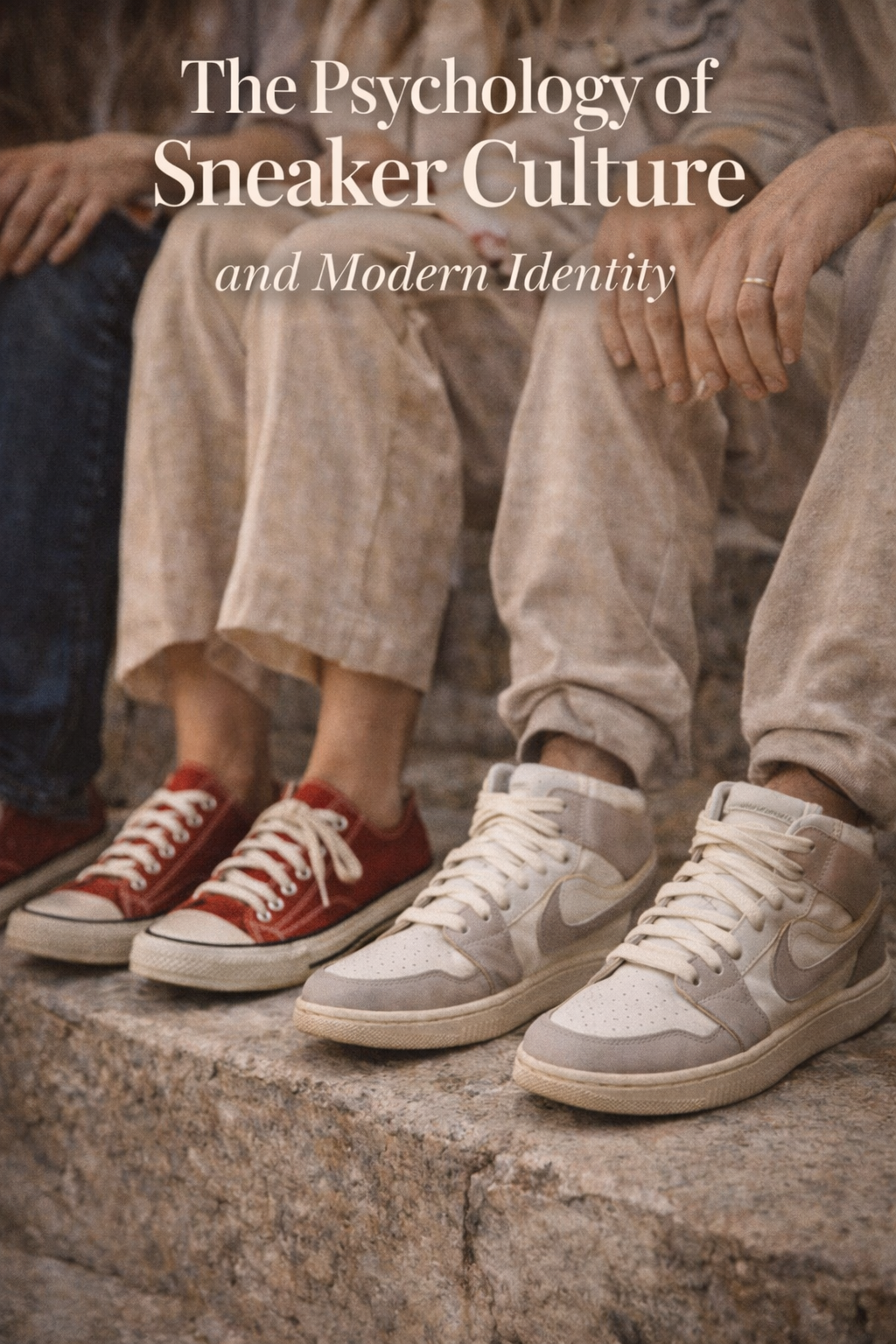
It starts from the ground up. Before a word is spoken, before a hand is shaken, a judgment is often made based solely on what is on a person’s feet. For the uninitiated, a sneaker is simply a rubber sole attached to a canvas or leather upper—a utilitarian object designed for protection and comfort. But for millions across the globe, it is a canvas of self-expression, a badge of community, and a potent psychological signal.
The transformation of the sneaker from humble athletic equipment to a dominant cultural artifact is one of the most fascinating shifts in modern fashion history. It is no longer just about performance; it is about narrative. Why do we queue for hours for a shoe we might never wear? Why does a specific silhouette evoke nostalgia while another signals futurism?
To understand this, we must look beyond the leather and laces. We must examine the intersection of behavioral psychology, tribalism, and design theory. This article explores the deep-seated reasons why humans care about shoes, specifically focusing on how the sneaker became the defining accessory of the modern era.
Read Here: Why Humans Care About Shoes: Culture, Identity & Psychology
The Origins of Sneaker Culture
The history of the sneaker is not merely a timeline of product releases; it is a timeline of cultural rebellion and democratization. To understand the current psychological grip sneakers have on society, we must look at the specific moments where rubber met the road of cultural change.
Early Athletic Shoes: The Vulcanized Revolution
The story begins not with fashion, but with chemistry. In the mid-19th century, Charles Goodyear’s invention of vulcanized rubber allowed for the creation of plimsolls. These early iterations were quiet, comfortable, and strictly utilitarian. By 1917, when Converse introduced the All Star, the shoe was a tool for the emerging sport of basketball.
For decades, the “sneaker”—named for its silent tread—was relegated to the gym. It was the uniform of the athlete, a symbol of physical prowess but not necessarily social standing. In this era, the shoe had little identity beyond function. It was a blank slate waiting for a culture to write upon it.
Basketball and Hip-Hop Influence
The seismic shift occurred in the mid-1980s. This is the “big bang” of sneaker culture. Two distinct forces collided to strip the sneaker of its purely athletic context: the defiance of Michael Jordan and the raw energy of Hip-Hop.
When Nike signed Michael Jordan in 1984, the NBA banned his black-and-red sneakers for violating uniform codes. Nike paid the fines, and Jordan wore the shoes. Suddenly, the sneaker was no longer just gear; it was a symbol of anti-authority. It was rebellion packaged in leather.
Simultaneously, the group Run-D.M.C. released “My Adidas,” an anthem that reclaimed the Superstar silhouette from negative street connotations and elevated it to a badge of honor. They wore them laceless, tongue out. They dictated the style, not the athletic coaches. This was the moment sneakers became a cultural language. They signaled that you were part of a movement, aware of the rhythm of the street, and distinct from the “buttoned-up” corporate world.
Rise of Streetwear Communities
From these sparks, localized communities formed. In New York, London, and Tokyo, tribes began to coalesce around specific silhouettes. The “sneakerhead” was born not as a consumer, but as a historian and archivist of the street.
This early community building is essential to the psychology of the movement. It established an “in-group” dynamic. Knowing the history of a colorway or the release date of a rare pair became a form of social currency. It was, and remains, a way to signal belonging without saying a word.
Identity and Self-Expression Through Sneakers
Psychologists often refer to “enclothed cognition”—the systematic influence that clothes have on the wearer’s psychological processes. Simply put, what we wear changes how we think and feel. Sneakers are perhaps the most potent trigger of this phenomenon in the modern wardrobe.
Personal Style Choices
In a world where dress codes have relaxed and corporate suits have largely vanished, footwear has become the primary anchor of personal style. A CEO might wear the same jeans and t-shirt as an intern, but their shoes will often tell a different story.
The choice of sneaker acts as a shorthand for values. A beat-up pair of Vans Old Skools signals a connection to skate culture, resilience, and a lack of pretension. A pristine pair of Common Projects Achilles signals an appreciation for minimalism, luxury, and subtle detailing. We curate our feet to project the version of ourselves we wish the world to see.
Minimalist vs. Bold Designs
The divide between minimalism and maximalism in footwear is a study in personality types.
- The Minimalist: Those drawn to clean lines, monochromatic colorways, and lack of branding (think Adidas Stan Smiths or luxury leather sneakers) often value order, timelessness, and versatility. The psychology here is one of “quiet confidence”—the shoe supports the outfit but does not dominate it.
- The Maximalist: Conversely, the rise of “hype” sneakers with deconstructed designs, neon laces, and oversized logos appeals to the desire for disruption. These wearers are often signaling creativity, risk-taking, and a desire to be visually audible in a crowded room.
Silhouette as Identity Marker
The silhouette—the overall outline and shape of the shoe—is the most fundamental element of sneaker design. It is what allows us to recognize a Jordan 1 or a Yeezy 350 from a block away.
Psychologically, we gravitate toward silhouettes that mirror our self-image. Sharp, streamlined silhouettes (like running spikes or low-profile racers) evoke speed, agility, and forward momentum. Heavy, grounded silhouettes (like the Air Force 1 or Dr. Martens) evoke stability, strength, and permanence. When we choose a silhouette, we are literally choosing the foundation upon which we stand.
The Psychology Behind Sneaker Collecting
Why do people amass hundreds of pairs of shoes, many of which remain in boxes, unworn? The psychology of collecting goes far beyond simple consumerism. It touches on human instincts regarding the hunt, scarcity, and preservation.
Scarcity and Limited Releases
Sneaker brands have mastered the art of artificial scarcity. By releasing shoes in limited quantities via “drops,” they trigger a powerful psychological response: the fear of missing out (FOMO) and the competitive instinct.
When a resource is scarce, its perceived value skyrockets. Winning a raffle to purchase a pair of shoes triggers a dopamine release comparable to gambling wins. The shoe becomes a trophy of the hunt. It signifies that the owner was diligent, lucky, or connected enough to secure the asset. This “thrill of the chase” is often more potent than the ownership itself.
Emotional Attachment
For many, sneakers are emotional time capsules. This connects directly to the concept of nostalgia. A 40-year-old collecting Air Jordans today is often not buying a shoe; they are buying back a piece of their childhood. They are purchasing the memory of watching a game in 1996, or the feeling of wanting a shoe their parents couldn’t afford.
This emotional attachment transforms the sneaker from a commodity into a sentimental artifact. The object serves as a bridge to a past self or a specific moment in cultural history.
Community Belonging
Collecting is rarely a solitary pursuit. It requires a marketplace, a forum, and an audience. The sneaker community provides a shared lexicon—terms like “deadstock,” “grail,” “colorway,” and “retro” create a barrier to entry that strengthens the bond between insiders.
Psychologically, this fulfills the human need for tribal belonging. Walking down the street and receiving a nod of recognition from a stranger because of the shoes on your feet validates your membership in the tribe. It is a shared understanding of codes and values.
Read Here: Streetwear Shoe Styles
Sneakers as Status Symbols in Modern Culture
Historically, status was signaled through stiff leather shoes, heeled boots, and materials that made manual labor impossible. Today, the script has flipped. The ultimate status symbol is often a rubber-soled athletic shoe.
Luxury Collaborations
The line between high fashion and streetwear has not just blurred; it has evaporated. Luxury houses like Dior, Louis Vuitton, and Balenciaga have pivoted to sneakers as their primary volume drivers. The Dior x Air Jordan 1 collaboration is the archetype of this shift.
This fusion signals a change in what society values. We no longer just value “heritage” and “craft” in the traditional sense; we value “cultural currency.” A luxury sneaker suggests that the wearer has both financial capital and cultural literacy. They know what is cool, and they can afford to participate in it.
Social Media Influence
Instagram and TikTok have accelerated the visual consumption of footwear. Sneakers are photogenic; they are architectural and colorful. On social media, they serve as instant visual communicators of lifestyle.
The “flex” culture on social media drives the status narrative. If a shoe is rare and recognizable, it garners engagement. This digital validation loop reinforces the desire to own the latest release, creating a cycle where status is constantly renegotiated based on the current week’s trends.
Fashion Hierarchies
The sneaker world has its own rigid class system. At the top are the “Grails”—rare, vintage, or friends-and-family exclusives. Below that are the high-heat collaborations. Further down are the general releases (GRs).
Navigating this hierarchy requires knowledge. It is not enough to have money; one must have “taste.” In this way, sneakers act as a meritocracy of style. A person wearing a beat-up pair of rare vintage Nikes often holds higher status in the community than someone wearing a brand-new pair of expensive, but generic, luxury designer sneakers.
How Design and Construction Influence Perception
As a footwear designer might explain, the psychology of a shoe is dictated by its anatomy. Every line, material, and proportion is a subliminal cue to the brain.
Chunky vs. Minimal Silhouettes
The “Dad Shoe” trend (chunky, oversized sneakers) creates a psychological feeling of safety and irony. The wide outsole provides a literal and figurative stable base. It rejects the seriousness of sleek fashion, embracing a “normcore” aesthetic that says, “I am comfortable enough to look uncool.”
Conversely, minimal silhouettes like the Common Projects Achilles rely on the “Golden Ratio” of design. They are pleasing to the eye because they lack distraction. They signal order, precision, and maturity.
Cushioning Technology
Visible technology, such as the Nike Air bubble or the Adidas Boost foam, serves a dual purpose. Functionally, it provides comfort. Psychologically, it signals innovation.
When we see a visible air unit, our brain registers “bounce” and “energy return” before we even take a step. We perceive the wearer as ready for action. The evolution of parts of a shoe—from the upper to the outsole—has been a constant march toward making the wearer look and feel more biologically capable.
Colorways and Materials
Color psychology plays a massive role in sneaker selection.
- White: Purity, freshness, high maintenance (signaling you don’t do dirty work).
- Black: Stealth, utility, rebellion.
- Bright/Neon: Athleticism, speed, attention-seeking.
Materials also dictate perception. Suede and nubuck imply luxury and fragility—they are not meant for the rain. Mesh and knit imply performance and breathability. By mixing these materials, designers create a narrative about where the shoe belongs—on the court, on the runway, or on the street.
Read Here: The Future of Shoes: Technology, Sustainability & AI Design
The Future of Sneaker Culture and Identity
As we look toward the horizon, the definition of a “shoe” is expanding. The future of sneaker culture will likely move in two divergent directions: the hyper-physical and the completely virtual.
Digital Sneakers and AI
We are entering the age of the “metaverse,” where digital identity is as important as physical identity. Brands are already selling NFTs (Non-Fungible Tokens) of sneakers—shoes that can only be “worn” by a digital avatar or viewed in augmented reality.
This strips the sneaker of its utility entirely, leaving only the psychological value: the status, the design, and the ownership. Furthermore, AI design personalization will likely allow consumers to generate silhouettes that are unique to their own data, creating the ultimate form of individualized expression.
Sustainable Fashion Identity
The other future is grounded in ethics. As climate anxiety rises, the “flex” is changing. Wearing a sneaker made from mushroom leather, recycled ocean plastic, or biodegradable materials is becoming a new form of status.
It signals that the wearer is conscientious and forward-thinking. The identity marker shifts from “I have money” to “I have morals.” Brands that fail to innovate in sustainability will likely lose their psychological grip on the next generation of consumers.
Sneakers as a Mirror of Modern Identity
We have come a long way from the vulcanized rubber of the 19th century. The sneaker has transcended its origins to become a complex artifact of human culture. It is a mirror of our modern identity—reflecting our desire for comfort, our need for belonging, and our obsession with status.
Whether you are a collector with a room full of boxes or someone who wears the same pair until the soles wear through, your choice is never accidental. It is a psychological declaration. As we continue to explore the nuances of footwear, from the anatomy of the shoe to the history of iconic silhouettes, one thing remains clear: we will always look to our feet to understand who we are.
Leave a Reply