

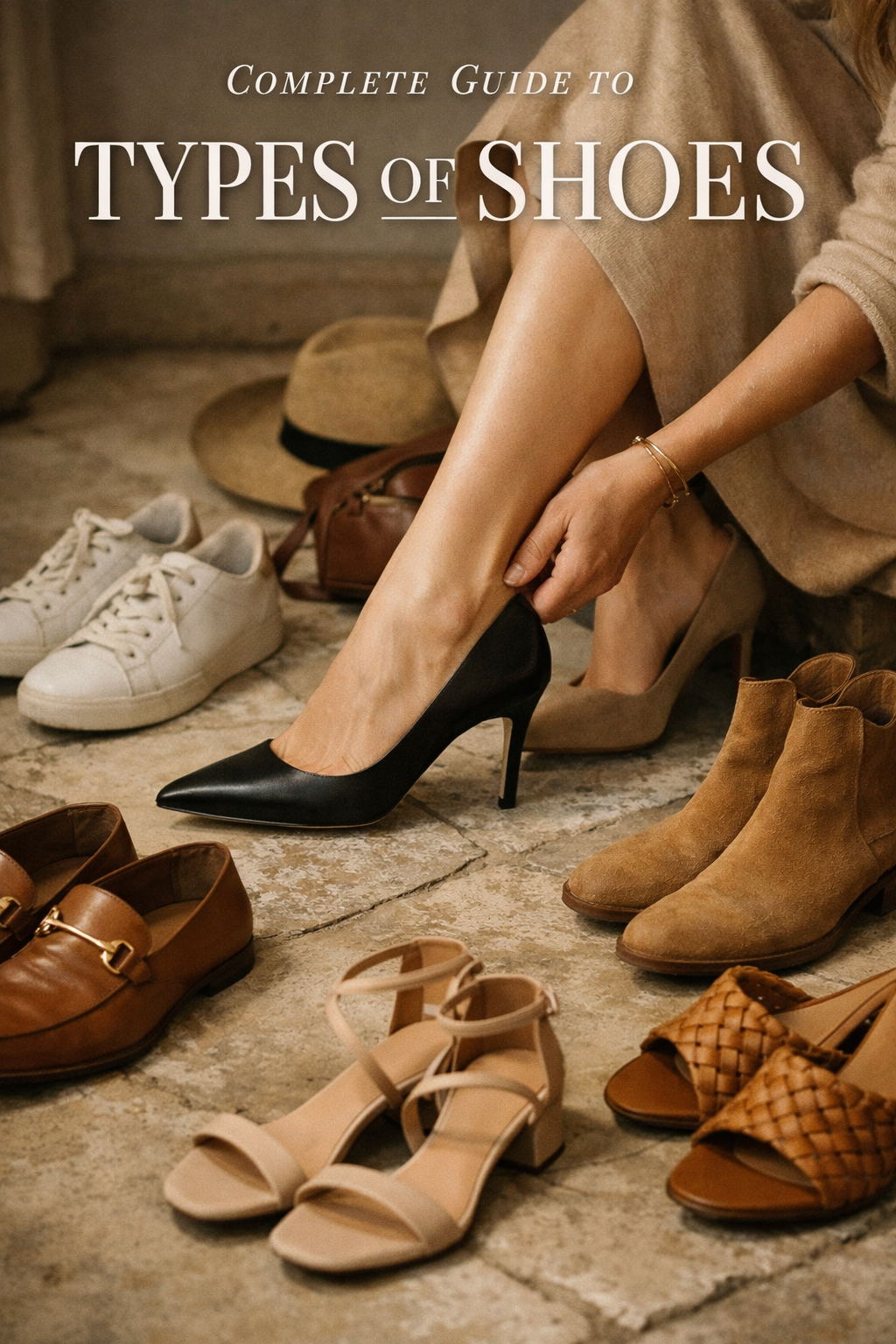
Shoe names are useful when they help you describe what you are looking for. They become less useful when a label is treated as a guarantee of comfort, formality or protection. Learn the visible distinctions, then check the exact model.
This guide is a glossary of common styles, not an exhaustive classification of every shoe. Retailers may use terms differently, especially for designs that combine features.
Oxfords and Derbies
The usual distinction concerns the lacing arrangement. In an Oxford, the eyelet sections are attached beneath the front of the upper; in a Derby, they are attached on top in a more open arrangement. Look at the construction rather than relying only on the product title.
Either style can vary in toe shape, decoration, materials and sole. Those details affect the appearance and fit of the actual pair. A style name alone does not decide whether it meets a particular office or event dress code.
Loafers and other slip-ons
A loafer is generally a low-opening slip-on without a lace closure. Penny straps, tassels and other details distinguish designs within the group. Some slip-on sneakers have elastic panels and a different construction, so not every laceless shoe is a loafer.
Check retention while walking and try your intended socks. Do not assume a loose pair will become a better fit with use. The sneaker, boot and loafer comparison covers practical selection questions.
Sneakers and trainers
These broad labels can describe casual shoes and models intended for specific activities. Check the current product’s purpose. A basketball-derived outline sold for lifestyle wear is not automatically equivalent to equipment selected for playing basketball.
Visible panels, collar height and sole shape help describe the design. The sneaker anatomy guide explains those parts. They do not, on their own, establish a fit or performance score.
Boots
Boots extend higher around the foot or leg, with lace-up, zipped and pull-on versions among the options. Chelsea-style elastic side panels and other closure details can help distinguish designs, but the internal fit still needs checking.
Weather and workplace claims require model-level information. A lugged outsole, high shaft or heavy upper is not enough to prove a particular protective function. Follow the relevant requirements for the task rather than buying by category alone.
Sandals, slides and heels
Sandals and slides include many open designs with different straps and retention. Check how the pair stays on and whether it suits the walking and conditions involved. An open appearance does not establish suitability for every warm-weather activity.
Heel describes a feature across several categories rather than one complete shoe type. Height, shape and placement affect the design, but personal fit and the activity still matter. There is no universal heel choice that everyone needs to wear.
Use the name, then investigate
Describe the shape, closure and intended use when narrowing your search. The shoe silhouette guide helps with visual vocabulary, while the lifestyle shoe guide connects the choice to your routine.
Try both shoes with the intended socks and assess movement, pressure and fastening. The useful category is the one that brings you closer to an appropriate pair, not a substitute for checking that pair.


Leave a Reply