

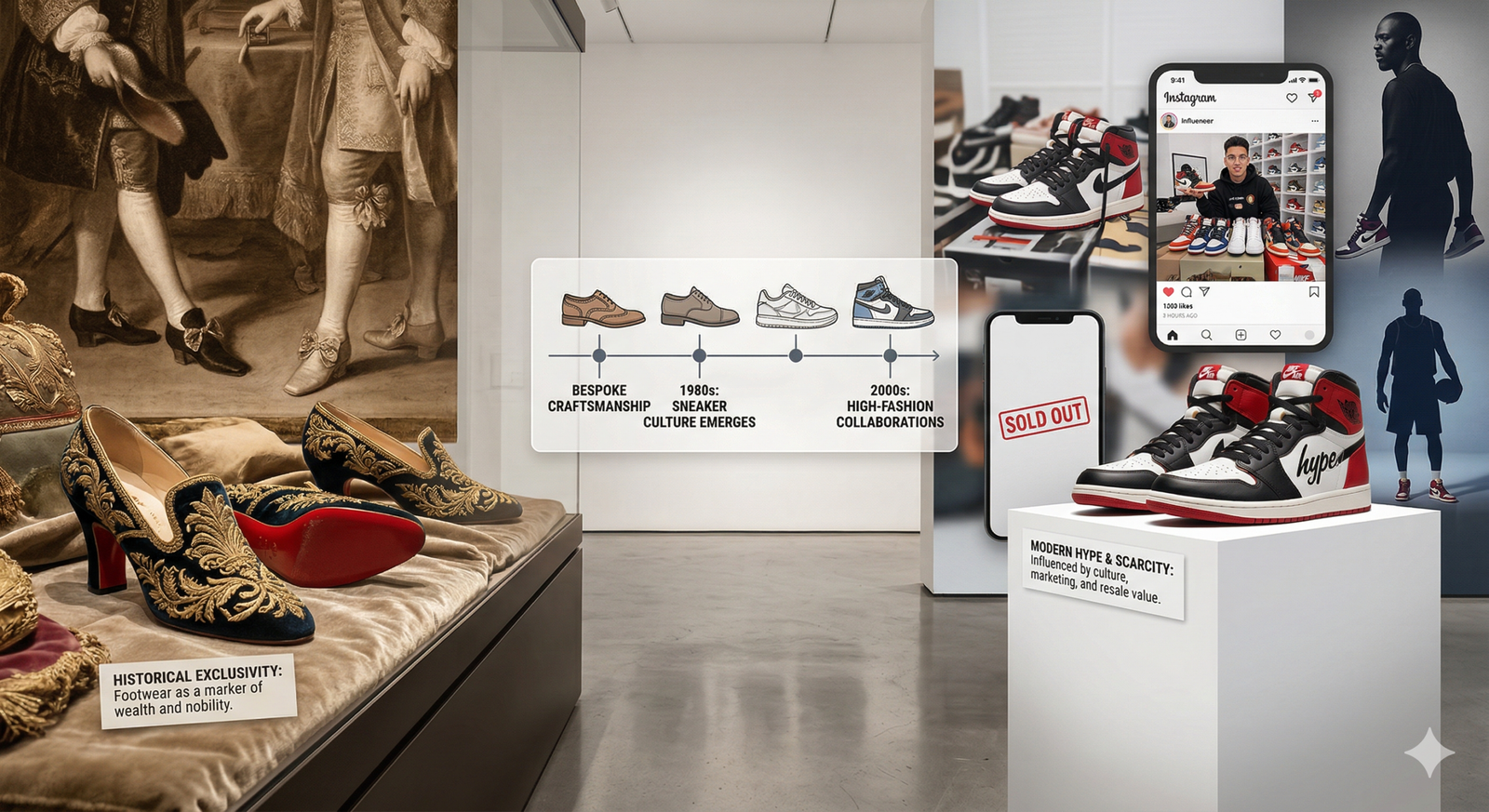
A shoe can be practical and still carry a social message. Its materials, shape, maker, or rarity may matter to people who recognise them. What counts as impressive changes with the setting: an elaborate court shoe, a beautifully made loafer, and a scarce sneaker belong to different worlds.
Shoes became status symbols through several overlapping routes, including access to expensive workmanship, association with powerful people, and recognition within a community. The history is more interesting than a straight line from wealthy people wearing shoes to everyone else copying them. Some famous examples also had a practical purpose.
Venetian chopines: height, protection, and display
The Metropolitan Museum of Art describes sixteenth-century Venetian chopines as platform shoes that helped keep feet away from damp, dirty streets while signalling elevated social status. That combination matters. A striking shape could answer a practical problem and become part of fashionable display.
It is tempting to reduce these shoes to a story about people proving they never had to walk or work. Surviving objects deserve a more careful reading. Their setting, materials, and use help explain their meaning; an extreme example does not establish how every woman in a city dressed.
Heels show how the meaning of a style can change
High heels have not always carried their present-day associations. The Bata Shoe Museum’s Standing Tall exhibition traces heels in men’s dress and explains their Western Asian riding background before their adoption in Europe. The heel’s story includes function, fashion, privilege, and changing expectations about gender.
The museum’s online exhibition also describes red heels at Louis XIV’s court as a sign of political privilege. In that setting, a recognisable detail communicated access to a particular social circle. It was a meaning attached to a time and place, rather than an inherent quality of the colour red or the height of a heel.
Workmanship and branding offer different kinds of recognition
Some shoes attract attention through conspicuous decoration. Others rely on details such as leather, construction, or a shape that a knowledgeable observer recognises. A prominent logo makes recognition easier, but an understated shoe can also carry meaning within an interested group.
Price, quality, and prestige are related questions, not identical ones. A higher price can include design, production costs, distribution, marketing, or a brand premium. It does not by itself prove better fit, greater durability, or the wearer’s wealth. A gift, a second-hand purchase, and a full-price purchase can put the same shoe on three different people.
Sneakers added new communities and new reference points
The Design Museum’s Sneakers Unboxed exhibition connects athletic footwear with music, subcultures, collaborations, and fashion. Basketball players, musicians, designers, and wearers all feature in that broader story. It is too simple to identify a single release as the exact moment sneakers acquired cultural value.
In a sneaker community, recognising a colourway or understanding a collaboration can be a form of shared knowledge. A rare pair may draw attention, but so can a thoughtful collection or a well-worn favourite with a personal history. The collecting motives are explored in our guide to sneaker culture and collecting.
Why scarcity can add prestige without guaranteeing value
Something difficult to obtain can become desirable partly because not everyone has it. With shoes, that difficulty might involve limited production, location, a particular size, or an old model that is no longer made. The story of finding a pair can become part of its appeal.
But scarcity and demand are separate conditions. A rare shoe needs interested buyers to command a premium, and those interests can change. A large asking price on a resale listing is not a completed sale. Keeping those distinctions in mind prevents a discussion of status from becoming an unsupported promise about investment returns.
Status depends on who is looking
A detailed reference that matters to a collector may be invisible to a colleague. A formal shoe that fits one workplace may look unnecessarily dressed-up in another. Even within the same city, people attach different meanings to the same pair.
This is why footwear should not be used as a shortcut for judging a person’s beliefs, character, or income. A recognisable symbol shows that the shoe has a social meaning; it does not establish why its owner chose it. Our article on shoes and first impressions explains the difference between an impression and evidence about an individual.
What the history helps us notice today
Looking at a status shoe, ask three questions: what makes it recognisable, who recognises it, and what does owning or wearing it mean in that setting? Those questions work for a museum object as well as a new release. They also leave room for the ordinary explanation that someone likes the shoe.
Footwear history shows how a useful object can gather layers of meaning. Those layers change as styles move between activities and communities. Understanding them can make fashion more interesting without turning an outfit into a ranking of the person wearing it.



Leave a Reply