

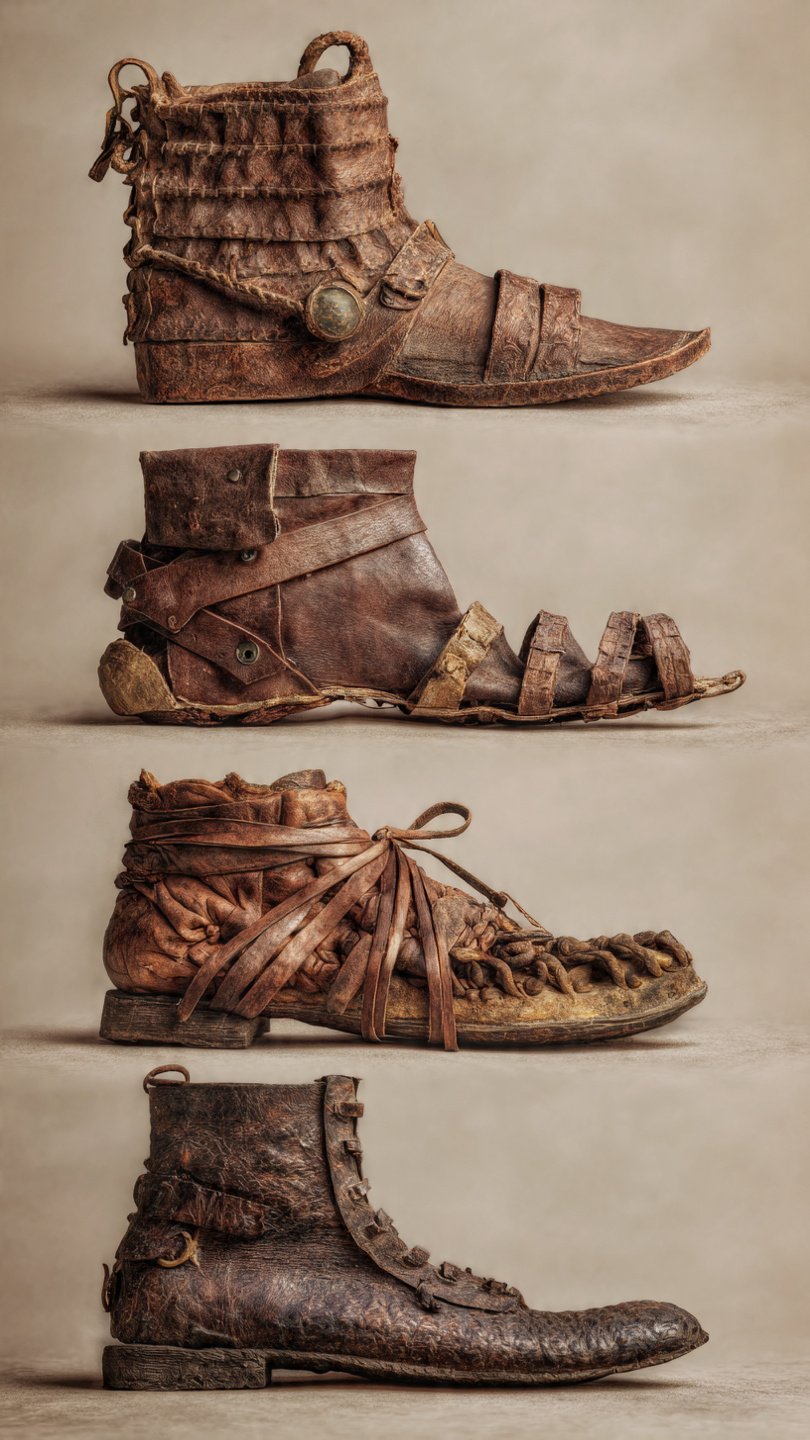
The history of shoes is not a single sequence in which every community moved from sandals to boots to sneakers. Materials, climate, work, status and local traditions produced different designs, often at the same time.
Surviving objects offer specific evidence. They can show how a pair was made or used, but they do not reveal the first moment humans wore footwear or explain every wearer’s experience.
Start with surviving examples
The University of Oregon’s Great Basin sandal collection includes Fort Rock-style fibre sandals dated to roughly 10,200 to 9,300 years ago. That is evidence about preserved and dated objects, not proof that footwear began at that place and time.
Notice the material, construction and condition of an example. Preservation affects what archaeologists can study. A material that survives in one setting may disappear in another, leaving gaps in the record.
Museum collections show variety
The V&A shoe collection brings together objects from different cultures and periods. Its examples show changes in height, heel shape and materials, as well as recurring ideas rather than a simple march toward one modern design.
Read the date, location, material and catalogue description of each object. A decorative shoe can reveal something about a particular context without representing every person living in that society.
Making methods are another part of the story
A design depends on the materials and methods available to the maker. Cutting, assembling an upper, shaping and attaching a sole can take different forms. Hand work and machinery are not opposites that neatly divide all historical and modern shoes.
The shoe manufacturing guide explains a general process while making clear that constructions differ. Avoid assuming every shoe from an era used the same method or that a particular method automatically establishes comfort.
Sporting designs have documented lineages
Named sneaker archives allow more precise claims than a general statement about when all athletic footwear began. Nike’s Air Force 1 page dates that design’s introduction to 1982. It is one model’s history, not the origin of every sneaker or cushioning system.
The classic sneaker history guide compares other documented examples. A current release may differ from an original, even when the family name is familiar.
Connect an object to its context
Ask who made the shoe, where it was used and what the record actually supports. Military footwear, ceremonial dress and sporting shoes need their own evidence rather than one explanation applied to all three.
The guide to reading historical footwear offers an object-by-object approach. History adds context to the outline you recognise, while the fit, purpose and condition of the pair in front of you remain separate questions.


Leave a Reply