

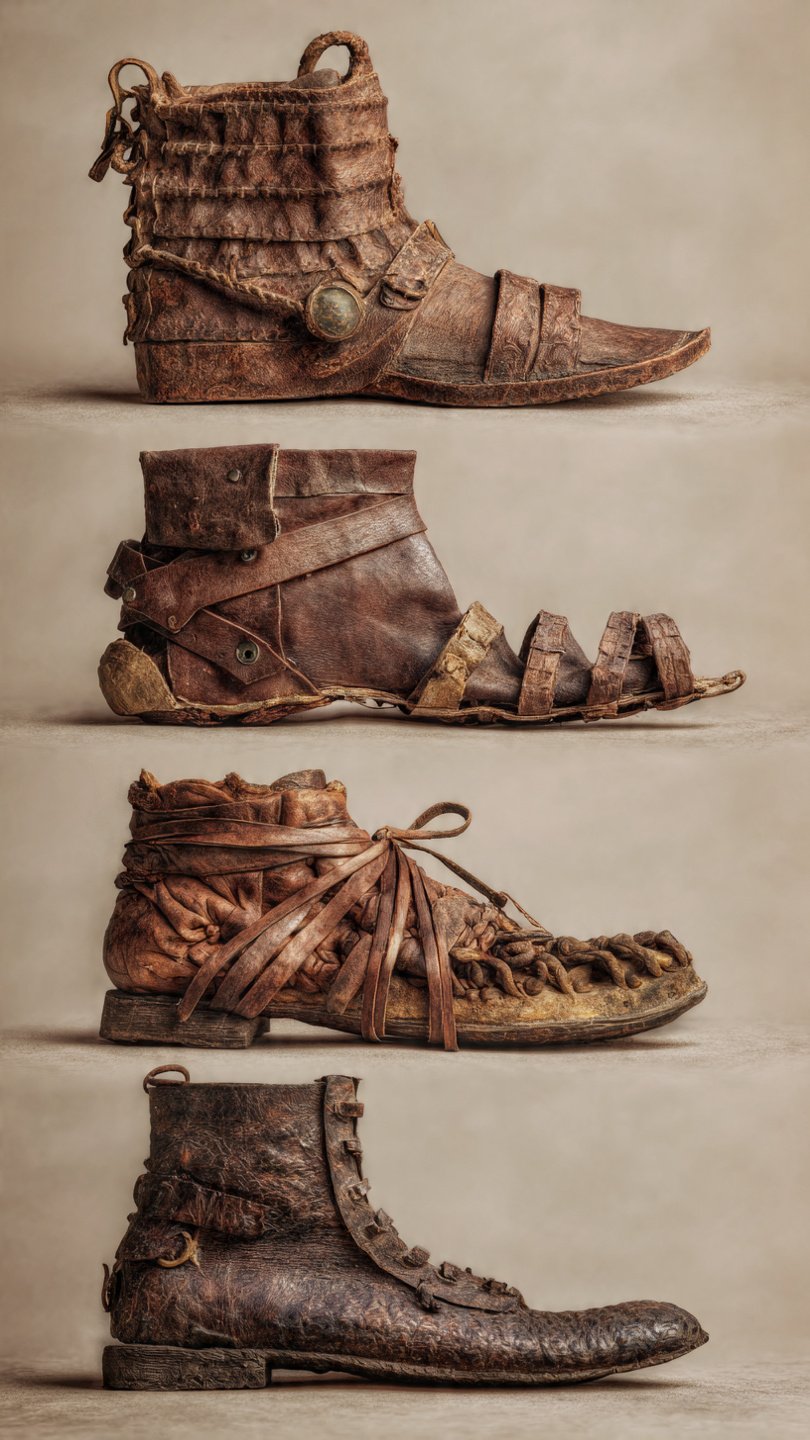
Shoes are more than practical items that protect our feet. They reflect technological innovation, cultural values, and human adaptation across thousands of years. From ancient sandals crafted from plant fibers to today’s high-tech athletic footwear, the evolution of shoes mirrors the broader story of civilization itself.
Understanding this evolution helps us appreciate why certain shoe styles persist, how materials and construction methods have advanced, and what drives contemporary footwear design. Whether shaped by climate, social hierarchy, or athletic performance, shoes have always been influenced by the needs and values of their time.
This guide traces the complete journey of footwear from its earliest origins through medieval craftsmanship, industrial mass production, the sneaker revolution, and today’s technology-driven designs. We’ll explore how each era contributed to the shoes we wear now and what the future might hold.
Ancient Footwear: Protection and Survival
Early Sandals and Natural Materials
The earliest known footwear dates back approximately 10,000 years. Archaeological evidence reveals sandals made from woven grasses, animal hides, and tree bark. These primitive shoes served one primary purpose: protecting feet from rough terrain, extreme temperatures, and potential injuries.
Ancient Egyptians crafted sandals from papyrus and palm leaves, while early Mesopotamian cultures used rawhide. The construction was simple but effective—flat soles attached to the foot with basic straps. These designs prioritized function over aesthetics, though some decorative elements appeared in footwear belonging to higher social classes.
The oldest surviving leather shoe, discovered in an Armenian cave, dates to around 3500 BCE. This well-preserved moccasin-style shoe demonstrates that even early humans understood the value of materials that molded to the foot’s shape and provided flexibility.
Climate and Terrain Influence
Geography played a crucial role in early footwear development. Communities in rocky, mountainous regions developed sturdier soles, while those in hot, sandy climates created ventilated designs that allowed airflow. Northern populations facing harsh winters wrapped their feet in animal fur for insulation.
This regional variation established a pattern that continues today: footwear design responds directly to environmental demands. The boots worn by Siberian hunters looked nothing like the sandals of Mediterranean farmers, yet both served their populations effectively.
Social Status in Early Civilizations
As societies became more complex, shoes evolved into status symbols. In ancient Egypt, only pharaohs and high-ranking officials wore ornate sandals, while commoners often went barefoot. Roman society similarly used footwear to denote social class—senators wore distinctive red shoes, while soldiers had standardized military boots called caligae.
These early civilizations understood that shoes communicated identity and position within social hierarchies. This connection between footwear and status would only strengthen through subsequent centuries.
For more on how natural materials shaped early footwear, see our Sustainable Shoe Materials Guide.
Medieval and Renaissance Shoe Design
Craftsmanship and Handmade Techniques
The medieval period transformed shoemaking into a recognized craft profession. Skilled artisans, known as cordwainers, created custom footwear using techniques passed down through apprenticeships. These craftspeople worked with leather, creating shoes tailored to individual feet.
Medieval shoes featured pointed toes, ankle boots, and various buckle and lacing systems. Construction quality varied significantly based on the wearer’s wealth. Nobles commissioned elaborately decorated shoes with embroidery and jewels, while peasants wore simple, functional designs that lasted through hard labor.
Shoemaking guilds emerged during this period, establishing quality standards and protecting the trade’s economic interests. This professionalization elevated shoemaking from basic necessity to artistic expression.
Symbolism and Fashion Hierarchies
Renaissance fashion pushed shoe design into increasingly extravagant territory. Poulaines—shoes with extremely long, pointed toes—became popular among European nobility. The length of the toe often indicated wealth and status, with some extending up to two feet beyond the actual foot.
Chopines, platform shoes worn primarily in Venice, elevated wealthy women several inches off the ground. Some reached heights of 20 inches, requiring assistance to walk. These impractical designs served as clear visual markers of privilege—only those who didn’t need to work could wear such footwear.
Sumptuary laws in various European countries regulated who could wear certain shoe styles and colors, further cementing footwear’s role in displaying social position.
Early Silhouette Experiments
This era saw experimentation with shoe shapes that would influence future designs. Square-toed shoes gained popularity in the late 15th century, while heeled shoes emerged in Persia before spreading to European courts in the 16th century. These early heels served both practical purposes (keeping feet secure in stirrups) and aesthetic ones (adding height and changing posture).
The Renaissance period established that shoes could be both functional and fashionable, setting the stage for footwear’s dual role in subsequent centuries.
Learn more about traditional craftsmanship in Handmade Shoes vs Factory Shoes.
Industrial Revolution and Mass Production
Factory Manufacturing
The Industrial Revolution fundamentally changed how shoes were made. What once required hours of skilled hand labor could now be accomplished through mechanized processes. Factories introduced assembly line production, with different workers specializing in specific construction steps.
The sewing machine, patented in the 1840s, revolutionized shoe manufacturing. Suddenly, uppers could be stitched to soles much faster and more consistently than by hand. This efficiency dramatically reduced costs and made quality footwear accessible to working-class populations for the first time.
Charles Goodyear’s vulcanization process in 1839 created durable, waterproof rubber soles. This innovation enabled new shoe categories and improved longevity across all footwear types.
Stitching Innovations
Various stitching techniques emerged to balance durability with production speed. The Goodyear welt, developed in the 1860s, created a watertight seal between the upper and sole while allowing for easy resoling. Blake stitching offered a sleeker profile with direct stitching through the insole.
These methods represented crucial advances in construction quality. Shoes could now withstand daily wear while remaining repairable, extending their useful life considerably.
For detailed information on construction methods, visit our Step-by-Step Shoe Manufacturing Process and Shoe Stitching Techniques Explained guides.
Standardized Shoe Sizes
Prior to industrialization, every shoe was custom-made. Mass production required standardization, leading to the development of sizing systems. Edwin B. Simpson created one of the first standardized sizing charts in the 1880s, establishing measurements that manufacturers could replicate consistently.
Sizing systems varied by country, and even today, no universal standard exists. However, the concept of ready-to-wear shoes in predetermined sizes fundamentally changed consumer access to footwear.
The Rise of Athletic Shoes and Sneaker Culture
Rubber Sole Innovation
The late 19th century introduced canvas-topped shoes with rubber soles, initially designed for beach and leisure activities. The U.S. Rubber Company’s Keds, launched in 1916, popularized these “sneakers”—named for their quiet rubber soles that allowed wearers to sneak around.
Converse released the All Star basketball shoe in 1917, creating one of the first sport-specific athletic shoes. When basketball player Chuck Taylor endorsed the shoe in the 1920s, it established the blueprint for athlete-brand partnerships that dominate sports marketing today.
High-Top Basketball Designs
Basketball shoes evolved to provide ankle support during quick directional changes and jumps. The high-top silhouette became synonymous with basketball, offering structural support while maintaining flexibility. This design influenced athletic footwear across multiple sports.
As basketball grew in popularity, particularly in urban communities, these shoes transcended their athletic origins to become cultural symbols. They represented access to sports, aspiration toward athletic achievement, and eventually, street style credibility.
Running Shoe Evolution
The 1960s and 1970s saw explosive growth in recreational running, driving demand for specialized running shoes. Nike, founded in 1964, introduced the waffle sole in 1974—a revolutionary tread pattern that provided superior traction and cushioning.
Running shoes prioritized lightweight construction, breathable materials, and shock absorption. Each innovation addressed specific biomechanical needs, establishing performance-driven design as a footwear category unto itself.
The silhouettes developed for athletic performance would eventually influence casual footwear, blurring the line between sports shoes and lifestyle fashion.
Explore how performance shaped design in Classic Sneaker Silhouettes in History and Running Shoe vs Lifestyle Silhouette.
Modern Footwear: Technology and Fashion Fusion
Cushioning Systems
Contemporary athletic shoes feature sophisticated cushioning technologies. Nike’s Air system, introduced in 1979, encapsulated pressurized gas in the sole for responsive cushioning. Adidas developed Boost foam in 2013, using thermoplastic polyurethane for energy return.
These innovations transform how shoes feel and perform. Runners experience less impact stress, basketball players get better court feel, and casual wearers enjoy all-day comfort. Technology once reserved for elite athletes now appears in everyday footwear.
Oversized and Minimalist Trends
Modern shoe design swings between two contrasting aesthetics. Chunky, maximalist shoes—often called “dad shoes”—feature exaggerated proportions, thick soles, and bold visual elements. Brands like Balenciaga and Nike have popularized these statement silhouettes.
Simultaneously, minimalist footwear emphasizes clean lines, reduced cushioning, and natural foot movement. Brands promoting “barefoot” running and lifestyle shoes strip away excess structure, arguing that feet perform better without excessive support.
This tension between maximalism and minimalism reflects broader fashion trends and demonstrates how cultural preferences shape footwear design.
Gender-Neutral Design Movement
Traditional footwear marketing heavily segregated shoes by gender, with distinct styles, colors, and sizing for men and women. Contemporary brands increasingly offer gender-neutral designs, recognizing that aesthetic preferences don’t align neatly with binary categories.
Unisex sizing and styling expands access and challenges assumptions about who should wear particular shoe types. This shift reflects changing cultural values around gender expression and identity.
Read more about these trends in Cushioning Technologies Explained, Minimalist vs Chunky Shoe Trends, and Gendered vs Gender-Neutral Silhouettes.
Cultural Meaning of Shoes Through Time
Throughout history, shoes have communicated far more than their practical function suggests. They’ve indicated social class, professional identity, cultural affiliation, and personal values. The shoes Roman senators wore declared their political position. Medieval poulaines announced aristocratic status. Modern sneaker collections signal cultural knowledge and economic resources.
Certain shoes become cultural touchstones. The Air Jordan 1, banned by the NBA in 1985, gained legendary status precisely because of that prohibition. Doc Martens transitioned from working-class boots to punk rock uniform to fashion staple. Red-soled Louboutins became instantly recognizable luxury symbols.
Shoes participate in subcultures, from skateboarding to hip-hop to high fashion. They mark belonging, signal authenticity, and communicate identity in ways that transcend their physical form.
This symbolic power explains why people form emotional attachments to particular shoes, why sneaker collecting has become a serious hobby and investment strategy, and why shoe choices often feel deeply personal.
For deeper exploration of shoes’ psychological and cultural significance, see The Psychology of Sneaker Culture and Modern Identity.
The Future of Shoes: Where Evolution Is Heading Next
Footwear innovation continues accelerating. Several emerging trends suggest where shoe evolution heads next:
AI-Designed Footwear: Machine learning algorithms now optimize shoe designs for specific performance metrics. AI can generate and test thousands of design variations, identifying solutions human designers might never consider. Expect increasingly specialized shoes tailored to particular activities, foot shapes, and movement patterns.
Sustainable Materials: Environmental concerns drive research into biodegradable, recycled, and renewable shoe materials. Brands experiment with mushroom leather, ocean plastic, and carbon-negative foams. Future shoes may have minimal environmental impact while maintaining performance and durability.
3D Printing and Customization: Additive manufacturing enables true customization at scale. Consumers may soon scan their feet and receive perfectly fitted shoes produced specifically for them. This technology could eliminate sizing issues while reducing waste from unsold inventory.
Smart Footwear: Shoes with embedded sensors track steps, analyze gait, and provide performance feedback. Future iterations might actively adjust cushioning based on terrain, heat or cool feet on demand, or integrate with broader health monitoring systems.
Modular Design: Some brands explore shoes with interchangeable components—swappable soles, customizable uppers, and replaceable parts that extend product life and allow aesthetic variation without purchasing entirely new shoes.
These innovations suggest a future where shoes become increasingly personalized, sustainable, and technologically sophisticated while maintaining the cultural and aesthetic significance they’ve always carried.
Discover what’s coming in Futuristic Shoe Shapes and The Future of Shoes: Technology & Innovation.
Shoes as a Reflection of Human Progress
The evolution of shoes reveals humanity’s remarkable capacity for innovation. From plant fiber sandals protecting ancient feet to AI-designed athletic shoes optimizing modern performance, footwear development mirrors our technological, cultural, and social evolution.
Each era contributed essential advances. Ancient civilizations established shoes as status symbols. Medieval craftspeople elevated shoemaking to an art form. Industrial manufacturing democratized access to quality footwear. Athletic innovation pushed performance boundaries. Contemporary designers balance technology, sustainability, and cultural expression.
Shoes will continue evolving as human needs, values, and capabilities change. They’ll incorporate new materials, respond to environmental challenges, and reflect shifting cultural priorities. Yet they’ll retain their fundamental purposes: protecting feet, expressing identity, and connecting us to the long human story of adaptation and innovation.
Understanding this history enriches how we think about the shoes we choose, wear, and cherish. Every pair participates in a tradition stretching back millennia, connecting us to everyone who’s ever laced up, slipped on, or buckled a shoe.
For comprehensive information on shoe design and structure, visit our authority guide: Shoe Silhouettes Explained: Shape, Structure & Style.
Leave a Reply