

For most of human history, shoes were made one pair at a time. A cobbler would measure your foot, cut the leather by hand, and stitch every seam with care. Each pair was unique, expensive, and took days—sometimes weeks—to complete. Only the wealthy could afford multiple pairs, while most people owned just one, worn until they fell apart.
Then came the Industrial Revolution, and everything changed.
Between the late 18th and early 19th centuries, a wave of technological innovation swept across Europe and North America. Steam engines powered factories. Machines replaced manual labor. Production soared. And footwear, once a luxury reserved for the few, became accessible to the masses.
This transformation didn’t happen overnight. It required new machinery, standardized systems, and a complete rethinking of how shoes were designed and constructed. The shift from handmade craftsmanship to factory-based production wasn’t just about speed—it reshaped the very nature of footwear itself.
This article explores how the Industrial Revolution gave birth to modern shoe manufacturing. We’ll examine the technologies that made mass production possible, the cultural impact of affordable footwear, and how industrialization laid the groundwork for the global sneaker industry we know today. Whether you’re a history enthusiast, a footwear designer, or simply curious about how your shoes came to be, this journey through manufacturing history will give you a new appreciation for what’s on your feet.
Footwear Before Industrialization
Before factories and assembly lines, shoemaking was an art form passed down through generations. Cobblers—skilled artisans who learned their craft through years of apprenticeship—dominated the trade. They worked in small workshops, often attached to their homes, producing shoes tailored to each customer’s foot.
Every pair was custom-made. The cobbler would trace your foot on a piece of leather, cut the upper by hand, and shape the sole to match your gait. Stitching was done with waxed thread and a curved awl. The process was slow, labor-intensive, and entirely dependent on the artisan’s skill.
Because production was so limited, shoes were expensive. Most people in medieval and early modern Europe owned only one or two pairs in their lifetime. The wealthy could commission elaborate Renaissance-style footwear, but for the working class, shoes were patched, repaired, and worn until they disintegrated.
This localized, handmade tradition defined footwear for centuries. But as populations grew and economies expanded, the demand for shoes began to outpace what individual craftsmen could produce. The stage was set for a revolution in manufacturing.
The Industrial Revolution and Technological Innovation
The Industrial Revolution didn’t just mechanize shoe production—it fundamentally reimagined it. Between the 1760s and 1840s, a series of inventions transformed how goods were made, distributed, and consumed. For the footwear industry, three key innovations stood out: sewing machines, standardized sizing, and factory assembly systems.
Sewing Machines and Mechanized Stitching
Before sewing machines, every stitch in a shoe was made by hand. A skilled cobbler could produce only a few pairs per week. But in 1846, Elias Howe patented the lockstitch sewing machine, and by the 1850s, Isaac Singer had refined it for commercial use.
For shoemakers, this was a game-changer. Machines could stitch leather faster, more consistently, and with less physical strain than any human hand. Early shoe factories adopted sewing machines to join uppers to soles, dramatically increasing output. What once took hours could now be done in minutes.
This shift didn’t eliminate craftsmanship entirely—skilled workers were still needed to operate the machines—but it marked the beginning of mechanized production. For more on how modern shoe stitching techniques evolved from these early innovations, the continuity between hand and machine stitching remains visible today.
Standardized Shoe Sizes
Before industrialization, there was no such thing as a universal shoe size. Every pair was made to fit a specific foot. But as factories began producing shoes in bulk, manufacturers needed a way to create footwear that could be sold to strangers—people they’d never meet.
The solution? Standardized sizing systems. In the early 19th century, shoemakers in England and the United States began developing size charts based on average foot measurements. The Brannock Device, invented in 1927, would later refine this system, but the concept of numbered sizes emerged much earlier.
Standardization allowed factories to produce shoes in batches rather than one at a time. A manufacturer could make hundreds of size 9 shoes knowing they’d fit a significant portion of the population. This efficiency was crucial to mass production—and it’s why we still use numbered sizes today.
Factory Assembly Systems
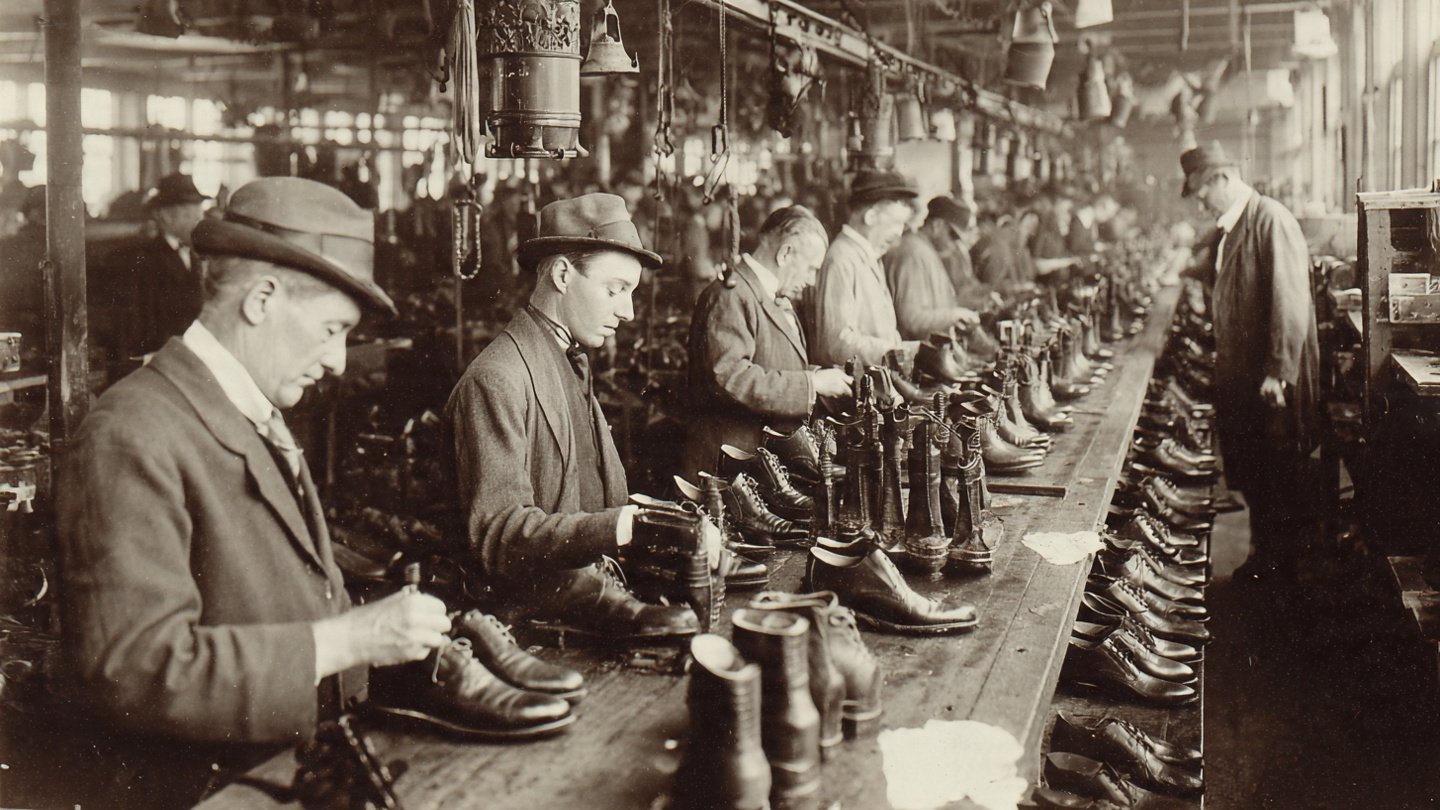
Perhaps the most transformative innovation was the factory assembly line. Instead of one cobbler making an entire shoe, each worker specialized in a single task: cutting leather, attaching soles, stitching seams, or polishing finishes.
This division of labor—championed by economists like Adam Smith—allowed factories to produce shoes at unprecedented speeds. A single factory could output thousands of pairs per day, compared to the handful a traditional cobbler might complete in a week.
The shift from craft to industry was profound. Shoemaking was no longer an artisan’s trade but a manufacturing process. For a deeper look at how modern footwear is made, explore our step-by-step shoe manufacturing guide.
Rise of Mass Shoe Production
With machines humming and assembly lines running, the footwear industry entered a new era. Mass production didn’t just increase output—it changed who could afford shoes and how they were distributed.
Factory-Based Manufacturing
By the mid-1800s, shoe factories had sprung up across England, France, Germany, and the northeastern United States. Cities like Lynn, Massachusetts, became known as shoemaking hubs, employing thousands of workers in sprawling facilities.
These factories operated on a scale that would have been unimaginable to earlier generations. Where a cobbler’s workshop might produce a dozen pairs per week, a factory could churn out hundreds—or even thousands—daily.
Faster Production Cycles
Speed was everything. Early shoe factories could complete a pair of shoes in hours rather than days. As machinery improved, production times continued to shrink. By the late 19th century, some factories were producing a finished pair every few minutes.
This acceleration didn’t just benefit manufacturers—it also meant retailers could stock shelves faster, respond to trends more quickly, and serve a growing consumer base.
Increased Accessibility of Footwear
Perhaps the most significant impact of mass production was democratization. Shoes, once a luxury, became affordable for the working class. Factory workers, farmers, and urban laborers could now purchase multiple pairs for different occasions.
This accessibility transformed daily life. People no longer had to repair and patch their shoes endlessly. They could replace them when worn out. Footwear became part of everyday fashion rather than a rare and precious commodity.
Handmade vs Factory Shoes: A Major Turning Point
The rise of factory production created a divide that still exists today: handmade versus mass-produced footwear.
Craftsmanship vs Efficiency
Handmade shoes offered superior customization and, often, higher quality materials. A skilled cobbler could adjust every detail to fit a customer’s unique foot shape. But this level of care came at a cost—both in time and money.
Factory shoes, on the other hand, prioritized efficiency and affordability. They couldn’t match the bespoke fit of handmade pairs, but they were good enough for most people—and far cheaper.
Changes in Materials and Construction
Mass production also influenced which materials were used. Factories favored materials that could be processed quickly and consistently: standardized leather grades, synthetic adhesives, and rubber soles (which became popular after Charles Goodyear’s vulcanization process in 1839).
Traditional cobblers, meanwhile, continued using time-tested methods: vegetable-tanned leather, hand-stitched welt construction, and natural materials. These techniques produced durable, high-quality shoes—but they couldn’t compete with factory prices.
Impact on Shoe Silhouettes
Industrialization also shaped shoe design. Factories needed standardized patterns and molds, which meant less variation in shoe silhouettes. Certain shapes became dominant because they were easier to produce at scale.
For a deeper comparison of these two production philosophies, see our article on handmade shoes vs factory shoes.
Quality Control and Standardization in Early Factories
With thousands of shoes rolling off assembly lines daily, maintaining consistent quality became a new challenge.
Early Inspection Systems
Early factories implemented basic inspection systems. Workers checked shoes for defects before they left the production floor. Crooked seams, uneven soles, or poor stitching were flagged and either repaired or discarded.
These systems were rudimentary compared to modern standards, but they represented the beginning of industrial quality control. For more on how quality assurance evolved, explore our guide to quality control in shoe production.
Consistency Challenges
Despite inspections, early factory shoes were often inconsistent. Variations in materials, machinery calibration, and worker skill meant that two “identical” pairs might fit quite differently.
Over time, manufacturers refined their processes. Better machinery, improved training, and stricter standards gradually improved consistency—laying the groundwork for the reliable sizing and quality we expect today.
Foundations of Modern Quality Assurance
The quality control practices developed during the Industrial Revolution set the stage for modern manufacturing standards. Today’s shoe factories use advanced testing equipment, statistical process control, and automated inspections—but the core principle remains the same: ensuring every pair meets a minimum standard before reaching the customer.
Cultural Impact of Mass-Produced Shoes
The availability of affordable footwear didn’t just change how shoes were made—it transformed how people lived.
Shoes became part of everyday fashion. No longer limited to the wealthy, working-class families could afford different styles for different occasions. Sunday shoes, work boots, and casual footwear became common distinctions.
This shift also fueled the rise of uniform styles. As factories produced popular designs in large quantities, certain silhouettes became ubiquitous. The Oxford shoe, the brogue, and early boot designs spread across continents, creating shared fashion norms.
Global footwear markets expanded rapidly. Shoes manufactured in England were sold in India. American factories exported to South America. The footwear industry became one of the first truly globalized industries—a trend that continues today.
For a deeper look at humanity’s relationship with footwear, see our article on why humans care about shoes.
How Industrialization Shaped Modern Shoe Silhouettes
Industrialization didn’t just change how shoes were made—it influenced their shapes.
Standardized Shapes
Factories needed molds and patterns that could be replicated thousands of times. This led to the standardization of shoe shapes. Certain silhouettes—like the rounded-toe Oxford or the pointed brogue—became dominant because they were efficient to produce.
Early Athletic Shoe Development
The late 19th and early 20th centuries also saw the emergence of specialized footwear. Rubber-soled shoes, initially designed for croquet and tennis, became early precursors to modern athletic shoes. These classic sneaker silhouettes evolved from industrial innovations in rubber processing and canvas manufacturing.
Formal Shoe Evolution
Formal footwear also benefited from industrialization. The modern dress shoe—with its sleek lines, polished leather, and refined construction—emerged as factories perfected techniques for producing elegant, consistent designs at scale.
From Industrial Revolution to Modern Sneaker Industry
The manufacturing principles established during the Industrial Revolution laid the foundation for the modern sneaker industry.
By the early 20th century, companies like Converse, Adidas, and Puma were applying factory production methods to athletic footwear. Rubber soles, canvas uppers, and streamlined assembly processes made sneakers affordable and popular.
As technology advanced, so did sneaker manufacturing. Injection molding, synthetic materials, and automated stitching pushed production speeds even higher. Today’s sneaker factories can produce millions of pairs annually—an unimaginable scale compared to the early shoe factories of the 1800s.
For a look at how sneakers are made today, check out our guide on how sneakers are manufactured. And if you’re curious about where footwear design is headed, explore our article on futuristic shoe shapes.
The Legacy of Industrialization in Footwear
The Industrial Revolution didn’t just change how shoes were made—it changed who could wear them, how they looked, and what they meant.
Before factories, shoes were a luxury. After industrialization, they became a necessity. The machines, systems, and innovations of the 19th century created the foundation for every pair of shoes produced today—from high-fashion heels to performance running shoes.
Understanding this history helps us appreciate not just the shoes we wear, but the centuries of innovation behind them. The transition from handmade craftsmanship to mass production wasn’t simply about efficiency. It was about democratizing access, standardizing quality, and reshaping culture.
To explore the full story of footwear—from ancient sandals to modern sneakers—read our comprehensive guide on the evolution of shoes from ancient to modern times.
Leave a Reply