

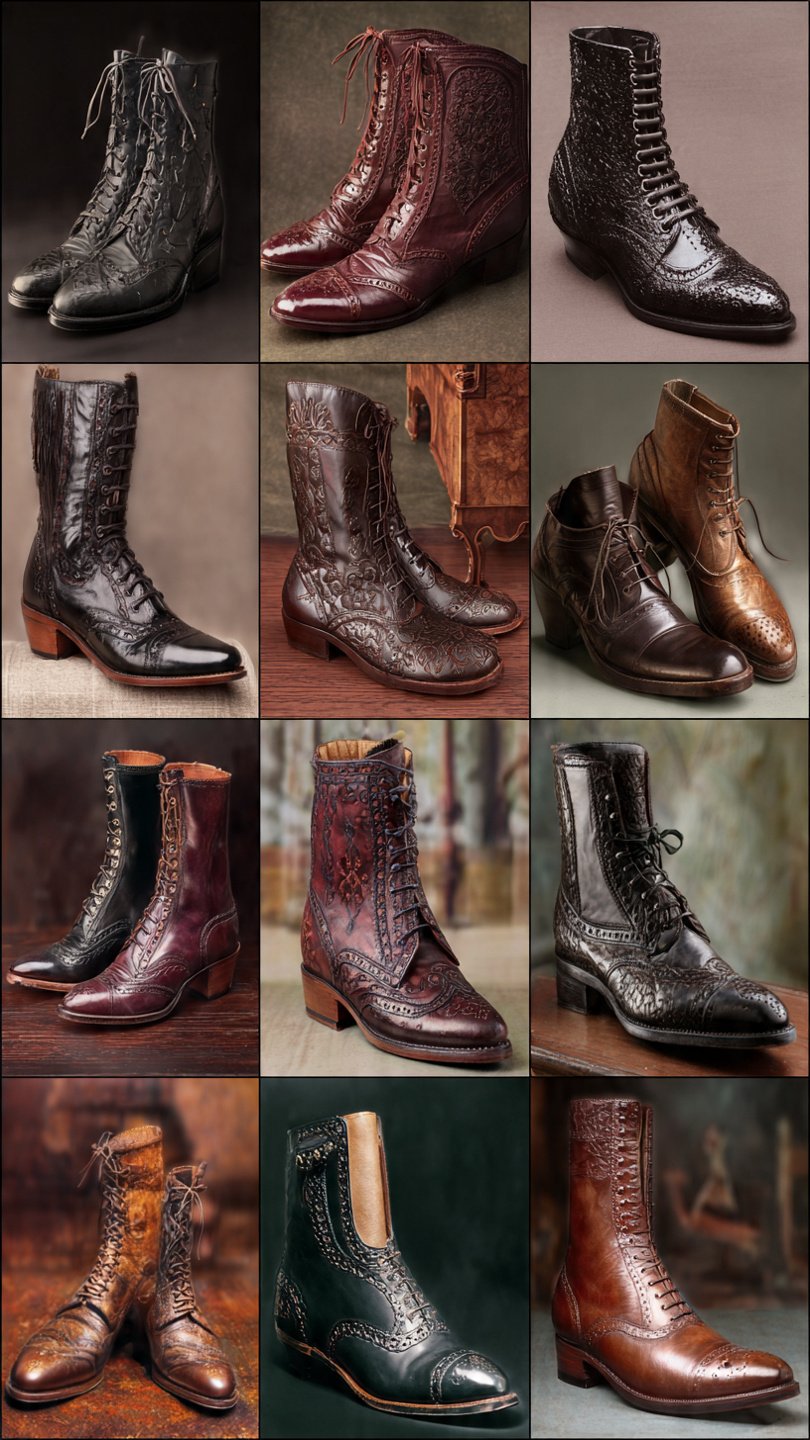
Victorian footwear covered far more than a single button boot. During Queen Victoria’s reign, from 1837 to 1901, people wore different shoes for walking, work and formal occasions. Surviving examples show how shape, materials and fastening could vary.
Boots for the street
Ankle boots could fasten with laces or buttons. The Met’s catalogue for a French button boot notes that short boots were fashionable streetwear from the 1830s into the 1920s, with laced and button styles alternating. This particular pair is dated 1900–1910, so it reaches just beyond the Victorian period and illustrates continuity into the next decade.
A different American pair of button walking boots shows heavier soles and relatively restrained decoration. It is one example, not proof that all Victorian walking boots had the same construction.
Different shoes for different settings
Footwear made for walking could be constructed differently from a delicate evening shoe. The Met notes bows and embroidery on some evening footwear in its description of the walking boots above. Material and decoration also depended on maker, date, region and what a buyer could afford.
It is tempting to read every shoe as a precise sign of class or occupation. Such connections can be useful historical questions, but an isolated object does not always establish who wore it or when.
Making and manufacturing
The 19th century saw changes in footwear production alongside continuing craft practices. The Met’s description of a pair of American button boots discusses machine stitching and expanding US shoe production in the late 19th century. Handwork and factory methods are better understood as practices that could coexist, rather than a single change that happened everywhere at once.
Looking at the details
When examining an example, notice its toe, heel, closure, upper material and sole. These details can suggest how the maker approached a particular design. Our guide to shoe parts provides useful terminology.
Modern formal shoes use a wide range of materials and attachment methods. The formal shoe construction guide explains what to check in a present-day pair.
Frequently asked questions
Were all Victorian boots buttoned? No. Laced styles and other fastenings were also used.
Were all shoes made by hand? No. Production methods changed during the century, and practices varied.
Do modern boots reproduce the same fit? A modern design may borrow a historical shape but use a different last and construction. Try the specific pair for fit.
For earlier examples, explore Renaissance footwear and medieval footwear.

Leave a Reply