

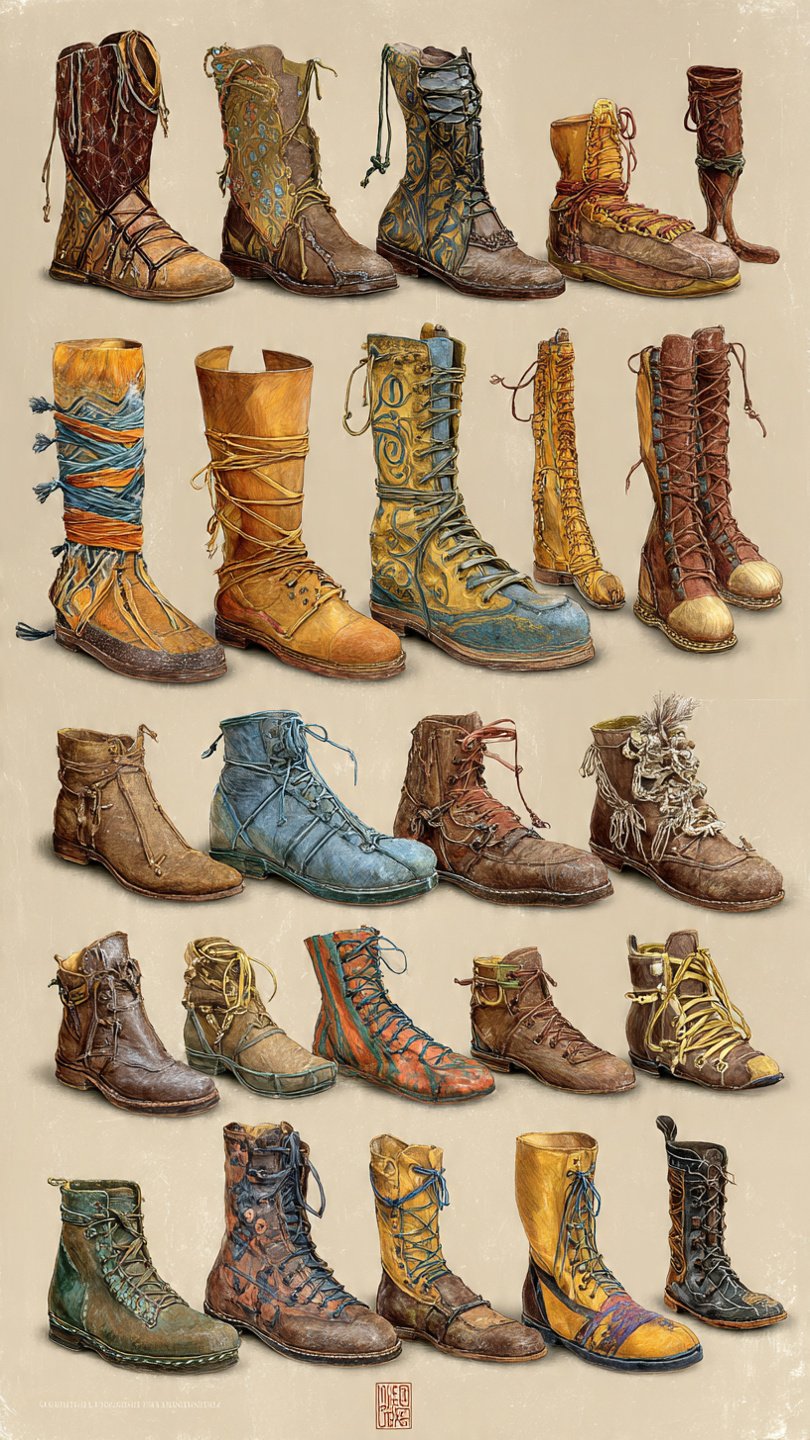
Medieval shoes were far more than basic protection for the feet. They served as status symbols, cultural markers, and expressions of emerging craftsmanship. During the Middle Ages—roughly spanning from the 5th to the 15th century—footwear design began to reflect social hierarchies, regional traditions, and the skill of individual artisans.
Unlike the mass-produced shoes we wear today, medieval footwear was entirely handmade. Each pair required hours of labor, precision stitching, and an understanding of materials that could only come from years of apprenticeship. Shoemakers, known as cordwainers, worked with limited tools but produced remarkably durable and sometimes elaborate designs.
The style of shoe you wore could immediately signal your place in society. A peasant might wear simple turnshoes made from a single piece of leather, while a nobleman could sport elongated poulaines with tips so long they had to be stuffed or tied up. These distinctions weren’t arbitrary—they were deeply tied to laws, religious beliefs, and cultural norms.
Understanding medieval footwear helps us trace the evolution of shoes from ancient to modern times. Many of the techniques, silhouettes, and social meanings established during this period continue to influence how we design and perceive shoes today. To fully appreciate modern footwear, we need to look back at the origin of shoes and the craftsmanship that defined an era.
Common Medieval Shoe Styles
Medieval footwear wasn’t uniform across Europe. Different regions, time periods, and social classes produced distinct styles. However, a few key designs dominated the landscape and laid the groundwork for future footwear evolution.
Turnshoes and Simple Leather Shoes
Turnshoes were among the most common medieval footwear styles, especially for everyday wear. They were constructed inside-out, stitched along the edges, and then turned right-side-out to hide the seams. This method created a smooth interior and made the shoe more comfortable against bare skin or thin stockings.
These shoes typically featured a simple, ankle-height cut and were made from soft leather. They offered minimal structure and no real cushioning, but they were flexible and relatively easy to produce. Turnshoes were worn by peasants, merchants, and even some members of the lower nobility.
Because they were sewn with the grain side of the leather on the inside, turnshoes were vulnerable to wear. The soles would thin quickly, especially on rough terrain. As a result, many people had their shoes resoled multiple times throughout their lifespan.
Pointed-Toe Poulaines
Poulaines, also known as crakows or pikes, were elongated shoes with exaggerated pointed toes. They became fashionable in the 14th and 15th centuries, particularly among the upper classes. The length of the point often correlated with the wearer’s social status—some shoes extended several inches beyond the toes.
These shoes were more than a fashion statement. They were a form of conspicuous consumption, signaling that the wearer didn’t need to perform manual labor. Walking in poulaines required a certain gait, and the longer versions had to be stuffed with moss or hair to maintain their shape.
Poulaines represented early experimentation with toe shapes in shoes. While they eventually fell out of favor due to changing tastes and even some legal restrictions, their influence persisted. Pointed-toe dress shoes remain a staple of formal footwear to this day.
Boots for Travel and Warfare
Boots served functional purposes during the medieval period, especially for travel, hunting, and combat. They rose higher on the leg than standard shoes, offering protection from mud, cold, and rough terrain. Military boots were often reinforced with thicker leather and sometimes featured metal elements for added durability.
Riding boots, in particular, became essential for mounted knights and horsemen. These boots needed to withstand long hours in the saddle while providing enough flexibility for movement. The design prioritized durability over comfort, though wealthier individuals could commission custom-fitted boots with better materials.
Boots were less common among peasants due to the cost and effort required to make them. However, travelers, soldiers, and those working outdoors regularly relied on them. The early boot structures developed during this time influenced later designs, including modern riding boots and combat footwear.
Materials Used in Medieval Footwear
Medieval shoemakers worked with a limited range of materials, but they understood how to maximize the properties of each one. Leather dominated footwear construction, chosen for its availability, durability, and workability.
Natural Leather Construction
Cattle, goats, and sheep provided the primary sources of leather for medieval shoes. Cowhide was prized for its thickness and strength, making it ideal for soles and structured uppers. Goat and sheep leather were softer and more flexible, often used for the shoe’s body where comfort mattered most.
Tanning processes during the Middle Ages were labor-intensive. Tanners used natural substances like oak bark, which required soaking hides for months. Vegetable tanning produced leather that was firm yet breathable, with a distinct earthy smell. The resulting material could last for years if cared for properly.
Different leather finishes were reserved for different social classes. Wealthier individuals could afford finer, smoother leathers with decorative tooling or dye work. Peasants typically wore rougher, undyed leather that showed its natural texture and imperfections.
Hand-Stitched Assembly
Every medieval shoe was sewn by hand using thread made from flax or sinew. Shoemakers employed techniques that distributed stress evenly across seams, ensuring the shoe held together under daily use. Common stitching methods included the tunnel stitch and the edge/flesh stitch, both of which are still studied in traditional shoe stitching techniques today.
Needles were made from bone, wood, or metal, depending on what the craftsman could access. Precision was critical—each hole had to be carefully awled (punched) before threading to prevent tearing the leather. Mistakes were costly, as materials were expensive and time-consuming to prepare.
This careful, deliberate construction created shoes that could be repaired rather than discarded. Resoling was common, and many medieval shoes show evidence of multiple repairs over their lifespan.
Basic Soles and Minimal Cushioning
Medieval footwear offered little in the way of cushioning or arch support. Soles were typically single layers of leather, sometimes reinforced with additional pieces in high-wear areas. There was no concept of shock absorption or ergonomic shaping—shoes were flat and followed the natural contour of the foot.
Wealthier individuals occasionally had wooden pattens, which were overshoes worn to elevate the wearer above mud and filth. These weren’t integrated into the shoe itself but served as protective accessories. The lack of internal cushioning meant that walking long distances in medieval shoes could be uncomfortable by modern standards.
This minimalist approach stood in stark contrast to today’s footwear, which often features multiple layers of foam, gel, and specialized cushioning technologies. However, the simplicity of medieval shoe construction also meant fewer points of failure and easier repairs.
Social Meaning Behind Medieval Shoe Designs
Footwear wasn’t just functional during the Middle Ages—it was a visual language. Shoes communicated wealth, occupation, gender, and even religious affiliation. Understanding these signals helps explain why humans care about shoes beyond their practical utility.
Status and Wealth Indicators
Shoe ornamentation and complexity directly reflected social standing. Nobles and wealthy merchants wore shoes made from finer leathers, often dyed in rich colors like red or purple. Decorative elements such as embroidery, metalwork, or jeweled buckles further distinguished elite footwear from everyday shoes.
Length and impracticality also signaled status. Poulaines, with their exaggerated points, were difficult to walk in and clearly marked the wearer as someone who didn’t need to labor. Sumptuary laws in some regions even restricted who could wear certain shoe styles, preventing lower classes from imitating the nobility.
Conversely, peasants and laborers wore simple, functional shoes with no adornment. Their footwear prioritized durability and cost-effectiveness, often patched and repaired until it was no longer usable.
Religious and Cultural Influences
Religious orders had specific footwear requirements, often tied to vows of poverty and humility. Monks and nuns typically wore plain, unadorned shoes or sandals. Pilgrims on long journeys might wear special shoes marked with religious symbols, believing they offered spiritual protection.
Cultural traditions also shaped shoe design. Certain regions developed distinctive styles based on local customs and available materials. For example, shoes in colder northern climates tended to be higher and more enclosed, while Mediterranean designs were often more open and breathable.
Some shoe styles carried superstitious significance. Worn-out shoes were sometimes placed in walls or under floors during construction as good luck charms—a practice that has helped modern historians understand medieval footwear through archaeological finds.
Gender Differences in Footwear
Medieval shoe design showed clear gender distinctions, though these weren’t as pronounced as in later periods. Men’s shoes tended to be sturdier and more practical, reflecting their roles in labor, warfare, and travel. Women’s shoes, particularly among the upper classes, could be more decorative but were still relatively functional compared to later eras.
Both men and women wore similar basic styles like turnshoes, but differences emerged in details. Women’s shoes might feature finer stitching or softer leather, while men’s boots were built for rougher use. Poulaines were primarily a male fashion, though some noblewomen adopted modified versions.
Footwear for children was essentially scaled-down adult shoes. There was little concept of shoes specifically designed for developing feet—children wore miniature versions of what adults wore, adjusted for size.
How Medieval Silhouettes Influenced Modern Shoes
Many contemporary shoe designs trace their roots directly back to medieval innovations. Understanding what is a shoe silhouette requires recognizing these historical precedents and how they’ve evolved over centuries.
Pointed Formal Shoe Shapes
The medieval poulaine established the pointed-toe aesthetic that remains central to formal menswear. While modern dress shoes don’t extend to the same extreme lengths, the elongated toe box creates a sleek, refined silhouette that conveys professionalism and sophistication.
This shape evolved from medieval excess into a more practical form, but the underlying principle remained: a pointed toe suggests elegance and attention to detail. The transition from poulaines to modern oxfords and derbies shows how fashion adapts while retaining core visual elements.
Shoemakers still reference medieval proportions when designing formal footwear. The balance between toe length, vamp height, and heel placement often echoes principles first established in medieval workshops.
Early Boot Structures
Medieval riding boots and military footwear laid the foundation for modern boot design. The idea of a shoe that rises above the ankle for protection and support remains central to everything from work boots to fashion chelsea boots.
Construction techniques developed during the Middle Ages—such as reinforced heel counters and structured shafts—continue to define how formal shoes are built differently from casual footwear. The emphasis on durability and purpose-driven design connects contemporary boots directly to their medieval ancestors.
Even the aesthetic of boots as rugged, masculine footwear has medieval roots. Knights and soldiers wore boots as part of their armor, creating associations between boots and strength that persist in modern fashion.
Minimalist Design Roots
Before industrialization introduced complex manufacturing processes, shoes were necessarily simple. This minimalism, born from practical constraints, has experienced a resurgence in modern footwear design. Brands emphasizing handmade shoes vs factory shoes often look to medieval construction methods for inspiration.
The barefoot shoe movement, which advocates for minimal cushioning and support, unknowingly echoes medieval footwear philosophy. While medieval shoemakers lacked the option to add cushioning, modern minimalist designers consciously choose simplicity based on biomechanical principles.
This connection demonstrates how innovation sometimes means returning to foundational concepts rather than constantly adding complexity.
Craftsmanship Techniques in the Middle Ages
Medieval shoemaking was a true craft, passed down through apprenticeship and guild systems. The techniques developed during this period formed the foundation for traditional shoemaking methods still practiced today.
Hand Stitching Methods
Medieval cordwainers mastered several stitching techniques, each suited to different parts of the shoe. The tunnel stitch, which ran through channels cut into the leather, created strong seams while keeping thread protected from abrasion. The edge/flesh stitch joined pieces along their edges, distributing tension evenly.
These methods required considerable skill. A shoemaker had to understand leather grain direction, tension control, and how different stitches would perform under stress. Modern shoe stitching techniques explained often begin with these medieval foundations before moving into industrial methods.
The quality of hand stitching meant that shoes could be taken apart and reconstructed during repairs. This repairability was essential in an economy where replacing goods was far more expensive than fixing them.
Early Lasting Concepts
The lasting process—shaping leather around a foot-shaped form—existed in rudimentary form during the Middle Ages. Early lasts were simple wooden forms that approximated foot shape but lacked the anatomical precision of modern lasts.
Shoemakers would pull dampened leather over the last, securing it in place while it dried and took shape. This process required understanding how different leathers would shrink and mold. The lasting process in shoemaking has become far more sophisticated, but the basic principle remains unchanged.
Custom lasts for wealthy clients allowed for better fit, though this was a luxury most people couldn’t afford. The majority of medieval shoes were made on generic lasts, with wearers breaking them in over time.
Custom Fit Philosophy
Despite limited tools, medieval shoemakers understood the importance of proper fit. Wealthy clients could commission shoes made specifically for their feet, with measurements taken and lasts carved accordingly. This attention to individual fit created a tradition of bespoke shoemaking that continues in high-end footwear today.
The relationship between shoemaker and customer was often long-term. A cordwainer might serve the same family for generations, learning the specific foot shapes and preferences of each member. This personalized approach contrasts sharply with modern mass production but survives in artisanal shoemaking communities.
Even for ready-made shoes, medieval craftsmen paid attention to construction details that improved fit. Well-placed gussets, adjustable lacing systems, and careful attention to foot contours all contributed to more comfortable footwear within the constraints of available materials and techniques.
Medieval Footwear vs Modern Shoes
Comparing medieval and contemporary footwear reveals dramatic changes in materials, construction, and purpose. However, many fundamental design principles remain surprisingly consistent.
Medieval shoes prioritized durability and repairability over immediate comfort. Modern footwear often reverses this priority, with complex cushioning technologies providing instant comfort but sometimes at the expense of longevity. Athletic shoes, for example, typically have a limited lifespan before their cushioning degrades, whereas a well-made medieval shoe could be resoled and repaired indefinitely.
Material innovation represents perhaps the biggest shift. Synthetic materials, rubber soles, and advanced foams were inconceivable to medieval shoemakers. These innovations have made shoes more affordable and accessible but have also created environmental challenges that medieval leather production didn’t face at scale.
The cultural shift from necessity to fashion has also transformed footwear. Medieval people needed shoes primarily for protection and social signaling. Modern consumers often own dozens of pairs, each serving specific aesthetic or functional purposes. Shoes have evolved from essential tools into expressions of personal identity and style.
Despite these differences, the core relationship between foot and shoe remains. Humans still need protection, support, and comfort—medieval shoemakers simply addressed these needs with different tools and materials. The craftsmanship and attention to detail they brought to their work continues to inspire shoemakers who value quality over quantity.
The Legacy of Medieval Footwear in Today’s Fashion
Medieval shoe designs continue to influence contemporary fashion in surprising ways. Designers regularly reference historical silhouettes, bringing retro silhouettes making a comeback into modern collections.
Pointed-toe dress shoes directly descend from poulaines, albeit in more wearable proportions. The sleek, elongated shape remains synonymous with formal footwear, especially in menswear. Fashion houses occasionally push these proportions further, creating avant-garde designs that echo medieval extremes.
Boots have maintained their medieval associations with ruggedness and practicality while expanding into fashion territory. Chelsea boots, riding boots, and combat boots all carry design DNA from medieval footwear, adapted for contemporary tastes and manufacturing methods.
The resurgence of interest in artisanal and handmade goods has brought renewed attention to traditional shoemaking techniques. Small workshops practicing methods nearly identical to those used by medieval cordwainers have found modern audiences willing to pay premium prices for historically-inspired craftsmanship.
Even fast fashion occasionally draws on medieval aesthetics. Renaissance faire fashion, historical costume enthusiasts, and designers seeking “timeless” looks all reference medieval footwear elements. These references may be superficial, but they demonstrate the enduring visual appeal of medieval design principles.
Medieval Shoes as the Foundation of Modern Footwear Design
Medieval footwear represents a crucial chapter in the broader story of how humans have protected and adorned their feet. The craftsmanship, social meanings, and design innovations developed during the Middle Ages established patterns that continue to shape contemporary footwear.
From pointed formal shoes to structured boots, from hand-stitching techniques to custom fitting philosophies, medieval shoemakers created a foundation that later innovations built upon rather than replaced. Understanding this historical context enriches our appreciation for both traditional craftsmanship and modern manufacturing.
The next time you slip on a pair of leather dress shoes or lace up boots, consider the centuries of evolution behind their design. Those medieval cordwainers, working by candlelight with simple tools, established principles of form, function, and meaning that resonate in footwear aisles today.
For a comprehensive look at how these medieval innovations fit into the larger narrative, explore the evolution of shoes from ancient to modern times. The story of footwear is ultimately a story of human ingenuity—and it began long before the first factory production line.
Leave a Reply