

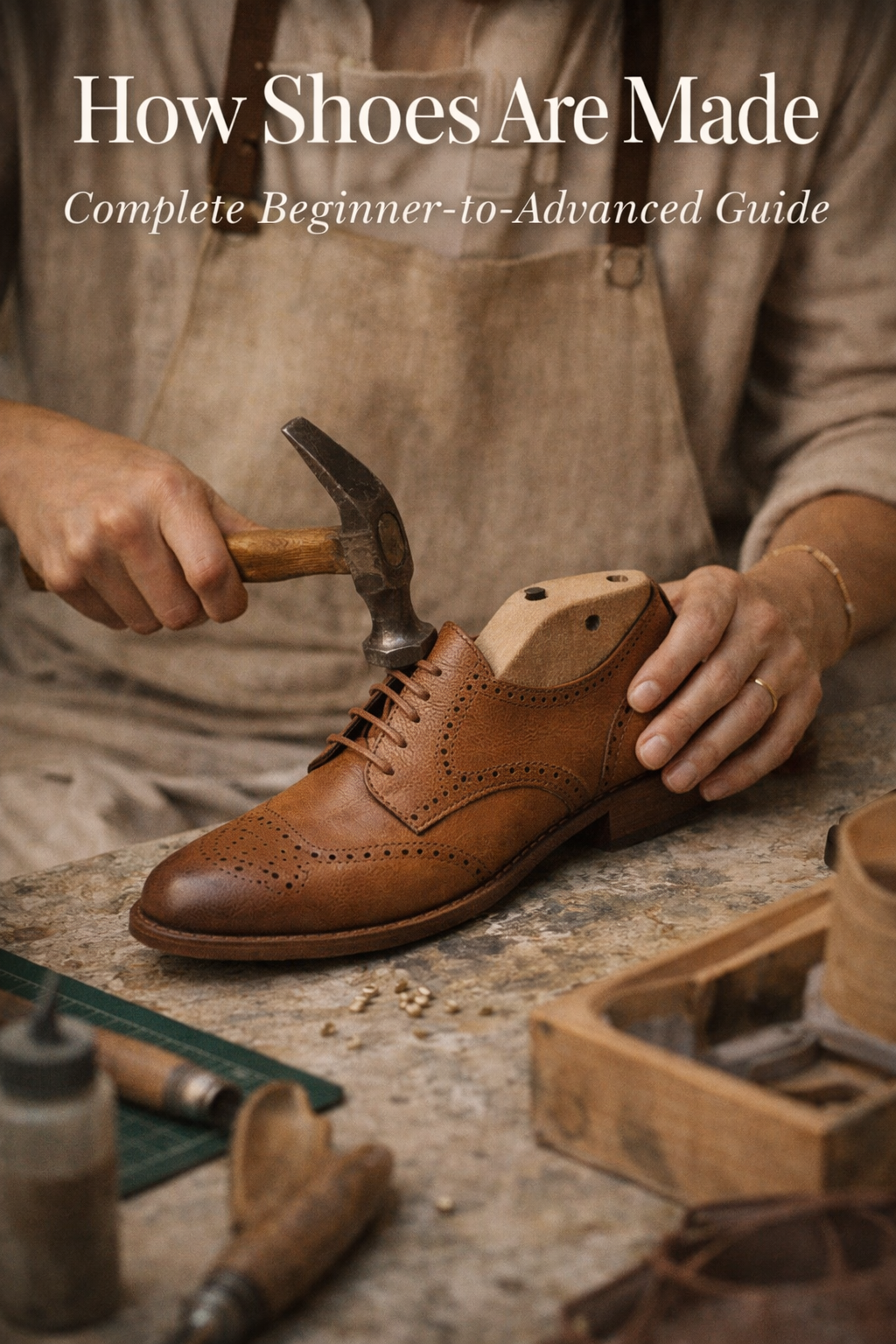
A finished shoe brings together an upper, bottom components and a fastening or other fit features. The steps used to make it depend on the design, materials and production method. A dress shoe, a running sneaker and a protective boot do not follow one identical recipe.
This guide outlines common stages. It is an overview, not a factory-specific production specification.
1. Design and development
A maker starts by deciding the shoe’s intended use, shape, size range and materials. Designers and technicians develop patterns and samples, then assess how the components fit together. The number of samples and revisions varies by project.
A last is the shaped form used in making the shoe. The Smithsonian’s shoe-last record describes its role in work on the upper and sole. Our lasting guide explains the forming stage.
2. Cut and join the upper
Upper pieces are cut from selected materials and joined by stitching or other methods. Linings, reinforcements, eyelets and labels may be added depending on the design. A single shoe can combine different materials; the shoe anatomy guide identifies common components.
3. Form and assemble
The upper is positioned around the last, then bottom components are attached according to the construction method. Some designs use adhesives; others use stitching as part of the attachment, and a pair may combine methods. Our glue vs stitching guide explains why a visible stitch does not reveal every step.
The insole, midsole and outsole are not always separate visible layers in every design. For their different roles, see the sole and midsole guide.
4. Finish and inspect
Finishing can include trimming, cleaning, attaching laces and checking the finished pair. Inspection points and test methods depend on the maker’s specification and intended use. Our quality-control guide describes examples of checks without assuming every shoe is tested identically.
The Footwear Maker training material illustrates practical operations including lasting and sole attachment; it is one training sequence, not a universal process.
Frequently asked questions
Are all shoes made around a last?
A last is common in many constructions, but shoe designs and production methods vary. Ask the maker about the exact model.
Is stitching always used to attach the sole?
No. Methods vary, and many shoes use adhesive or a combination of techniques.
Does handmade mean no machinery?
Not necessarily. Ask which steps are done by hand; workshops and factories use different mixes of tools and labor.



Leave a Reply