

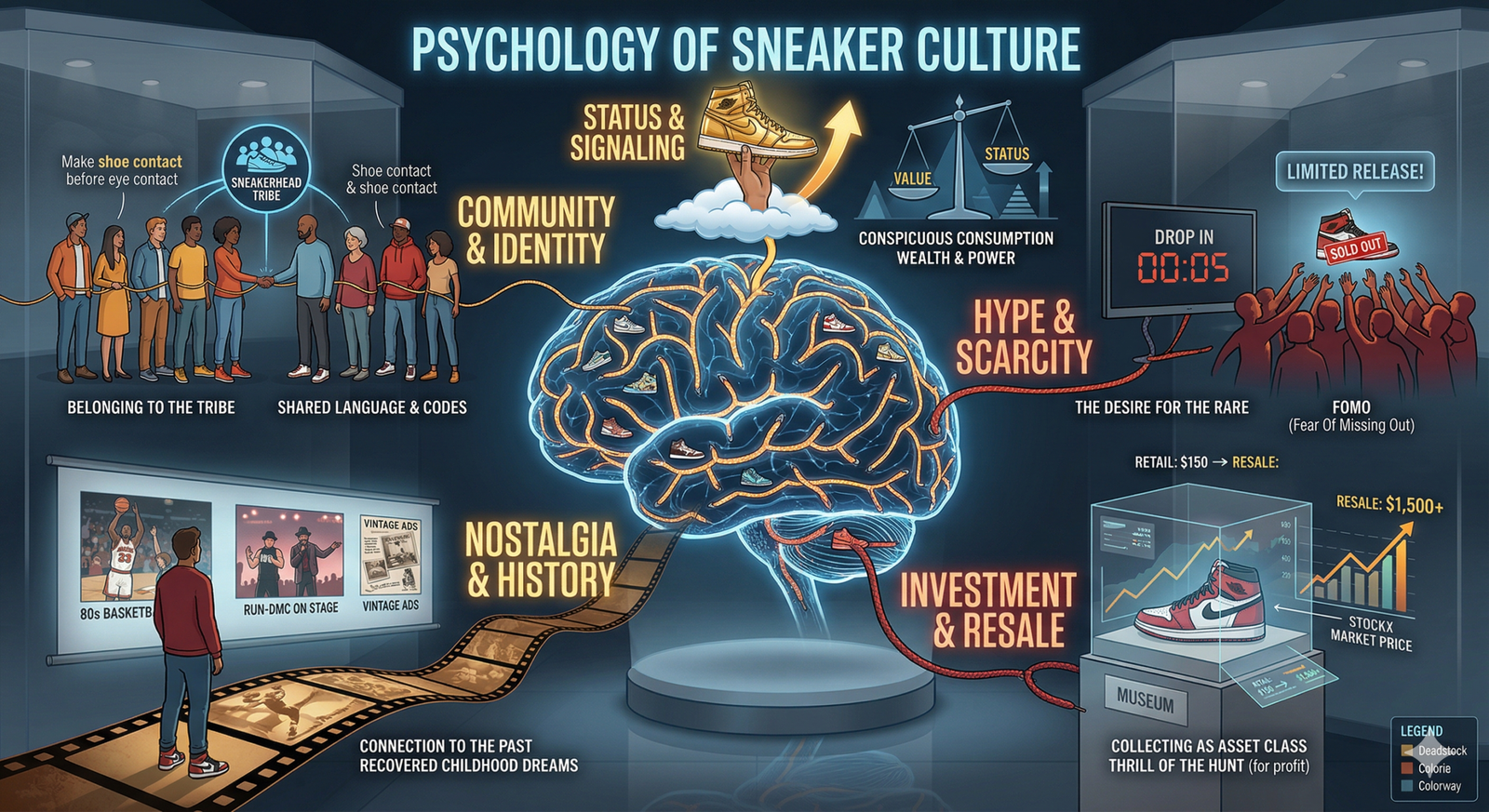
People used to buy shoes simply to protect their feet. Now, millions of people worldwide set alarms for the middle of the night, camp outside stores in freezing weather, and spend thousands of dollars just to secure a single pair of sneakers. This phenomenon has transformed the footwear industry into a massive cultural movement.
But what exactly drives someone to obsess over a pair of shoes? The answer goes far deeper than leather, rubber, and mesh. Sneaker obsession is deeply rooted in human psychology, drawing on our fundamental needs for social connection, status, and self-expression.
By understanding the cognitive processes that drive sneakerheads, we can uncover a lot about modern consumer behavior. This blog post explores the psychological triggers behind sneaker culture, explaining why we form intense emotional attachments to footwear and how brands masterfully use hype to keep us coming back for more.
Understanding Sneaker Culture Beyond Footwear
What defines sneaker culture today
Modern sneaker culture is not just about the product itself. It is a massive, interconnected lifestyle. Enthusiasts build their entire wardrobes, social circles, and even daily routines around sneaker releases.
At its core, this is a community-driven culture. People bond over shared interests, trading stories about rare finds and commiserating over missed opportunities. This shared passion has created a global influence, uniting people across different countries, languages, and backgrounds through a mutual love for footwear.
From performance gear to cultural symbol
Decades ago, athletic shoes served a strictly functional purpose. You wore basketball shoes on the court and running shoes on the track. Over time, there was a massive shift from sports utility to fashion identity.
This transformation was heavily influenced by the worlds of music, sports, and streetwear. Hip-hop artists and professional athletes began wearing specific sneakers as badges of honor, bringing them from the courts to the streets. If you look at the rise of sneakers in street culture, you will see how these shoes became cultural artifacts. Understanding the history of athletic shoes helps explain how utility eventually gave way to unmistakable cultural symbolism.
Why Humans Form Emotional Attachments to Sneakers
Identity and self-expression through footwear
The clothes we wear send a message to the world. Sneakers function as highly visible personality markers. Whether someone wears a classic, understated pair or a bright, futuristic design, their style acts as a form of non-verbal communication.
Footwear also signifies belonging to specific subcultures. Skaters, hip-hop fans, and high-fashion enthusiasts all favor different silhouettes. Getting familiar with the most popular sneaker types explained can help decode what someone’s footwear says about their personal identity.
Nostalgia and memory association
Psychology tells us that objects can hold powerful emotional memories. For many collectors, buying sneakers is a way to reconnect with their past. A specific pair might remind them of childhood sneakers they could not afford growing up, or a favorite athlete they idolized.
Brands understand this emotional recall perfectly. They regularly launch retro releases to tap into this powerful sense of nostalgia. Furthermore, storytelling in sneaker design—where shoes are themed around historical moments or cultural icons—deepens the emotional bond between the buyer and the product.
The Power of Scarcity and Hype
Limited releases and perceived value
One of the most powerful psychological drivers in the sneaker market is artificial scarcity. Brands deliberately produce fewer pairs than the market demands. This creates an intense environment where the perceived value of a shoe skyrockets simply because it is hard to get.
The mechanics of drop culture rely on this scarcity. By announcing a specific release date and time, brands create an event out of a simple product launch.
Fear of missing out (FOMO)
Scarcity directly triggers the fear of missing out, commonly known as FOMO. When consumers know a shoe might sell out in seconds, they experience urgency-driven buying behavior.
This leads to the massive queue culture and digital raffles we see today. People want the shoe, but they also desperately want to avoid the feeling of being left out. Reading an iconic sneaker silhouettes guide reveals how this FOMO has cemented certain shoes into legendary status simply because they are perpetually out of reach.
Dopamine, Reward Systems, and Sneaker Buying
Anticipation vs ownership
Neurologically, the human brain loves a challenge. The psychological reward cycle of buying a rare sneaker often peaks before the shoe even arrives. Anticipating a release, entering a raffle, and waiting for the results releases massive amounts of dopamine.
For many, the thrill of “winning” a drop is actually more satisfying than owning the physical shoe. Once the purchase is complete, the dopamine levels drop, leading the brain to seek out the next thrill.
Habit formation and repeat buying
This dopamine cycle creates powerful sneaker collecting loops. Consumers learn that buying a new, hyped pair of shoes makes them feel good, so they repeat the behavior. This behavioral reinforcement is the exact reason why sneaker closets quickly turn from holding five pairs to fifty pairs.
Social Status and Validation in Sneaker Culture
Sneakers as status symbols
Humans have always used physical items to signal their rank in society. Today, sneakers function as modern status symbols. Wearing limited editions serves as a luxury signal to those in the know.
In this space, price acts as perception. If a shoe costs thousands of dollars on the resale market, wearing it instantly communicates wealth, dedication, and insider knowledge to other members of the community.
Social media amplification
The desire for social validation is amplified heavily by digital platforms. Instagram and TikTok influence how sneakers are perceived and consumed. Sneakerheads post their collections and “fit pics” to gain validation through likes and community praise. The internet has turned a local hobby into a global flex.
Brand Psychology and Loyalty
Emotional branding in sneakers
Successful sneaker brands do not just sell shoes; they sell emotions. Through emotional branding, companies leverage storytelling surrounding their heritage, star athletes, and exclusive collaborations.
When a brand’s identity aligns with a consumer’s personal values—such as a dedication to greatness or a rebellious spirit—the consumer forms a fierce, emotional loyalty to the company.
Tribal behavior among sneaker fans
This loyalty often translates into tribal behavior. The fierce Nike vs Adidas loyalty debates are prime examples of this phenomenon. People naturally want to align themselves with a winning team, and brand loyalty provides a strong sense of community belonging. A look back at the history of athletic shoes shows that this brand tribalism has been building for decades.
Sneaker Collecting as a Psychological Behavior
Collector mindset
Sneaker collecting taps into a specific psychological trait known as the collector mindset. For some, this manifests as completionism—the need to own every colorway of a specific model. For others, it is the rare item pursuit, driven by the thrill of hunting down the most obscure, difficult-to-find pairs on the planet.
Sneakers as investments
Recently, the psychology of collecting has shifted toward financial gain. Sneakers are now viewed as legitimate investments, spawning a massive resale culture. The difference between the perceived value and the intrinsic value of a shoe creates opportunities for massive profit. As people continue to view shoes as stock market assets, we will likely see a shift in the future of sneaker technology as brands try to outsmart counterfeiters and protect these investments.
Cultural and Digital Influence on Sneaker Psychology
Celebrity and influencer impact
Humans naturally mimic the behavior of those they admire. Athletes, rappers, and high-profile designers have an enormous impact on what the masses want to buy. When a cultural icon wears an unknown shoe, that shoe can sell out globally within minutes.
Online communities and hype ecosystems
The psychology of hype is sustained by online communities and hype ecosystems. Dedicated forums, Reddit threads, and resale platforms keep the conversation going 24/7. This global connectivity ensures that sneaker obsession never sleeps, and the hype machine is always being fed new information.
The Dark Side of Sneaker Obsession
Overconsumption and financial pressure
While sneaker culture can be a fun and rewarding hobby, it has a dark side. The constant pressure to keep up with releases leads to severe overconsumption. Impulse buying takes over, causing many young consumers to face debt and overspending just to maintain their social standing within the community.
Psychological dependency
For some, this behavior morphs into psychological dependency. The dopamine hits become addictive, resulting in addiction-like patterns where the buyer feels anxious if they miss a drop. Furthermore, when an individual builds their entire persona around footwear, they face an identity over-reliance that can be damaging to their mental health.
The Future of Sneaker Psychology
Digital sneakers and virtual identity
As our lives move further online, the psychology of self-expression is adapting. We are now seeing the rise of digital sneakers and virtual identity markers. Gaming skins, digital wearables, and NFTs allow people to flex their rare sneakers in virtual worlds, tapping into the same psychological needs for status and validation.
Sustainability vs consumer desire
Another major psychological shift involves the environment. There is a growing tension between sustainability and consumer desire. Will eco-awareness eventually reduce hype? Brands are currently experimenting with the future of sneaker technology to create biodegradable and recycled shoes, hoping to satisfy the consumer’s need for newness without destroying the planet.
Final Thoughts: Sneakers as Psychological Artifacts
Sneakers are much more than pieces of rubber and fabric sewn together. They exist at the perfect intersection of fashion, behavior, and culture. They allow us to express who we are, connect with others, and experience the thrill of the chase. As long as humans have a psychological need for status, community, and self-expression, sneakers will remain emotionally powerful artifacts in our modern world.
Leave a Reply