

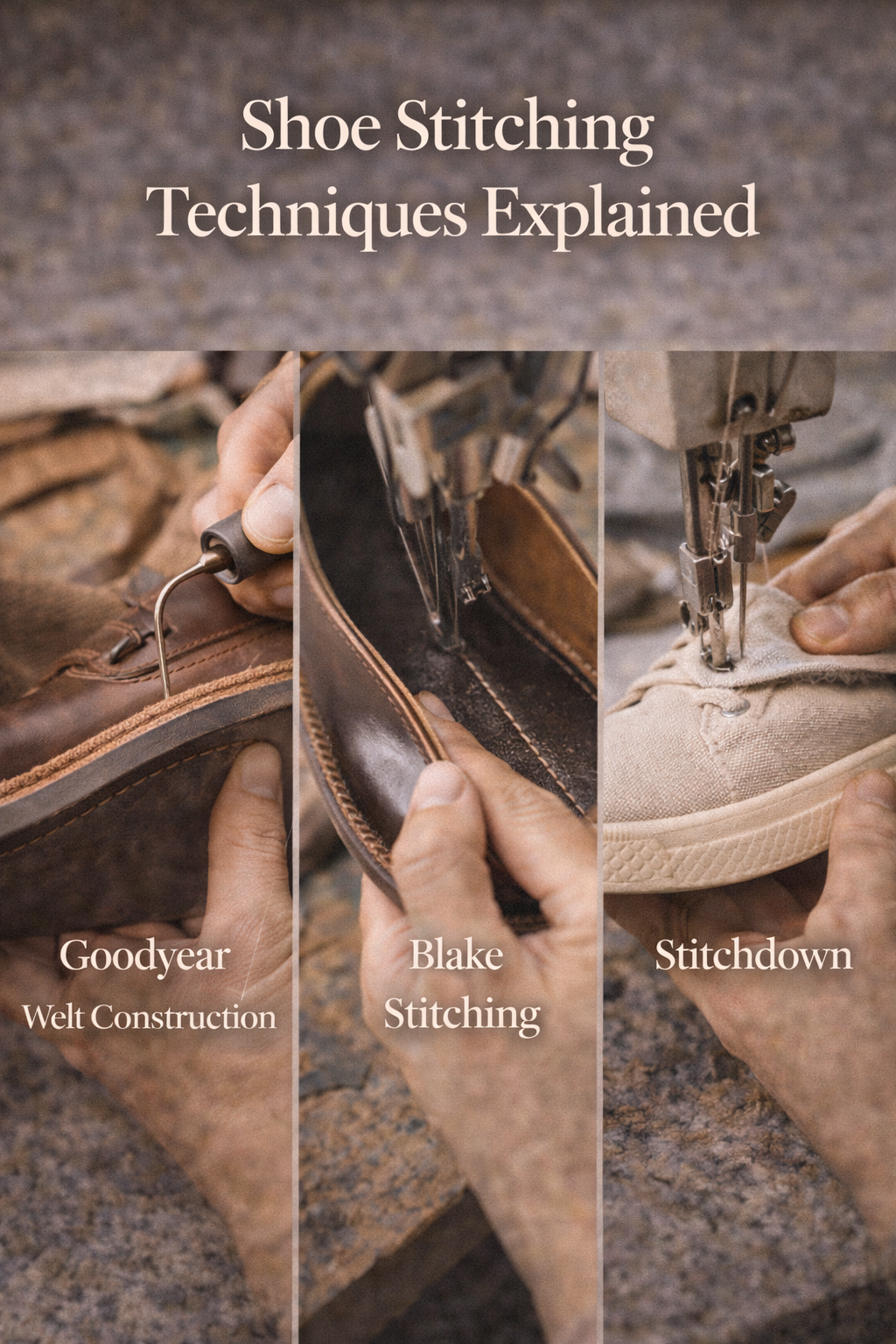
A line of stitching can hold parts of a shoe together, add decoration or do both. To understand a pair, look at where the stitches sit and ask what they connect. A visible seam alone does not tell you everything about the construction or how long the shoe will last.
Upper seams and decorative details
Upper stitching can join panels, linings or reinforcements. Decorative stitching may follow an edge or create a pattern without attaching the sole. Examine whether seams are even and whether loose threads or rubbing points are present, but remember that the parts hidden inside matter too.
The shoe anatomy guide identifies the upper, insole and outsole.
How stitching can be used in construction
Welted construction: A welt is a strip used in some methods of joining the upper and sole. Exact structures vary by maker and model; not every visible stitch around the edge proves a particular welt construction.
Blake stitching: In a Blake-stitched shoe, a stitch joins the sole and upper assembly through the shoe. A repairer can assess whether a specific pair can be resoled and what equipment it needs.
Strobel construction: A fabric layer can be stitched to the bottom edge of the upper before the sole is attached. This does not mean the outsole itself is necessarily stitched on.
Adhesive attachment: Cemented construction uses adhesive to attach components. It is not a stitching technique, although a cemented shoe can still have stitched upper panels. Our glue versus stitching guide compares the methods.
Does stitching guarantee durability or repairability?
No. Materials, workmanship, use, care and design all matter. Some stitched shoes can be resoled; some cannot be repaired economically, and some adhesive constructions can be repaired. Ask a manufacturer or local repairer about the specific model and the likely cost.
For dress shoes, the formal shoe construction guide explains the relationship between lasts, soles and attachment.
What to check when buying
Look for tidy seams and securely attached parts. Flex the shoe gently where it is meant to bend, check fit in both shoes, and read care instructions. If repair is a priority, ask how the outsole is attached and whether replacement parts or repair services are available.
Common questions
Does more stitching mean a better shoe? Not necessarily. The placement and purpose of the stitching matter more than the visible amount.
Are machine-stitched shoes inferior? No. Both hand and machine methods can be used well or poorly.
Can I identify a welt by sight alone? Not reliably. Confirm the construction with the maker or a knowledgeable repairer.



Leave a Reply