

Cricket has always held a sacred place in the hearts of millions, operating almost like a religion in certain parts of the world. When the Indian Premier League launched in 2008, it revolutionized the sport, bringing together international superstars, glamorous franchises, and unprecedented financial backing. Fans embraced the fast-paced action of T20 cricket. The tournament quickly became an annual festival of sports entertainment.
However, beneath the bright stadium lights and roaring crowds, a darker underbelly threatened to destroy everything the league had built. In 2013, a massive scandal broke out, sending shockwaves through the cricketing community. Police arrested players in the middle of the night. High-ranking team officials were heavily scrutinized. The very foundation of the tournament was shaken to its core.
The integrity of the sport was questioned, leaving fans wondering if the dramatic finishes they cheered for were genuine or scripted. This incident forced a massive reckoning within the sport’s governing bodies. To understand how the league survived and eventually thrived, we must examine the events that unfolded during this turbulent period.
What Is Spot-Fixing in Cricket?
Understanding the mechanics of cricket corruption is essential to grasping the severity of the 2013 crisis. While many fans are familiar with general match manipulation, the specific methods used by illegal syndicates are highly calculated.
Difference Between Match-Fixing and Spot-Fixing
Match-fixing involves manipulating the final outcome of a game, ensuring a specific team wins or loses. Spot-fixing is entirely different and far more insidious. Instead of rigging the final result, spot-fixing targets specific moments or “spots” within a match. A bowler might deliberately bowl a no-ball on the third delivery of their second over, or a batsman might intentionally score fewer than three runs in a specific over.
Because these actions do not necessarily alter the final match result, spot-fixing is significantly harder to detect. A single wide ball or a dropped catch can easily be dismissed as a simple athletic error. Bookmakers exploit these micro-moments, allowing gamblers to place massive bets on highly specific occurrences.
History of Fixing in Cricket
Cricket unfortunately has a long history with betting syndicates. The late 1990s and early 2000s saw massive match-fixing scandals that led to life bans for high-profile international captains. Hansie Cronje and Mohammad Azharuddin were famously implicated in widespread corruption.
Even after strict anti-corruption units were established, the problem persisted. In 2010, the cricket world was rocked when three Pakistani players were caught spot-fixing during a Test match against England. This incident proved that illegal betting networks were still actively infiltrating the sport. Growing concerns before 2013 suggested that the lucrative T20 leagues were becoming prime targets. To learn more about the specific guidelines players must follow today, review the IPL Rules and Regulations Explained.
IPL 2013 – The Context Before the Scandal
To fully comprehend the impact of the 2013 crisis, one must look at the immense success the tournament enjoyed leading up to that fateful season.
Growth of Indian Premier League (2008–2012)
Between 2008 and 2012, the league experienced a massive popularity surge. The combination of Bollywood glamour, corporate investment, and elite cricketing talent created an unstoppable entertainment juggernaut. Stadiums were consistently sold out. Television ratings broke records year after year.
This financial boom transformed the landscape of professional cricket. Players who previously earned modest domestic salaries became overnight millionaires. Franchises turned into highly profitable entities, and the governing board established itself as the richest body in world cricket.
Increasing Betting Influence
Where money flows, illegal elements often follow. The rise of illegal betting networks grew parallel to the league’s success. Billions of dollars were illegally wagered on matches in underground markets across Asia.
The vulnerabilities in the T20 format made it particularly susceptible to manipulation. With matches decided in a matter of hours and momentum shifting every single delivery, bookmakers found endless opportunities to create betting markets. Understanding the financial mechanics of the tournament provides further context, as detailed in How IPL Makes Money.
The 2013 Spot-Fixing Scandal – What Happened?
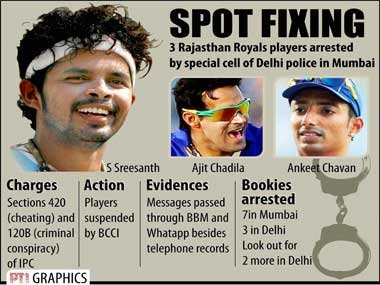
The bubble finally burst in May 2013. Delhi Police intercepted phone calls between bookies and players, leading to a dramatic sting operation that changed the sport forever.
Arrest of Players
The authorities arrested three players from the Rajasthan Royals franchise: S. Sreesanth, Ajit Chandila, and Ankeet Chavan. Sreesanth was a prominent fast bowler who had won two World Cups with the Indian national team. His involvement left fans completely stunned.
Chandila and Chavan were domestic players who allegedly agreed to underperform during specific overs. Police raids produced cash, laptops, and mobile phones, providing a mountain of evidence against the accused cricketers.
Role of Bookmakers
The investigation revealed a deeply entrenched network of betting syndicates. Bookmakers had approached players with specific demands. They organized pre-decided no-balls and overs where a guaranteed number of runs would be conceded.
To signal the bookies that a fixed over was about to begin, players allegedly used physical cues. Tucking a towel into their trousers or performing a specific stretching routine served as confirmation that the fix was on.
Impact on Rajasthan Royals
The Rajasthan Royals had built a reputation as the ultimate underdog team. They were celebrated for discovering raw talent and playing with high integrity under the leadership of Rahul Dravid. The scandal severely damaged this reputation. The franchise faced immediate suspension threats and deep public scrutiny. Fans can explore the histories of all franchises in the IPL Teams Complete Guide.
The Bigger Controversy – Franchise-Level Allegations
While the player arrests were shocking, the scandal quickly escalated far beyond the actions of three individuals on the field. The investigation soon reached the highest levels of team management.
Chennai Super Kings & Rajasthan Royals Issues
Police investigations implicated team officials from two of the league’s most successful franchises. Gurunath Meiyappan, a key official of the Chennai Super Kings, and Raj Kundra, co-owner of the Rajasthan Royals, were accused of being in contact with illegal bookmakers.
The allegations involving team officials crossing the line from management into illegal betting operations threatened to delegitimize the entire tournament.
Governance Crisis in Board of Control for Cricket in India
The scandal triggered a massive governance crisis. Gurunath Meiyappan was the son-in-law of N. Srinivasan, the president of the Board of Control for Cricket in India (BCCI) at the time. This massive conflict of interest led to intense leadership scrutiny. Critics demanded Srinivasan’s resignation, arguing that a fair investigation was impossible while he remained in power. You can read more about these administrative shifts in the IPL Governance and Management Evolution.
Supreme Court Intervention & Lodha Committee
The governing body’s failure to handle the crisis internally led to the highest judicial authority stepping in to clean up the sport.
Investigation and Findings
The Supreme Court of India took control of the situation. They established an independent probe, leading to the formation of the Lodha Committee. Headed by former Chief Justice R.M. Lodha, this panel was tasked with determining punishments and recommending structural changes to the cricket board.
Major Decisions
The Lodha Committee delivered massive verdicts. They handed down two-year bans on CSK and RR, suspending the franchises from participating in the 2016 and 2017 seasons. Meiyappan and Kundra received life bans from all cricket-related activities. The committee also demanded sweeping structural reforms to the BCCI to ensure transparency and prevent future conflicts of interest. These adjustments are documented in the IPL Rules and Reforms After 2013.
Impact of the Scandal on IPL
The immediate aftermath of the scandal left the tournament fighting for its survival.
Loss of Credibility
The league suffered a catastrophic fan trust decline. Spectators watched matches with deep suspicion, wondering if dropped catches or poor bowling performances were genuine mistakes or paid actions. Sponsor concerns grew rapidly. Major brands hesitated to associate their products with a property stained by corruption and legal battles.
Financial and Brand Impact
The media narrative surrounding the tournament turned overwhelmingly negative. Headlines focused on police investigations and court hearings rather than big hits and thrilling victories. The risk of collapse was genuinely high. If broadcasters pulled out or major sponsors abandoned the league, the financial model would have shattered entirely. Track how the league navigated these economic hurdles through the IPL Brand Value Growth.
How IPL Recovered from the Crisis
Despite the dire circumstances, the league’s organizers took necessary steps to reform and rebuild the tournament from the ground up.
Governance Reforms
The governing board implemented massive transparency improvements. They brought in independent auditors and completely restructured their operational hierarchy to comply with the Lodha Committee’s mandate. Strict anti-corruption measures were established. Players were required to attend educational seminars on the dangers of betting syndicates, and team hotel security was drastically upgraded.
Return of Suspended Teams
The comeback of CSK and RR in the 2018 season marked a major turning point. Rather than rejecting the returning franchises, the audience welcomed them back warmly. Chennai Super Kings went on to win the 2018 championship, completing a fairytale fan revival that helped wash away the lingering negativity of the previous years. Discover more about this era in the IPL Comeback Stories and Milestones.
Lessons Learned from the 2013 Scandal
The crisis served as a harsh wake-up call for cricket administrators around the globe.
Importance of Integrity in Sports
The scandal highlighted that without absolute integrity, a sporting competition is meaningless. The league drastically expanded its anti-corruption units, placing dedicated integrity officers with every franchise. These officers monitor communications, track suspicious individuals, and provide a safe space for players to report illegal approaches.
Strengthening League Structure
Administrators implemented rigid policy changes regarding team ownership and board management. Comprehensive monitoring systems are now active during every match, tracking betting market fluctuations to detect any anomalous behavior on the field. These protocols lay the foundation for the Future of IPL After 2026.
IPL Today – Stronger Than Ever
More than a decade after the scandal, the tournament has not just survived; it has reached unprecedented heights.
From Crisis to Dominance
The growth post-2015 has been astronomical. The league secured broadcast rights deals worth billions of dollars, firmly establishing itself as one of the most valuable sporting properties on the planet. Global expansion continues as the brand influences T20 leagues worldwide.
Trust Rebuilding
Through strict governance and a renewed focus on the cricket itself, the league achieved massive brand recovery. Fan engagement is at an all-time high. The 2013 spot-fixing scandal remains a dark chapter, but the aggressive reforms it triggered ultimately saved the sport, ensuring a transparent and thrilling product for future generations. Prepare for the upcoming seasons with the IPL 2026 Complete Guide.
Leave a Reply