

For thousands of years, footwear was designed with a singular, simple purpose: protection. A slab of leather or wood stood between the human foot and the rugged terrain. While this protected the skin from cuts and extreme temperatures, it did little to spare the skeleton from the jarring impact of every step.
The modern sneaker has changed that equation entirely. Today, what lies beneath your foot is a marvel of engineering—a complex system of foams, gels, and pressurized gases designed to manipulate physics. The midsole has become the engine room of the shoe, responsible for absorbing shock, returning energy, and correcting stride mechanics.
Understanding these technologies is no longer just for marathon runners or sneakerheads. Whether you are standing on concrete all day, training for a 5K, or simply looking for a sneaker that looks good with jeans, the cushioning technology inside plays a pivotal role in your daily comfort and long-term joint health. This guide explores the mechanics, materials, and future of what keeps you moving.
[Read Here Evolution of Shoes]
[Read Here Understanding Shoe Soles and Midsoles]
How Cushioning Works in Shoes
At a casual glance, a thick sole looks like a simple pillow for the foot. However, the mechanics of cushioning are far more active than passive. When you walk or run, you generate ground reaction forces. Without cushioning, that force reverberates up through your ankles, knees, and hips. Modern cushioning systems manage this energy through three distinct phases: shock absorption, energy return, and stability.
Shock Absorption Basics
Newton’s third law states that for every action, there is an equal and opposite reaction. When a runner strikes the pavement, the pavement strikes back with equal force. Shock absorption is the process of dissipating that force before it reaches the skeletal system.
Cushioning materials compress upon impact. This compression slows down the deceleration of the foot, spreading the force over a longer period and a wider surface area. By extending the duration of the impact—even by milliseconds—the peak force transferred to the body is significantly reduced. This is the primary function of soft, plush foams found in recovery footwear and maximalist running shoes.
Energy Return and Responsiveness
While shock absorption is about dampening force, energy return is about recycling it. If a material absorbs too much energy (like walking in dry sand), it feels “dead” or sluggish, requiring more muscular effort to lift the foot for the next step.
Responsive cushioning acts like a spring. When the material compresses, it stores potential energy. As the foot rolls forward to push off, the material quickly expands back to its original shape, releasing that stored energy to propel the runner forward. High-performance running shoes prioritize this “pop” or “bounce,” helping athletes maintain speed with less fatigue.
Stability and Support
There is a delicate balance between softness and stability. A shoe that is too soft can be unstable, causing the foot to wobble or the ankle to roll inward (overpronation). Cushioning technologies must provide a stable platform.
Engineers achieve this by manipulating the density of the foam. Firmer compounds are often placed on the medial (inner) side of the midsole to prevent the arch from collapsing, while softer compounds remain on the lateral side for comfort. This zoning allows the shoe to guide the foot through a neutral stride without feeling like a rigid brick.
[Also See Parts of a Shoe Anatomy Guide]
Types of Cushioning Technologies
The quest for the perfect balance of soft, light, and durable has led to a variety of material innovations. While marketing teams invent flashy names for these compounds, they generally fall into four main categories.
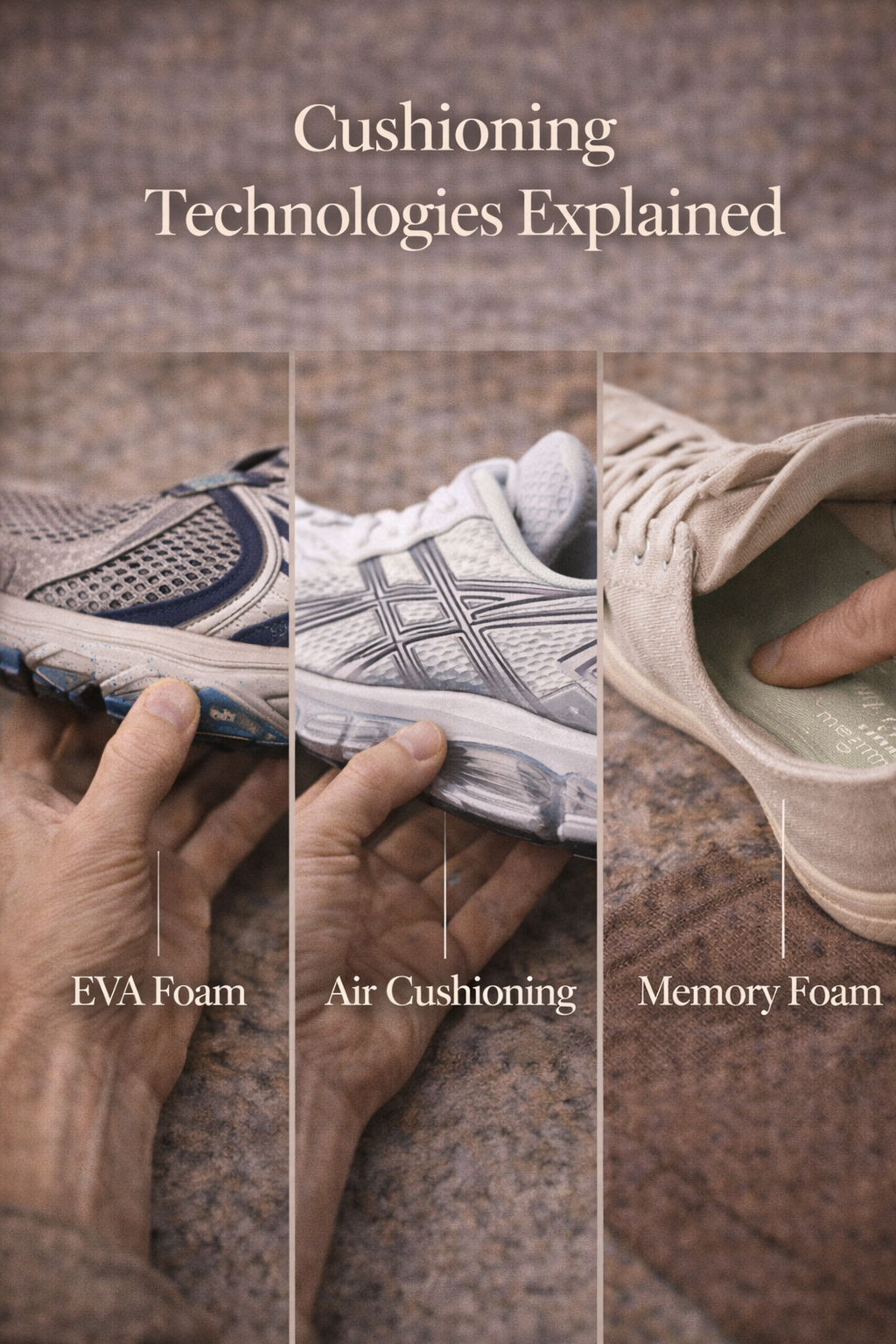
EVA Foam (Ethylene-Vinyl Acetate)
EVA has been the industry standard for decades. It is a polymer that is expanded into a foam, filled with tiny air bubbles.
- Pros: It is lightweight, easy to mold, and cost-effective.
- Cons: Over time, the air bubbles inside the foam collapse permanently. This is why an old pair of running shoes feels hard and flat; the EVA has “packed out.”
Despite its age, EVA remains popular because it is reliable. Modern variations, such as compression-molded EVA (CMEVA) or injection-molded EVA (IMEVA), offer improved durability and specific density tuning for different sports.
TPU and Advanced Foam Compounds
Thermoplastic Polyurethane (TPU) represented a massive leap forward in midsole tech. Often seen as fused beads (resembling styrofoam, though much stronger), TPU is unique because of its elasticity and temperature resistance.
- Performance: Unlike EVA, which can get hard in freezing weather and mushy in heat, TPU maintains its feel across climates.
- Durability: It is incredibly resilient. It resists compression set, meaning it keeps its “bouncy” feeling for hundreds of miles longer than standard foams.
- Feel: It offers a distinct springy sensation, providing high energy return that changed the running industry’s expectations for performance footwear.
Air Cushioning Systems
Instead of relying solely on solid materials, some manufacturers trap pressurized gas inside durable urethane pouches.
- The Concept: Gas does not break down or lose its shape like foam does. As long as the bag doesn’t pop, the cushioning remains consistent from the first step to the last.
- Weight: Since gas is lighter than solid foam, these systems can reduce the overall weight of the shoe while maintaining substantial impact protection.
- Application: You will often see these units visible in the heel or forefoot, serving as both a functional shock absorber and a bold aesthetic choice.
Gel and Hybrid Technologies
Gel systems use semi-fluid silicone-based substances encapsulated within the midsole.
- Function: Gel is excellent at absorbing shear forces—the horizontal friction that occurs when the foot strikes the ground. It creates a smooth transition from heel to toe.
- The Hybrid Approach: Because gel is heavy, it is rarely used for the entire sole. Instead, it is strategically placed in high-impact zones (like the heel) and surrounded by lighter foam to keep the shoe agile.
[Read Here How Shoes Are Made]
Cushioning and Shoe Silhouettes
The technology inside a shoe inevitably dictates what it looks like on the outside. As cushioning systems have become more advanced, they have dramatically altered the silhouettes of modern footwear.
Chunky Platform Designs
The “maximalist” trend—characterized by towering stack heights and oversized midsoles—is a direct result of foam innovation. Brands discovered that by using lighter-weight foams, they could double the thickness of the sole without making the shoe feel like an anchor. Visually, this creates a bold, chunky aesthetic that dominates street style, but the primary driver is the desire for a plush, cloud-like underfoot experience.
Minimalist Cushioning Trends
On the other end of the spectrum is the minimalist movement. Proponents argue that excessive cushioning dampens the sensory feedback (proprioception) the feet send to the brain. These silhouettes feature ultra-thin midsoles designed to offer just enough protection from puncture wounds while allowing the foot to move and flex naturally. The profile is sleek, low-to-the-ground, and unobtrusive.
Athletic vs Lifestyle Profiles
Performance running shoes often feature aggressive geometries, such as “rocker” soles that curve upward at the toe and heel to propel the runner forward. This gives the shoe a feeling of constant motion, even when standing still.
Lifestyle sneakers, however, prioritize stability and style over forward propulsion. The cushioning is often tuned to be softer for walking speeds, and the silhouette is flatter to look better with casual clothing like denim or chinos.
[Read Here Shoe Silhouettes Explained]
Choosing the Right Cushioning for Your Lifestyle
More cushioning isn’t always better. The “best” shoe depends entirely on how you plan to use it. Matching the technology to the activity prevents fatigue and injury.
Running and Training Shoes
Running generates forces up to three times your body weight. Here, specialized foam is non-negotiable.
- Long Distance: Look for maximal cushioning with high energy return to save your legs over many miles.
- Sprinting/Speed: Look for firmer, responsive foams that react quickly.
- Gym/Lifting: Avoid thick, squishy cushioning. You need a firm, flat midsole to drive power into the ground and maintain balance during squats or deadlifts.
Everyday Casual Wear
For a shoe worn to the office, the grocery store, or on a walk, durability and moderate softness are key. Super-soft racing foams can be unstable for standing around and may wear out quickly on concrete. Polyurethane (PU) midsoles or standard EVA offer a great blend of all-day support and durability for lifestyle wear.
Formal and Minimal Shoes
Traditionally, dress shoes had zero cushioning—just a leather insole on a wooden or leather stacked heel. This is changing. Many modern dress shoes now incorporate sneaker-like technology, hiding EVA layers or gel pods inside classic leather silhouettes. If you walk to work but need to dress formally, look for “hybrid” dress shoes that utilize these hidden comfort technologies.
[Also See How to Choose the Right Shoes for Your Lifestyle]
Sustainability in Cushioning Materials
The footwear industry faces a significant challenge: most cushioning foams are plastics derived from petroleum. They are difficult to recycle and can persist in landfills for centuries. However, material science is pivoting toward greener solutions.
Recycled Foam Innovations
Many brands are now grinding down manufacturing waste—leftover scraps of foam—and reforming them into new midsoles. While this often results in a “speckled” aesthetic, it significantly reduces the amount of virgin plastic required to make a shoe.
Bio-Based Cushioning
The cutting edge of sustainable cushioning involves replacing petroleum with plants. Foams derived from sugarcane, castor beans, and even algae biomass are hitting the market. These bio-based foams offer performance characteristics nearly identical to traditional EVA but with a fraction of the carbon footprint.
Future Eco Technologies
Researchers are currently developing foams that are fully biodegradable or designed for circularity—meaning the shoe can be chemically broken down and turned back into a new shoe at the end of its life, creating a zero-waste loop.
[Read Here Sustainable Shoe Materials Guide]
The Future of Cushioning Technology
We are moving beyond simple blocks of foam. The future of cushioning is personalized, intelligent, and adaptive.
AI and 3D Printing
Generative design software and 3D printing are allowing brands to create lattice structures that were previously impossible to mold. Instead of a solid block of foam, the midsole is a complex web of struts. By tweaking the thickness of these struts, engineers can precisely tune the cushioning for specific areas of the foot—softer under the heel, firmer under the arch—all in a single printed piece.
Adaptive Cushioning Systems
Imagine a shoe that changes how it feels based on what you are doing. Emerging “smart” cushioning concepts utilize magneto-rheological fluids or mechanical systems that can sense impact data in real-time. These shoes could stiffen up instantly for a sprint and soften immediately when you slow down to a walk.
[Read Here The Future of Shoes: Technology & Innovation]
Cushioning as the Engine of Modern Footwear Comfort
We have come a long way from hard leather soles. Today, cushioning technology is the defining feature of functional footwear, dictating how a shoe performs, how long it lasts, and how it protects your body.
Whether it is the snap of a nitrogen-infused foam, the reliability of EVA, or the lattice structure of a 3D-printed sole, the technology under your feet is working hard with every step. By understanding the mechanics of shock absorption and energy return, you can make smarter choices, selecting footwear that doesn’t just look the part, but actively supports your lifestyle.
[Read Here Complete Guide to Types of Shoes]
Leave a Reply