

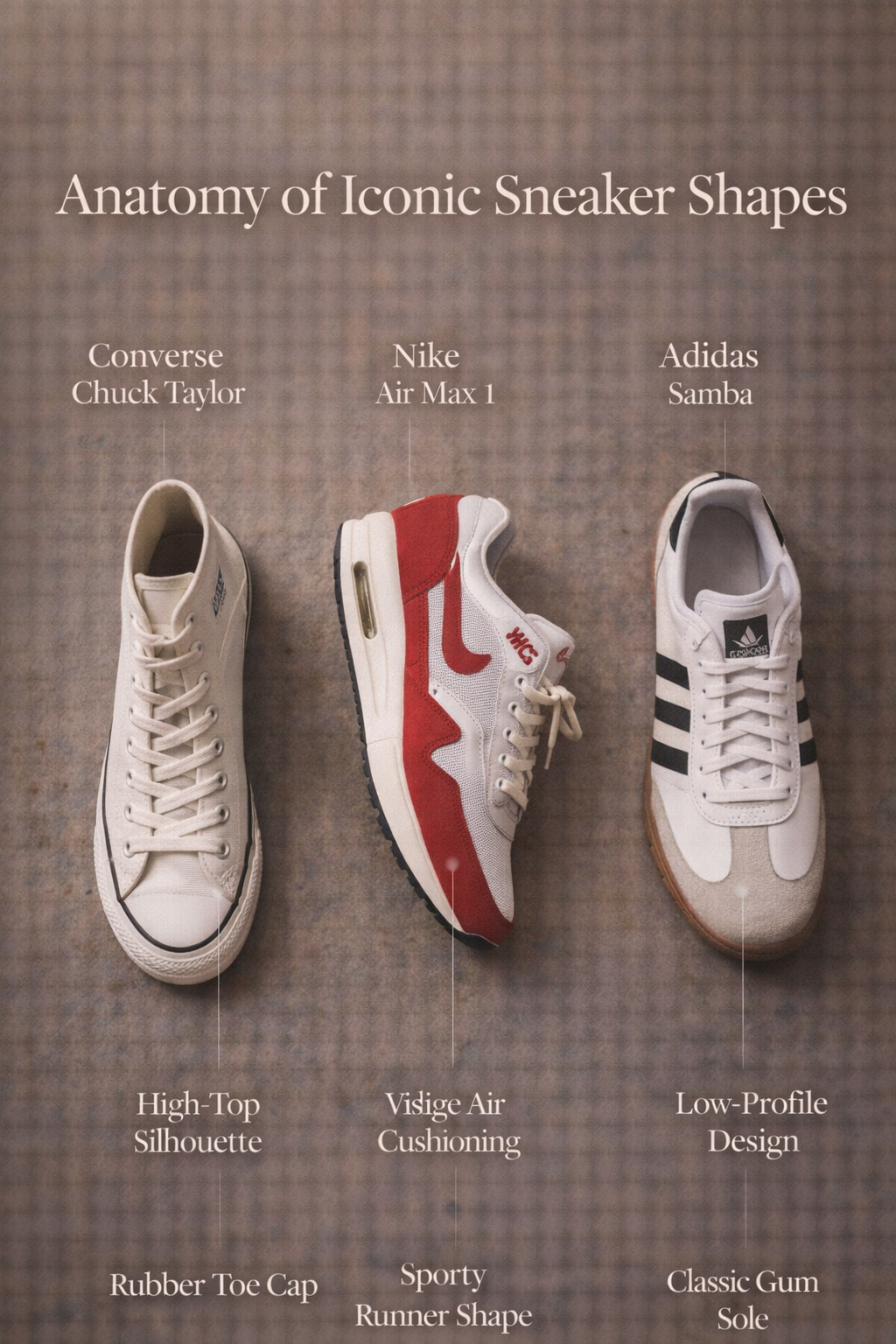
Close your eyes and picture a classic basketball shoe from the 1980s. Now, picture a modern marathon runner. You didn’t need to visualize a logo, a specific colorway, or a price tag to see the difference. You saw the shape.
In the footwear industry, this is known as the silhouette. It is the shadowy outline that defines a sneaker’s character before a single stitch is sewn. While colorways generate hype and collaborations drive resale prices, the anatomy of the shoe—its structural DNA—is what secures its place in history.
From the vulcanized rubber soles of the early 20th century to the 3D-printed lattices of today, the physical structure of a sneaker tells a story of engineering, culture, and utility. Understanding this anatomy isn’t just for designers; it is essential for anyone who wants to understand why some shoes fade away while others become icons.
Why Certain Sneaker Shapes Become Iconic
The longevity of a sneaker is rarely determined by its marketing campaign. It is determined by its bones.
When we talk about the “identity” of a shoe, we are referencing its silhouette. This outline acts as a visual anchor. It allows a design to be reimagined thousands of times—changed from leather to canvas, from white to neon green—without losing its soul. The silhouette creates a lineage.
Think about the most recognizable sneakers in history. They possess a design consistency that transcends generations. A low-profile tennis shoe from the 1970s communicates “casual luxury” just as effectively today as it did fifty years ago. A bulky, high-top basketball shoe communicates “power and protection.” This is because the anatomy of the shoe was built to solve a problem, and over time, that solution became a style.
Anatomy provides the foundation of recognition. When the structural elements—the toe box, the heel counter, the arch—are balanced perfectly, the shoe becomes timeless. It stops being a product and starts being a piece of design history.
[Evolution of Shoes Through History]
Core Elements That Define Sneaker Anatomy
To understand the whole, you must understand the parts. A sneaker is an assembly of disparate materials engineered to move with the human foot. While there are dozens of components in a standard shoe, four key structural elements dictate the final silhouette.
Toe Shape and Front Profile
The toe box is the handshake of the sneaker—it is the first thing you notice. The shape of the toe defines the “speed” of the shoe. A sharp, tapered toe box, often found in vintage runners, suggests forward momentum and agility. It cuts through the air visually. Conversely, a rounded, bulbous toe box, common in court shoes and work boots, implies stability, grounding, and durability.
Designers obsess over the “mudguard”—the piece of material wrapping the toe. The height and curve of this element can completely change the front profile. A high mudguard makes the shoe look aggressive and utilitarian; a low profile makes it look sleek and refined.
[Toe Shapes in Shoes Explained]
Midsole Thickness and Cushioning
The midsole is the engine room. It sits between the insole and the outsole, providing cushioning and energy return. However, structurally, it dictates the visual weight of the sneaker.
In the 1970s, midsoles were razor-thin slabs of rubber. By the 1990s, the introduction of encapsulated gas and high-density foams turned midsoles into architectural statements. A thick midsole creates a “chunky” silhouette that dominates the eye, anchoring the wearer. A slim midsole creates a “low-profile” look that feels closer to the ground. This thickness is the primary battleground for the shift between minimalism and maximalism.
[Sole Thickness and Style Impact]
Heel Structure and Support
The rear of the shoe is responsible for locking the foot in place, but it also balances the visual design. The heel counter—a plastic or cardboard insert—provides the shape.
Anatomy here is about angles. A heel that slants forward looks fast. A heel that stands vertical looks sturdy. In modern designs, the heel often extends past the back of the foot (a “spoiler”), extending the silhouette and giving the shoe a futuristic, aerodynamic aesthetic.
Collar Height and Ankle Design
The collar is where the shoe meets the body. It dictates how pants fall and how the leg is perceived.
- High-Top: extends over the ankle bone. It shortens the leg visually but creates a unified line from calf to floor.
- Mid-Top: sits right at the ankle. It is the hybrid choice, offering support without the restriction of a full boot.
- Low-Top: sits below the ankle. It elongates the leg and is generally viewed as the most casual and versatile option.
The padding around the collar also matters. A deconstructed, thin collar feels vintage and raw. A heavily padded collar feels technical and skate-inspired.
Classic Sneaker Shapes and Their Design Features
History has filtered millions of designs down to a few archetypes. These classic shapes serve as the templates for almost all modern footwear.
High-Top Basketball Silhouettes
The high-top basketball sneaker is perhaps the most culturally significant shape in American fashion. Anatomically, these shoes are built like fortresses. They feature high collars for ankle stability during lateral movements and wide, flat outsoles for maximum traction.
The design features are bold. Large panels of leather allow for color blocking, which is why these silhouettes became the canvas for team colors and eventually, streetwear expression. The shape demands attention; it does not hide under a pant leg.
[Classic Sneaker Silhouettes in History]
Retro Running Profiles
The “wedge” shape defines the retro runner. If you look at these shoes from the side, the heel is significantly higher than the toe, creating an aggressive downward slope. This anatomy was originally functional, designed to pitch the runner forward and relieve strain on the Achilles tendon.
Aesthetically, this creates a dynamic, sporty look even when standing still. The upper is usually a complex layering of mesh and suede, creating depth and texture that emphasizes the speed of the silhouette.
Minimalist Low-Top Designs
Born from tennis and maritime roots, the minimalist low-top is the study of restraint. The anatomy here is stripped back. The sole is flat and uniform. The upper is often a single piece of leather or canvas with minimal stitching.
The goal of this shape is invisibility. It is designed to complement an outfit rather than define it. The clean lines and lack of technical bulk make it the “chameleon” of sneaker shapes, acceptable in both boardrooms and skate parks.
[High-Top vs Low-Top Explained]
Chunky vs Minimal Anatomy in Modern Sneakers
The pendulum of fashion swings constantly between excess and restraint. In the sneaker world, this manifests as the war between the Chunky and the Minimal.
Oversized Midsole Structures
The “Dad Shoe” trend or the luxury sneaker market explosion brought oversized anatomy to the forefront. These shapes are defined by exaggerated midsoles that extend beyond the footprint of the wearer.
This is architectural brutalism for the feet. The structure is often layered, complex, and intentionally clunky. It challenges the traditional idea that a shoe should make the foot look smaller or more elegant. Instead, it treats the shoe as a sculpture that engulfs the foot.
[Oversized Sneaker Design Trend]
Slim Vintage Profiles
In direct contrast, we are seeing a resurgence of slim, vintage profiles—shoes originally designed for indoor sports or track in the 1970s. These shoes have almost no padding. The anatomy hugs the foot shape closely.
This silhouette appeals to a desire for authenticity and ease. There is no hidden technology, no air bubbles, no pumps. It is rubber and leather, shaped to the human foot.
Balance Between Function and Style
The most successful modern designs often find a middle ground. They take the comfort technology of a chunky runner—high-rebound foam, stability plates—and package it in a sharper, more aerodynamic silhouette. This balance creates a shoe that looks fast but feels soft, bridging the gap between performance gear and lifestyle fashion.
[Minimalist vs Chunky Shoe Trends]
Construction Techniques Behind Iconic Shapes
A silhouette is only an idea until it is manufactured. The way a shoe is put together—the construction—dictates its final shape just as much as the pattern pieces do.
Lasting Methods
Every shoe starts with a “last”—a mechanical form that mimics a human foot. The material of the upper is pulled tight over this last to give the shoe its shape.
- Board Lasting: The upper is glued to a stiff board at the bottom. This creates a stable, stiff shoe, often used in boots or stable court shoes.
- Slip Lasting: The upper is sewn together like a sock before being attached to the sole. This creates a flexible, soft shoe, common in running and casual wear.
The shape of the last determines the shape of the toe box and the arch. If a brand changes their last, they change the fit and the silhouette entirely.
[Lasting Process in Shoemaking]
Stitching and Panel Layout
Stitching is not just for holding pieces together; it is for structure. A shoe with many overlays (layers of material on top of each other) will hold its shape better than a shoe made of a single piece of knit fabric.
Strategic stitching acts like a skeleton. It prevents the leather from stretching out and losing the iconic silhouette over time. The placement of these panels creates the visual lines that our eyes follow—the “swooping” lines of a runner or the sharp angles of a basketball shoe.
[Shoe Stitching Techniques Explained]
Cushioning Technology
Technology changes anatomy. When air-based cushioning was invented, midsoles had to become taller and include windows to show off the tech. When knit uppers were invented, the silhouette became sock-like and form-fitting, eliminating the need for a tongue or heavy padding. The engineering inside the shoe often forces the exterior shape to adapt.
[Cushioning Technologies Explained]
Cultural Meaning Behind Iconic Sneaker Anatomy
Why do we feel nostalgia when we see a specific high-top silhouette? Why does a certain rubber toe cap remind us of rebellion?
Identity and recognition are tied to shape. Subcultures adopt specific silhouettes as part of their uniform. The canvas high-top became the symbol of punk rock and grunge. The chunky basketball shoe became the symbol of hip-hop and court dominance. The anatomy of the shoe absorbs the culture of the people wearing it.
Storytelling relies on these familiar shapes. When a designer wants to evoke the feeling of 1985, they don’t just use the colors of 1985; they use the bulky, stitched, rubber-soled anatomy of 1985. We have an emotional connection to these forms because they represent eras of our lives.
[The Psychology of Sneaker Culture and Modern Identity]
Why Silhouette Matters More Than Color or Branding
Here is the ultimate test of sneaker design: The Shadow Test.
If you paint the shoe entirely black and remove all logos, can you still name it? If the answer is yes, the silhouette is iconic.
A great silhouette does not need a logo to be recognized. The shape of the heel, the curve of the toe, and the height of the collar act as a signature. This is the “shape-first” design philosophy. Brands that rely too heavily on logos often fail to create lasting legacies. Brands that focus on distinct, owningable anatomy create shoes that last for decades.
[Why Silhouette Matters More Than Color]
The Future Anatomy of Sneaker Shapes
We are currently standing on the edge of a new era in sneaker anatomy. Traditional manufacturing—cutting leather and gluing it to rubber—is being challenged by new methods that will fundamentally change the shape of shoes.
AI-Generated Sculpted Designs
Artificial Intelligence is generating shapes that human designers would never conceive. These forms are organic, biomorphic, and complex. They look like coral reefs or muscle fibers rather than traditional shoes. As 3D printing becomes scalable, we will see silhouettes that are entirely seamless—one single piece of material printed in a complex lattice.
Sustainable Materials Shaping Structure
Sustainability is also forcing a change in anatomy. Mushroom leathers, recycled plastics, and algae foams behave differently than cowhide and virgin rubber. They drape differently; they age differently. Design structure will have to adapt to the properties of these new earth-friendly materials.
[Sustainable Shoe Materials Guide]
Futuristic Ergonomic Forms
The future is also ergonomic. We are moving away from shoes that force the foot into a shape, and toward shoes that are shaped like the foot. Wide toe boxes, zero-drop heels, and articulated soles are changing the “ideal” silhouette from a pointed fashion statement to a functional, anatomical tool.
Anatomy as the Blueprint of Iconic Sneakers
Fashion is fleeting, but structure is permanent. The sneakers that define our culture do so because they are built on a foundation of strong anatomy. They balance the technical requirements of the foot with the aesthetic desires of the eye.
Whether it is the aggressive stance of a sprinter or the relaxed posture of a skate shoe, the silhouette tells the story. By understanding the toe box, the midsole, and the construction techniques, we gain a deeper appreciation for the craft. We stop seeing just a shoe, and start seeing the blueprint of an icon.
Leave a Reply