

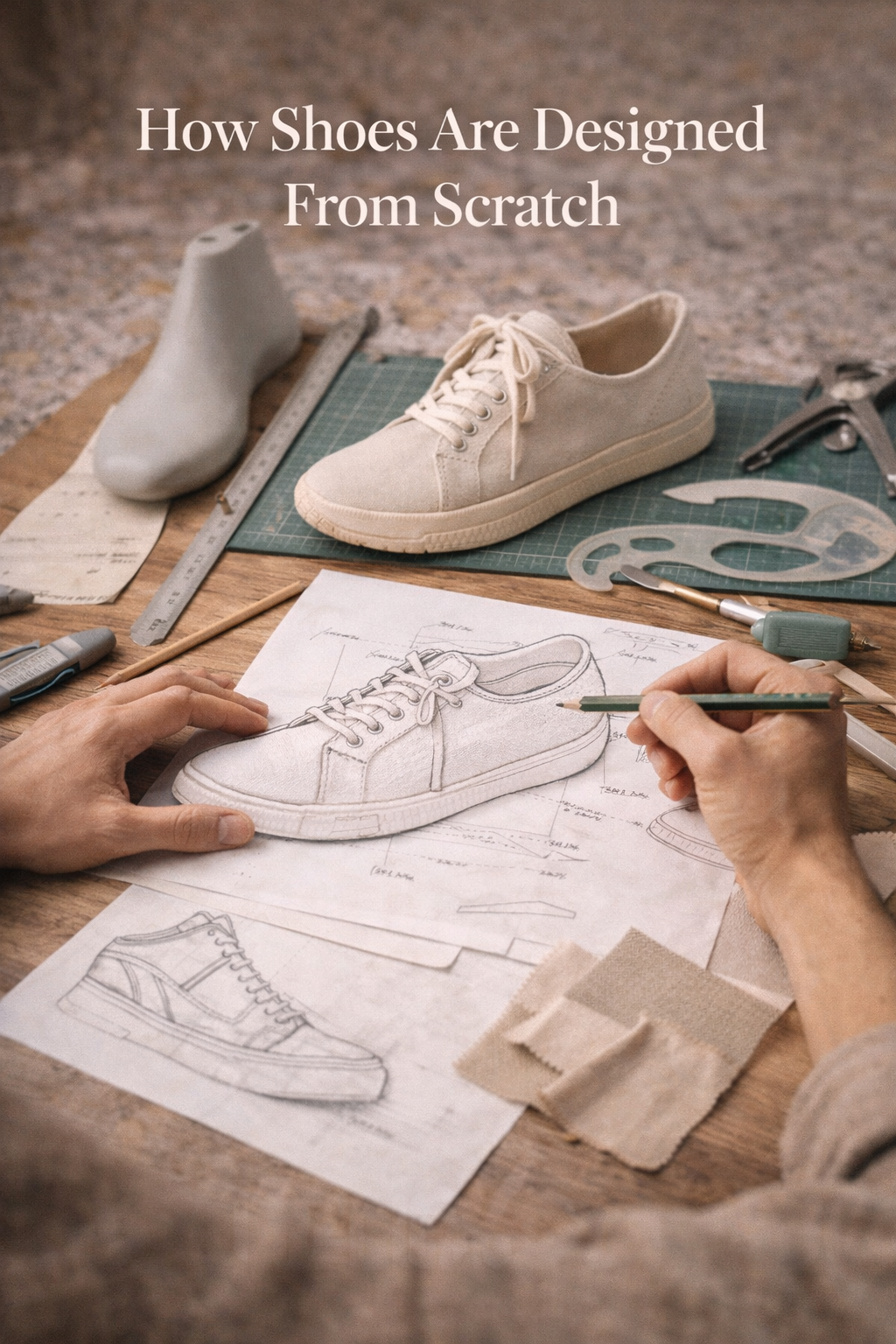
Before a sneaker hits the pavement or a stiletto graces a runway, it exists as a spark in a designer’s mind. We often think of shoes as purely physical objects—leather, rubber, and lace stitched together in a factory. However, the creation of footwear is a rigorous intellectual and artistic discipline that predates the assembly line by thousands of years.
Shoe design is where anatomy meets architecture. It is the delicate negotiation between the rigid demands of the human foot and the boundless possibilities of aesthetic expression. A shoe must support the body’s weight, endure friction and weather, and yet, it must also tell a story about the person wearing it.
Also See: How Shoes Are Made
In the modern footwear industry, the journey from a sketchbook doodle to a finished product is a complex symphony of creative vision, biomechanical engineering, and material science. This guide explores that journey, dissecting how an abstract concept transforms into a wearable reality.
The Creative Beginning of Every Shoe
Every great shoe begins with a problem to solve or a feeling to evoke. Whether it’s an ultra-lightweight runner for a marathon or a structural boot for high-fashion week, the design process is rarely linear. It is a cycle of observation, ideation, and refinement.
Historically, shoe design was a solitary craft. A cordwainer (a shoemaker who works with new leather) would measure a client’s foot and build the shoe directly around it. Today, the role of the designer has evolved. Modern footwear designers are part artist, part engineer, and part sociologist. They must understand the Evolution of Shoes to know where we’ve been, and they must grasp contemporary culture to know where we are going.
The design phase is the blueprint for everything that follows. It dictates the silhouette, the materials, and the eventual construction method. Without a solid design foundation, even the most advanced manufacturing technology cannot save a shoe from failure.
Step 1: Inspiration and Research
Long before a pencil touches paper, a designer immerses themselves in research. A shoe does not exist in a vacuum; it is a response to the world around it. This initial phase helps the design team establish a “mood” or a direction for the collection.
Cultural and Fashion Influences
Fashion is a reflection of the times. Designers look to art, architecture, music, and street culture for visual cues. A designer might be inspired by the brutalist lines of a concrete building, the organic curves of a leaf, or the color palette of a 1970s film.
This research often culminates in a “mood board”—a collage of images, textures, and colors that sets the emotional tone for the shoe. For example, a hiking boot collection might be inspired by “urban survival,” pulling rugged textures into a sleek, city-ready silhouette. This connection to culture helps explain Why Humans Care About Shoes beyond mere protection; we wear them to signal our identity.
Performance Needs
For athletic and functional footwear, research is data-driven. Designers must ask: What does the athlete need? A basketball player needs ankle support and shock absorption for hard landings. A sprinter needs minimal weight and maximum traction.
Designers study biomechanics, often working with sports scientists to understand how the foot moves during specific activities. They analyze heat maps of the foot to see where pressure is highest and study gait cycles to understand pronation. This research ensures that the final design isn’t just beautiful, but biomechanically sound.
Trend Forecasting
The fashion industry works on a calendar that is often 12 to 18 months ahead of the retail market. Designers must predict what colors, shapes, and materials will be desirable in the future.
Trend forecasting agencies provide reports on global consumer shifts. For instance, a rise in remote work might signal a trend toward “comfort-first” hybrids that blur the line between slippers and street shoes. By analyzing these shifts, designers ensure their creations land in the market at the exact moment consumers are ready for them.
Step 2: Sketching and Concept Development
Once the direction is set, the visualization process begins. This is where the shoe takes its first tentative form.
Hand Sketches
Despite the prevalence of digital tools, the humble sketchbook remains a designer’s most vital tool. Hand sketching allows for rapid ideation. A designer might sketch fifty variations of a heel counter or a toe box in an hour, searching for the perfect line.
These initial sketches are loose and gestural. They focus on the “gesture” of the shoe—the sense of speed, stability, or elegance it conveys. This is where the overall silhouette is established. The silhouette is the most recognizable aspect of a shoe; think of the profile of a Chuck Taylor or a Jordan 1. These shapes are defined early in the sketching phase.
Digital Design Tools
As concepts solidify, designers move to digital platforms. Software like Adobe Illustrator is used to create crisp, 2D line art (often called “CADs” or Computer-Aided Designs). These drawings are precise, showing the side view (lateral), top view, back view (heel), and sole (outsole).
In recent years, 3D modeling software has revolutionized this step. Programs like Rhino, Modo, or gravity-sketching VR tools allow designers to sculpt the shoe in virtual space. They can rotate the object, apply textures, and see how light hits the curves, saving time and reducing the need for physical sample waste.
Proportion and Silhouette Planning
A critical part of concept development is balancing proportion. A chunky outsole needs a substantial upper to look balanced; a delicate stiletto heel requires a sleek vamp. Designers play with the “collar height” (where the shoe hits the ankle) and the “toe spring” (how much the toe curves upward).
These decisions are crucial because they define the Shoe Silhouettes Explained. A high-top silhouette communicates protection and vintage sportiness, while a low-cut profile suggests speed and casual ease.
Step 3: Creating the Shoe Last
If the sketch is the soul of the shoe, the “last” is the body. The last is a mechanical form that resembles a human foot. It is the physical mold around which the shoe is constructed.
Foot Shape Modeling
A last is not a replica of a foot; it is an abstraction of it. It has been smoothed and stylized to create the desired toe shape and heel height. A last for a cowboy boot looks significantly different from a last for a ballet flat, even if they are for the same size foot.
Traditionally, lasts were carved from hard maple wood or beech. Today, they are typically made from high-density plastic or milled aluminum. The designer works with a “last maker” to translate the 2D sketch into this 3D volume.
Fit and Ergonomics
The geometry of the last dictates the fit. The “girth” (the measurement around the ball of the foot) must be precise. If the last is too narrow, the shoe will pinch. If the “instep” is too low, the foot won’t slide in.
Ergonomics are paramount here. The bottom of the last usually has a curve to mimic the foot’s arch and allow for the natural rocking motion of walking. This is where the Parts of a Shoe Anatomy Guide becomes practical reality; the last ensures the insole, outsole, and upper all align correctly with human anatomy.
Structural Balance
The last also determines the “heel drop” (the height difference between the heel and the toe). This is critical for balance. A high-heel last is designed with a steep pitch, shifting the weight distribution forward. The center line of the heel must be perfectly aligned with the center of the heel bone (calcaneus) to prevent the wearer from wobbling.
Step 4: Material Selection and Color Design
With the shape defined, the designer must choose the “skin” of the shoe. This is the CMF phase: Color, Material, and Finish.
Leather vs. Synthetic Materials
Material selection is a battle between durability, cost, and aesthetics.
- Leather: The traditional choice. Full-grain leather offers breathability and molds to the foot over time. It is durable but expensive and heavy.
- Synthetics: Materials like PU (polyurethane), mesh, and knits dominate the sneaker market. They are lightweight, consistent, and can be engineered for specific breathability or water resistance.
- Textiles: Canvas, denim, and wool offer textural variety and are often used in casual footwear.
Sustainability Considerations
Modern design is increasingly driven by environmental responsibility. Designers are now tasked with sourcing materials that have a lower carbon footprint. This includes recycled polyesters, plant-based leathers (like mushroom or pineapple leather), and biodegradable foams. The challenge lies in maintaining the durability consumers expect while reducing waste.
Texture and Visual Identity
Texture adds depth to a design. A shoe might be entirely black, but by mixing matte nubuck, glossy patent leather, and breathable mesh, the designer creates visual interest.
Colorways are also finalized here. A single shoe design might be released in five different color palettes to appeal to different customers. One colorway might be bold and neon for the “hype” consumer, while another is tonal and subtle for the mass market.
Step 5: Prototyping and Testing
The design is now a complete concept, but does it work? Prototyping is the process of turning the theoretical into the physical.
Sample Creation
The designer creates a “tech pack”—a detailed instruction manual for the factory. This document specifies measurements, materials, stitch types, and Pantone colors. The factory then produces a “first sample” or “pullover.”
This first sample is rarely perfect. The lines might look different in 3D than they did in the sketch. The toe might look too bulbous, or the collar might sit too high.
Fit Testing
The sample is put on a fit model—a person with the standard foot size for that brand (usually a US sample size 7 for women or 9 for men). The model walks, runs, and stands in the shoe. They provide feedback: Does the heel slip? Is the toe box tight? Is the arch support sufficient?
Performance Adjustments
For technical footwear, testing is rigorous. Shoes are put through flex tests (bending them thousands of times to see if the glue holds) and abrasion tests. If a running shoe causes blisters after mile three, the interior lining or seam placement must be redesigned. This iterative loop can happen three or four times before the design is approved.
Step 6: Final Design and Production Preparation
Once the “confirmation sample” is approved, the design is locked. The focus shifts from creativity to manufacturability.
Technical Specifications
The final tech pack is updated with every minute detail from the prototyping phase. This includes “grading” rules. Grading is the mathematical formula used to scale the shoe up and down sizes. A size 12 isn’t just a longer size 7; the proportions of the arch and width must change to support a larger foot.
Manufacturing Collaboration
Designers work closely with developers and factory managers to ensure the shoe can be mass-produced efficiently. A complex design element, like an intricate woven pattern, might be beautiful, but if it takes three hours to stitch by hand, it may be too expensive for the final price point. Design compromises are often made here to streamline How Shoes Are Made: Complete Guide.
Branding Elements
The final touches involve branding. Where does the logo go? Is it embossed, embroidered, or printed? The packaging box, the tissue paper, and the hangtags are also designed to ensure a cohesive unboxing experience.
The Future of Shoe Design
The process of designing shoes is currently undergoing its most significant shift since the Industrial Revolution.
AI-Assisted Design: Artificial Intelligence is beginning to assist in the ideation phase, generating hundreds of silhouette variations based on specific parameters, allowing designers to explore options they might not have conceived.
3D Printing: We are moving toward a future where the “last” might become obsolete for some shoes. 3D printing allows for lattice structures that can be printed directly, offering customized cushioning tuned to an individual’s weight and gait.
Circular Design: The future of design is circular. Shoes are being designed for disassembly, meaning they are constructed in a way that allows them to be easily taken apart and recycled at the end of their life, rather than glued together permanently.
For a deeper look into where technology is taking us, explore The Future of Shoes: Technology & Innovation.
Design as the Foundation of Every Shoe
The design process is the bridge between human need and human ingenuity. It turns raw materials into objects of desire and utility. When you lace up a pair of sneakers or slip into a pair of loafers, you are stepping into the result of hundreds of hours of research, sketching, and engineering.
A well-designed shoe is invisible to the wearer—it fits so well and functions so seamlessly that you forget it is there. Yet, visually, it makes a statement that can be seen from down the street. Understanding this process deepens our appreciation for the footwear we rely on every day. For a closer look at the different shapes that emerge from this process, visit our guide on Shoe Silhouettes Explained.
Leave a Reply