

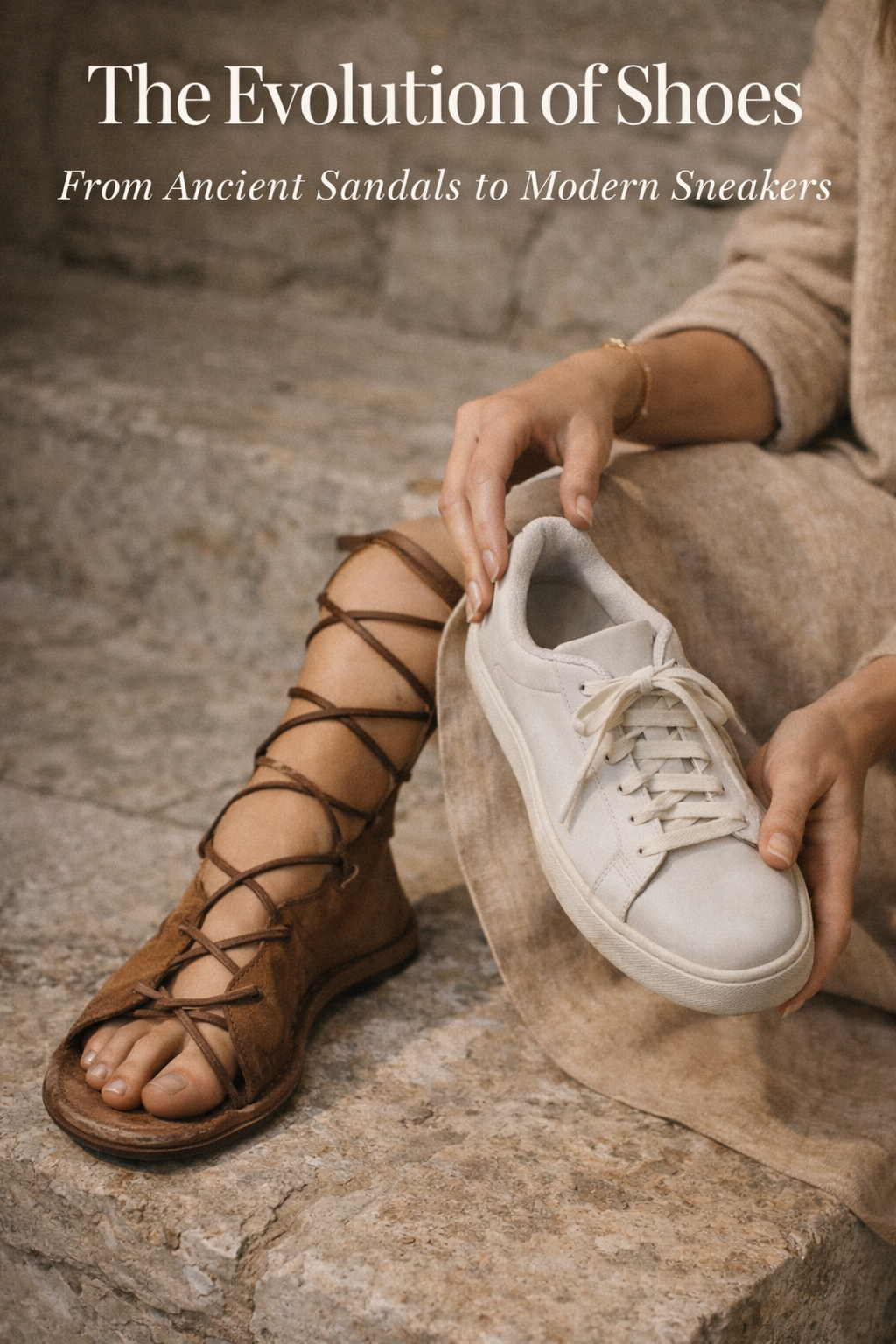
Look down at your feet. What do you see? Perhaps a pair of cushioned running shoes, sleek leather boots, or simple canvas slip-ons. Whatever protects your soles today is the result of thousands of years of engineering, cultural shifting, and artistic expression.
Footwear is arguably the most important accessory humans have ever invented. While clothing protects the body, shoes protect our mobility. Without them, early humans could not migrate across frozen tundras or navigate jagged terrains. Yet, somewhere along the timeline, shoes ceased to be mere survival tools. They transformed into symbols of power, rebellion, athletic prowess, and artistic identity.
The history of the shoe is the history of the human experience. It tracks our journey from the caves to the cobblestones of Rome, through the factories of the Industrial Revolution, and onto the concrete courts of urban metropolises.
As part of The Complete Human Shoes Evolution Project, this article explores that journey. We will examine how necessity birthed design, how social hierarchy dictated silhouette, and how modern technology is reshaping the future of what we wear.
Why the History of Shoes Matters Today
Understanding where our footwear comes from changes how we view modern fashion. The anatomy of a sneaker, the heel of a boot, and the strap of a sandal all carry DNA from centuries past.
Design evolution mirrors human lifestyle changes. When we rode horses, we invented heels to lock into stirrups. When we started playing basketball on hardwood floors, we invented vulcanized rubber soles for grip. Every feature on your current shoe likely originated as a specific solution to a historical problem.
By tracing these origins, we gain a deeper appreciation for the craftsmanship involved. Whether you are a collector, a designer, or simply someone who appreciates comfort, recognizing the lineage of your footwear connects you to a broader narrative of human innovation.
Recommended reading: [Link: Origin of Shoes] and [Link: Complete Guide to Types of Shoes]
The Earliest Footwear: Ancient Beginnings
The story begins not with fashion, but with friction. The earliest shoes were created solely to put a barrier between the soft human foot and the harsh environment.
Prehistoric Foot Protection
For prehistoric humans, footwear was a matter of life and death. The oldest known leather shoe, found in a cave in Armenia, dates back to around 3500 B.C. However, evidence suggests humans were wrapping their feet much earlier.
Otzi the Iceman, a mummy discovered in the Alps dating back to 3300 B.C., wore sophisticated footwear. His shoes featured a bearskin sole for durability, a deerskin top for flexibility, and a stuffing of dried grass for insulation, all held together by a netting of bark. This wasn’t primitive; it was advanced thermal engineering.
In warmer climates, the design focus was different. Native Americans in the Oregon region created sandals from sagebrush bark over 10,000 years ago. These designs prioritized breathability and protection from hot ground rather than insulation.
Egyptian and Roman Sandals
As civilizations settled, footwear began to signify more than just survival—it began to signify class.
In Ancient Egypt, the sandal was the standard. While commoners often went barefoot or wore simple sandals made of woven papyrus, the elite wore leather. Pharaohs were depicted wearing sandals with extended, upturned toes—a purely aesthetic feature that separated them from the working class.
The Roman Empire took footwear engineering to a military level. The caligae was a heavy-duty, hobnailed sandal boot worn by Roman legionaries. The open design allowed for ventilation during long marches, while the iron hobnails provided traction on rough terrain, acting essentially as the first cleats.
Conversely, indoors, Romans might wear the soccus, a loose-fitting slipper that is the linguistic and design ancestor of the modern sock. Even then, the distinction between “outdoor performance” and “indoor comfort” was being established.
Learn more about the foundation of footwear: [Link: Parts of a Shoe Explained]
Medieval and Renaissance Footwear
As Europe moved into the Middle Ages and the Renaissance, footwear became a primary method of signaling social status. This era saw a distinct split between the functional boots of the working class and the increasingly impractical shoes of the aristocracy.
Functional Boots and Protective Designs
For the peasant or the soldier, the leather boot was essential. It offered protection from mud, waste, and injury. However, specialized protective overshoes also emerged.
The “patten” was a wooden sole held onto the foot by leather bands, worn over normal shoes to elevate the wearer above the mud and grime of medieval streets. This was a precursor to the modern platform and the galosh, proving that protecting the shoe was just as important as protecting the foot.
Decorative Shoes and Social Status
The most famous example of fashion trumping function occurred in the 14th century with the Poulaine (also known as the Crackowe). These were soft leather shoes with incredibly long, pointed toes.
The length of the toe was strictly regulated by sumptuary laws. A prince could have a toe up to 24 inches long, while a commoner was restricted to a few inches. The tips were often stuffed with moss or wool to keep them stiff and were sometimes chained to the knee so the wearer could walk without tripping.
This was a clear message: “I am so wealthy and powerful that I do not need to perform manual labor or walk efficiently.”
Early Craftsmanship Techniques
During this period, shoemaking solidified as a skilled trade. Guilds were formed, and the “cordwainer” (a shoemaker who worked with new luxury leather from Cordoba, Spain) became a respected artisan.
Construction methods like the “turnshoe”—where the shoe was sewn inside out and then turned right-side out to hide the seams—became standard. This technique required immense skill and strength, laying the groundwork for the bespoke manufacturing processes we still see in high-end dress shoes today.
Discover the construction details: [Link: How Shoes Are Made]
Industrial Revolution: The Birth of Modern Shoemaking
If the Renaissance was about art, the Industrial Revolution was about scale. The 18th and 19th centuries completely dismantled the bespoke shoemaking process and rebuilt it into the industry we recognize today.
Standardized Sizing
It is difficult to imagine, but for most of human history, there was no difference between a left shoe and a right shoe. Shoes were made on “straight” lasts (the mold used to shape the shoe), meaning they were interchangeable and uncomfortable until broken in.
It wasn’t until the 1800s that “crooked shoes”—shoes specifically shaped for the left and right foot—became the standard. Alongside this came the standardization of sizing systems. Instead of a cobbler measuring your foot for a custom fit, factories could produce sizes 8, 9, and 10 in mass quantities. This democratization of fit made comfortable footwear accessible to the general public, not just the wealthy.
Mass Production
The invention of the sewing machine in 1846 was a catalyst, but the true revolution came with Jan Matzeliger. In 1883, Matzeliger, an inventor of African and Dutch descent, patented the “lasting machine.”
Previously, stretching the leather upper over the mold (lasting) could only be done by hand, limiting production to about 50 pairs a day. Matzeliger’s machine could produce up to 700 pairs a day. This drastically lowered the cost of shoes, making quality footwear available to the working class for the first time.
Rubber Soles and New Materials
Perhaps the most significant material innovation was the vulcanization of rubber by Charles Goodyear.
Before rubber, soles were made of leather or wood. Leather was slippery and water-permeable; wood was heavy and loud. Vulcanized rubber was waterproof, durable, flexible, and silent. This “silent” footfall led to the term “sneakers,” as the wearer could sneak up on someone without being heard. This material shift paved the way for the athletic shoe industry.
Explore the components of modern shoes: [Link: Parts of a Shoe Anatomy Guide]
The Rise of Athletic Shoes and Sneaker Culture
The 20th century saw the shoe pivot from a utilitarian item to a cultural icon. This shift was driven almost entirely by the athletic shoe.
Early Sports Footwear
In the late 19th and early 20th centuries, leisure time became more common, and with it, organized sports. The “Plimsoll,” a canvas shoe with a rubber sole, became a beachwear staple.
Companies began refining this design for performance. In 1916, Keds produced the first mass-market canvas sneaker. Shortly after, the Marquis Converse Rubber Shoe Company introduced the “All Star,” a shoe specifically designed for the new sport of basketball. These were tools of the trade, not fashion statements.
Basketball and Running Influence
The 1970s and 80s changed everything. Running became a global hobby, leading to the creation of brands like Nike (formerly Blue Ribbon Sports) and Adidas, who focused on biomechanics, cushioning, and weight reduction. The Waffle Trainer, created by pouring rubber into a waffle iron, exemplified the drive for traction and innovation.
Simultaneously, basketball shoes became larger, more protective, and more visible. When Michael Jordan signed with Nike in 1984, the Air Jordan 1 transcended sport. It was banned by the NBA for violating uniform color rules, which only fueled its popularity.
Sneakers as Cultural Identity
The sneaker moved from the court to the street. Hip-hop culture adopted the sneaker as a core element of style. Run-DMC’s song “My Adidas” was a pivotal moment where a music group dictated fashion trends, leading to the first non-athlete endorsement deal for a sneaker brand.
Today, sneakers are the most dominant form of footwear globally. They are worn in boardrooms, on runways, and in gyms. They are collectible assets, traded on stock-market-like platforms, proving that the shoe has evolved into a currency of cool.
Deep dive into styles and meaning: [Link: Shoe Silhouettes Explained] and [Link: Psychology of Sneaker Culture]
Evolution of Shoe Silhouettes Over Time
The shape of the shoe—the silhouette—tells the story of technology and taste.
Ancient Minimal Forms
Early silhouettes were dictated by natural materials. They wrapped the foot. The silhouette was organic, following the curves of the heel and toe because leather and grass have no structural integrity of their own.
Structured Industrial Designs
With the Industrial Revolution came rigidity. Leather could be tanned harder; soles were stacked. The silhouette became sharp, angular, and defined. The Oxford, the Brogue, and the Boot defined a silhouette that signaled “civilized” society. The foot was forced to conform to the shoe, rather than the shoe conforming to the foot.
Modern Chunky vs. Minimal Trends
Modern technology allows for silhouettes that were previously impossible. The invention of EVA foam and injection molding allows for the “Chunky” sneaker trend—massive, oversized soles that are surprisingly lightweight. Conversely, the “barefoot” movement uses high-tech mesh and thin rubber to mimic the ancient minimal forms, but with modern protection.
We are currently in an era where the silhouette is free from the constraints of weight. A shoe can look heavy but feel like air.
See the bigger picture: [Link: Shoe Silhouettes Explained]
Modern Categories Born From Historical Evolution
The timeline of history has fractured into the distinct categories we shop for today.
Casual Shoes
The casual category is the direct descendant of the early industrial innovations. Loafers, boat shoes, and Chelsea boots were originally specific utility items (for milking cows, sailing, or walking) that lost their specific utility but kept their comfort, becoming the uniform of the weekend.
Formal Footwear
Formal shoes are essentially “fossilized” fashion. The patent leather Oxford or the high heel are retained not because they are practical—they aren’t—but because they represent the history of aristocracy and status. When we wear formal shoes, we are participating in a ritual of the past.
Performance Shoes
This is where the frontier of evolution lives. Carbon fiber plates, energy-returning foam, and 3D-printed uppers are the modern equivalent of the Roman hobnail boot. They are pure engineering designed to maximize human output.
For a full breakdown: [Link: Complete Guide to Types of Shoes]
Cultural Meaning Behind Changing Shoe Styles
Why do we care so much about what is on our feet?
Psychologically, shoes are an extension of the self. Because they connect us to the ground, they represent our “standing” in the world.
- Status Symbols: In the Renaissance, it was the length of the toe. Today, it is the rarity of the sneaker or the red lacquer on the sole of a Louboutin. The mechanism is the same: scarcity implies value.
- Identity and Subcultures: Dr. Martens combat boots signal punk or grunge rebellion. Skate shoes signal a laid-back, counter-culture attitude. We use shoes to signal to our “tribe” that we belong.
- Fashion Cycles: The evolution is cyclical. The platform shoes of the 1970s disco era were echoes of the 15th-century Chopines. The history of shoes is a history of remembering, forgetting, and reinventing.
Read more: [Link: Why Humans Care About Shoes]
The Future Evolution of Shoes
If the past is any indication, the shoes of the future will be radically different.
We are entering the age of AI design and Generative Engineering. Computers can now design lattice structures for midsoles that provide support exactly where a specific individual needs it, creating a shoe that is unique to one human.
Sustainability is the new necessity. Just as prehistoric man used the materials around him (bark, skin), modern designers are returning to nature. Leather made from mushroom mycelium, soles made from algae, and fully recyclable thermoplastics are replacing the toxic glues and plastics of the 20th century.
Finally, we are seeing the rise of Hybrid Footwear. As work and leisure blend, the “dress sneaker” is becoming the new standard. The rigid lines between “gym” and “office” are dissolving.
See where we are going: [Link: Future of Shoes: Technology & Innovation]
Conclusion: Shoes as a Timeline of Human Progress
From the grass-filled boots of the Ice Age to the 3D-printed soles of the modern marathon runner, the evolution of shoes is a testament to human ingenuity.
We started with a need to survive the cold. We moved to a desire to show status. We industrialized for the masses, and we specialized for the athletes. Today, our footwear is a blend of all these histories—a complex mix of technology, art, and sociology wrapped around our feet.
As you step into tomorrow, take a moment to appreciate the engineering marvels you are standing on.
Ready to understand exactly how your footwear functions? Dive into our next guide: [Link: Parts of a Shoe Explained]
Leave a Reply