

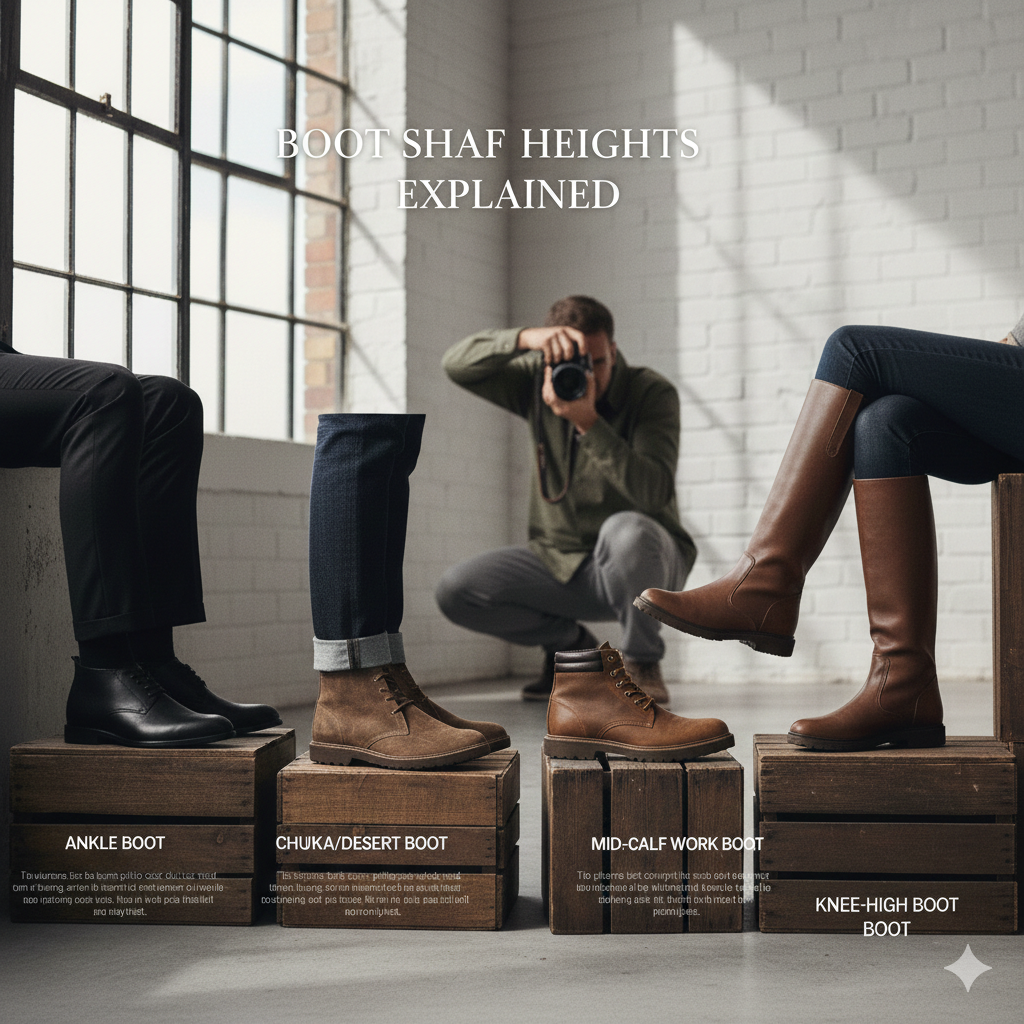
When you look at a pair of boots, your eye is likely drawn to the material or the shape of the toe. But the architecture of the boot—specifically the shaft height—is what truly defines its character. The shaft is the component of the boot that rises above the foot, covering the ankle, the calf, or even the thigh. It dictates how the footwear interacts with your body, your clothing, and the environment.
Choosing the right boot isn’t just about shoe size. It is about understanding vertical proportions. A shaft that cuts off at the wrong point on the ankle can shorten the visual length of the leg, while a knee-high silhouette can streamline an entire outfit. Beyond aesthetics, the height of the shaft determines the boot’s utility. It is the difference between a shoe designed for a light city stroll and one engineered to protect you from snake bites in tall grass.
This guide explores the anatomy of boot shaft heights, breaking down how vertical structure influences style, function, and comfort.
Why Boot Shaft Height Matters
The shaft height is the primary architect of a boot’s silhouette. In footwear design, the silhouette is the overall outline or shape of the shoe, and the vertical rise of the shaft is the most dramatic variable in that equation.
From a design perspective, the shaft serves two masters: function and fashion. Historically, height was strictly functional. Roman soldiers wore caligae that laced up the shin for protection. Cowboys needed tall leather shafts to protect against chafing from stirrups and brush. Today, however, we often choose height for the visual statement it makes. A slouchy mid-calf boot communicates a relaxed, bohemian energy, while a structured riding boot suggests refinement and order.
Understanding these proportions is crucial for creating visual balance. The “break” of a pant leg or the hemline of a skirt relies entirely on where the boot shaft ends. If the proportions are off, the outfit feels disjointed. If they align, the result is a cohesive, intentional look.
[See also: What Is a Shoe Silhouette]
[See also: Evolution of Shoes]
Common Boot Shaft Heights
Boot heights are generally categorized by where the top of the shaft hits the leg. While specific measurements vary by brand and shoe size, these categories remain consistent across the footwear industry.
Ankle Boots
Ankle boots are the chameleons of the footwear world. Typically, the shaft height ranges from three to eight inches, ending at or just above the ankle bone (the malleolus). This category includes widely popular styles like the Chelsea boot, the Chukka, and the combat bootie.
Because they leave the calf exposed, ankle boots are generally the easiest to style. They do not require the wearer to worry about calf circumference, making them a universal fit for most body types. Visually, they act as an extension of the foot rather than a covering for the leg, which maintains the natural line of the leg when worn with trousers or jeans.
Mid-Calf Boots
Mid-calf boots sit in the “middle ground,” typically rising 8 to 12 inches up the leg. They end at the widest part of the calf muscle. This height is historically significant—think of the classic engineer boot, the darker aesthetic of Dr. Martens 1460s (which flirt with the lower end of this range), or the traditional cowboy boot.
This is often considered the most difficult height to style because the horizontal line cuts across the thickest part of the lower leg. However, when styled correctly, mid-calf boots offer a rugged, utilitarian edge that ankle boots lack. They provide significant protection from debris and weather without the restrictiveness of a full knee-high shaft.
Knee-High Boots
Knee-high boots are a pillar of autumn and winter fashion. The shaft usually measures between 15 and 18 inches, ending just below the patella (kneecap). This category encompasses the equestrian riding boot, the Wellington rain boot, and the dressy tall boot.
The visual impact here is about continuity. A knee-high boot creates a long, unbroken vertical line. This can have a lengthening effect on the silhouette. Functionally, this height offers maximum warmth and protection against deep snow, mud, or rain. The challenge with knee-high boots often lies in the fit; the shaft must accommodate the calf circumference comfortably without gaping or pinching.
Over-the-Knee Styles
Over-the-Knee (OTK) and thigh-high boots are fashion-forward statements. With shafts rising 19 inches or more, these boots extend past the knee and cover part of the thigh.
Originally worn by men in the 15th century for horse riding and protection, OTK boots are now predominantly a high-fashion item. They blur the line between footwear and clothing, acting almost like a second skin or a pair of leather leggings. They offer incredible warmth and drama but restrict knee flexibility more than any other style.
[Read Here: Complete Guide to Types of Shoes]
How Shaft Height Changes Comfort and Function
While style often drives the purchase, physics dictates the experience. The height of the boot shaft directly alters the biomechanics of walking and the level of protection provided.
Protection and Coverage
The most obvious functional difference is coverage. A higher shaft equals more surface area protection. For hikers, a mid-height boot prevents pebbles and grit from entering the shoe. For industrial workers, a tall shaft protects the shin from impacts and chemical splashes. In winter climates, the difference between an ankle boot and a mid-calf boot is often the difference between dry socks and wet ankles when stepping off a curb into a slush puddle.
Stability and Support
There is a common misconception that high-top boots automatically prevent ankle rolls. While a leather shaft provides proprioceptive feedback (the sensation of the material against the skin tells your brain where your ankle is), the shaft itself must be stiff and tightly laced to offer true mechanical support.
A stiff, tall shaft acts as a brace. It restricts the range of motion of the ankle joint. This is beneficial for carrying heavy loads on uneven terrain, as it reduces fatigue by doing some of the work for your muscles. However, for fast-paced movement, this restriction can be a hindrance.
Flexibility and Movement
As the shaft rises, flexibility generally decreases. An ankle boot allows for nearly full dorsal flexion (pulling toes up) and plantar flexion (pointing toes down). A knee-high boot, especially one made of thick leather, creates a lever arm against the shin.
If the leather is too stiff, walking can feel clunky or “robotic” until the material breaks in. This is why tall boots often feature softer leathers, elastic gussets, or zippers—to mitigate the stiffness and allow the leg to move naturally while walking or sitting.
[See also: Parts of a Shoe Anatomy Guide]
Shaft Height and Boot Silhouettes
The shaft height does not exist in a vacuum. It interacts with the sole, the toe shape, and the width of the boot to create a specific visual identity.
Slim vs Structured Profiles
The “volume” of the shaft changes the vibe of the boot. A slim, sock-like shaft that hugs the ankle creates a modern, sleek silhouette perfect for formal wear or wearing under straight-leg jeans. Conversely, a structured, wide shaft (like a Wellington or a slouch boot) adds volume to the lower leg.
Designers play with this volume to alter proportions. A wide shaft can make the leg above it appear slimmer by comparison, while a tight shaft emphasizes the natural shape of the leg.
Chunky Sole Combinations
We are currently seeing a trend where massive, chunky soles are paired with higher shafts. A heavy lug sole anchors a tall combat boot, giving it a grounded, aggressive stance. If you pair a tall shaft with a thin, delicate sole, the boot feels lighter and more refined. The shaft height balances the visual weight of the sole; a heavy sole needs a substantial upper to keep the shoe from looking bottom-heavy.
Minimalist Boot Designs
Minimalist designs often rely on shaft height to create interest without using hardware or logos. A clean, unadorned leather shaft that rises to the knee relies entirely on the quality of the material and the purity of the line. In these designs, the height is the feature.
[See also: Sole Thickness and Style Impact]
Cultural and Fashion Meaning of Boot Heights
Every height tells a story. We associate specific shaft heights with specific archetypes, and these associations influence how we style them.
Tall black boots often evoke authority. This stems from military history and law enforcement uniforms. When fashion adopted the combat boot, it retained that edge of rebellion and toughness. Wearing a boot with a high, laced shaft signals a readiness for action.
On the other hand, the Chelsea boot (an ankle height) is born from Victorian innovation but popularized by the Mods in the 1960s. It signals ease, coolness, and urbanity. It is the footwear of the artist and the musician.
Cowboy boots, with their distinctive scalloped mid-calf shafts, carry the weight of the American West. Wearing them brings a heritage aesthetic that speaks of rugged individualism, even if worn in the middle of New York City. We choose our boot heights to align ourselves with these cultural narratives.
[See also: Why Humans Care About Shoes]
Choosing the Right Boot Height for Your Lifestyle
Selecting the right shaft height is a negotiation between your daily activities and your wardrobe needs.
Everyday Casual Wear
For most people, the ankle boot is the king of everyday wear. It is easy to slip on and off, it drives a car comfortably (no restriction on the gas pedal foot), and it works indoors without overheating the wearer. If you work in an office or transition frequently between indoors and outdoors, the ankle height offers the best thermal regulation.
Outdoor and Utility Use
If your lifestyle involves mud, snow, or uneven ground, you need to graduate to at least a mid-calf height. The extra inches provide a necessary barrier against the elements. For serious hiking, a shaft that covers the ankle bone is usually preferred to prevent debris entry and provide stability on rocky descents.
Formal or Fashion Styling
Tall boots—knee-high and over-the-knee—often read as more “dressed up,” particularly in women’s fashion. They are staples for skirts and dresses in cooler months. A tall leather boot commands attention and elevates a simple outfit. However, they are less practical for days that require a lot of sitting (which can pinch the back of the knee) or highly active days where the extra weight becomes noticeable.
[See also: How to Choose the Right Shoes for Your Lifestyle]
Construction Factors That Influence Boot Height
From a manufacturing standpoint, making a tall boot is exponentially more difficult and expensive than making a low shoe.
Materials and Structure
A tall boot requires a large, unblemished piece of hide. Finding a piece of leather large enough to cut a knee-high shaft without defects is difficult, which drives up the price. Furthermore, the material must be sturdy enough to stand up on its own (or be lined with a stiffener). If the material is too thin, the boot creates “puddles” around the ankle, ruining the silhouette.
Stitching and Lasting Methods
The “last” is the mold around which a shoe is built. Lasting a tall boot is a complex mechanical challenge. The shoemaker has to maneuver a large amount of material around the heel and toe. You will often see different stitching techniques used on the shaft to reinforce the back seam (the backstay), which is crucial for maintaining the boot’s upright posture over years of wear.
[See also: Shoe Stitching Techniques Explained]
[See also: Lasting Process in Shoemaking]
Sole Thickness Impact
The connection between the shaft and the sole must be robust. A tall boot acts as a lever; every step applies torque to the junction where the upper meets the sole. Therefore, high-shaft boots often utilize durable construction methods like Goodyear welting to ensure the heavy upper doesn’t rip away from the base.
The Future of Boot Silhouettes
Technology is changing how we define boot heights. We are moving away from the rigid categories of the past into a more fluid era of footwear design.
Hybrid sneaker-boots are blurring the lines, taking the comfortable, flexible sole of an athletic shoe and grafting it onto a high-performance knit shaft. This creates a “sock boot” that offers the silhouette of a tall boot with the comfort of a running shoe.
Sustainability is also playing a role. As leather becomes more expensive and scrutinized, designers are using recycled synthetics and plant-based leathers. These materials behave differently than animal hide, leading to new silhouettes that embrace the unique drape and fold of the new fabrics.
We are even seeing the early stages of AI-designed ergonomic shafts—boots that are knitted or 3D printed to match the exact curvature of a specific wearer’s calf muscle, eliminating the fit issues that have plagued tall boots for centuries.
[Link to: The Future of Shoes: Technology & Innovation]
Boot Height as a Key Design Language in Footwear
The height of a boot shaft is never an accident. It is a deliberate choice that dictates the shoe’s purpose, its comfort level, and its style credentials. Whether you opt for the versatility of an ankle boot or the commanding presence of a knee-high riding boot, understanding the architecture behind the silhouette empowers you to make better choices.
When you understand the shaft, you understand the boot. You stop seeing just a shoe and start seeing the interplay of proportion, history, and engineering.
[Read here: Shoe Silhouettes Explained: Shape, Structure & Style]
Leave a Reply