

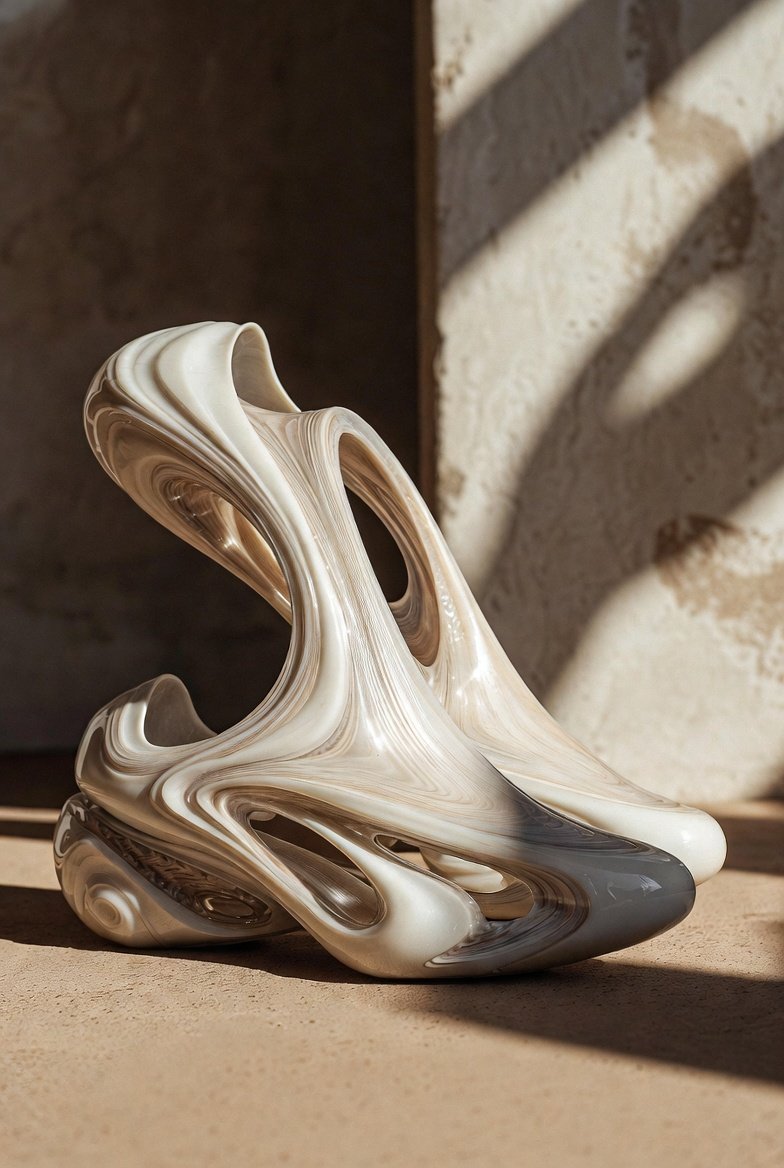
For decades, the silhouette of a shoe remained relatively static. Whether it was a high-top basketball sneaker, a running trainer, or a leather boot, the construction followed a familiar pattern: an upper stitched to a sole, with laces to hold it all together. The materials—leather, canvas, rubber—dictated the limits of what a shoe could look like.
That era is ending.
Walk into a high-end sneaker boutique or scroll through a concept design feed today, and you will see footwear that looks more like alien architecture than traditional clothing. We are witnessing a radical shift from standard stitched panels to experimental, fluid, and often impossible-seeming shapes.
This evolution isn’t just an aesthetic choice. It is the direct result of a technological revolution in design and manufacturing. From 3D printing to AI-generated concept art, technology is rewriting the rules of footwear geometry. This article explores how these innovations are altering the physical shape of shoes and what that means for the future of what we wear on our feet.
[Related reading: What Is a Shoe Silhouette]
[Related reading: Evolution of Shoes Through History]
What Defines a Futuristic Shoe Shape?
The “futuristic” aesthetic in footwear is characterized by a departure from the multi-panel construction of the 20th century. Instead of distinct toe boxes, tongues, and heel counters, modern design favors cohesion and flow. Three primary characteristics define this new wave of silhouettes.
Sculpted and Organic Forms
The most immediate change is the move toward “monocoque” or single-shell designs. Traditional shoes are assemblages of flat materials cut and sewn together. Futuristic shapes, however, often look as though they were grown rather than built.
Drawing inspiration from nature—specifically biomimicry—these silhouettes feature flowing lines, ridges that mimic muscle fibers, and porous structures resembling bone or coral. The harsh angles of cut leather are replaced by the smooth, continuous curves of molded foam and polymer. This organic approach makes the shoe appear as a single, unified object rather than a collection of parts.
Oversized Cushioning Structures
Maximalism has taken hold of the footwear industry, driven by the desire for comfort and visual impact. As cushioning technology improves, the sole unit has expanded, often engulfing the upper.
We are seeing heels that extend far beyond the back of the foot, flared outsoles that create a wide, stable base, and midsoles with bulbous, balloon-like geometries. These oversized structures serve a dual purpose: they provide immense shock absorption and create a striking, avant-garde profile that dominates an outfit.
[See also: Sole Thickness and Style Impact]
Minimal Seamless Designs
On the opposite end of the spectrum from maximalist soles is the trend toward seamless, sock-like uppers. Advances in knitting technology and synthetic skins allow for shoes that have virtually no visible seams.
This results in a sleek, aerodynamic silhouette that hugs the foot like a second skin. Without the visual clutter of overlays, stitching, and eyelets, the shape becomes pure and elemental. These designs often forego traditional laces entirely, relying on the elasticity of the material or alternative closure systems to secure the foot, further smoothing out the silhouette.
Technology Driving Futuristic Silhouettes
Designers have always dreamed of wild shapes, but until recently, they lacked the tools to build them. Three specific technological advancements are responsible for bridging the gap between concept art and retail reality.
AI-Generated Design Concepts
Artificial Intelligence has become a collaborator in the design process. Tools like Midjourney and DALL-E allow designers to input prompts describing textures, materials, and abstract concepts, generating hundreds of silhouette variations in seconds.
AI does not know the constraints of traditional manufacturing, so it suggests shapes that a human trained in shoemaking might never consider. It blends geology, automotive design, and biology into footwear concepts. While not every AI design is manufacturable, these visualizations push human designers to explore more complex, unconventional geometries that defy traditional logic.
3D Printing and Digital Modeling
If AI helps dream up the shape, 3D printing (additive manufacturing) brings it to life. Traditional injection molding requires expensive metal molds, making it risky to experiment with complex shapes. 3D printing eliminates this barrier.
Printers can create lattice structures—intricate, web-like internal geometries—that are impossible to mold. This allows for shoes that are entirely hollow, or possess variable density throughout the sole without changing materials. Companies can now print a shoe as a single piece, allowing for complex overhangs, voids, and interlocking textures that define the futuristic look.
Advanced Cushioning Systems
The shape of a shoe is often dictated by what lies beneath the foot. Modern energy-return foams and mechanical cushioning systems have allowed for more aggressive silhouettes.
Carbon fiber plates and air-pod systems allow designers to create voids and gaps in the sole unit (decoupling the heel from the forefoot) without sacrificing stability. This technology enables “floating” elements and architectural heels that look precarious but offer elite performance. The silhouette is no longer a solid block; it is a suspension system.
[See also: Cushioning Technologies Explained]
[See also: How Sneakers Are Manufactured]
Sustainable Innovation and Future Shapes
Sustainability is often viewed as a limitation, but in footwear, it is a catalyst for new shapes. As brands move toward circular design, the visual language of the shoe changes to reflect its eco-friendly construction.
Bio-Based Materials
The shift away from petroleum-based plastics toward materials derived from algae, sugarcane, and mycelium (mushroom root) is influencing design. These materials often behave differently than plastic—they shrink, expand, and cure in unique ways.
Designers are embracing these properties, creating silhouettes that look earthy and raw. Algae foams, for example, are often injection-molded into clogging-style silhouettes with distinctive swirling textures. The “imperfect” look of bio-materials is becoming a desired aesthetic, leading to shapes that feel harvested rather than manufactured.
[See also: Sustainable Shoe Materials Guide]
Modular and Repairable Designs
To reduce waste, some future-focused brands are designing shoes that can be taken apart. This leads to a “modular” silhouette where the mechanical connections are visible.
Instead of hidden glue, you might see exaggerated clips, removable booties, or interlocking sole units. The aesthetic becomes utilitarian and industrial. A shoe designed to be disassembled looks fundamentally different from one fused together forever; it celebrates the connection points, turning the function of repairability into a style statement.
Lightweight Foam Structures
Sustainability also means using less material. Topology optimization software can calculate exactly where a shoe needs support and where it doesn’t.
This results in silhouettes filled with negative space—holes and windows through the sole and upper that remove weight. These skeletal structures look undeniably futuristic, resembling the bones of a bird or the chassis of a race car. It represents a move toward “reductive design,” where the shape is defined by what has been taken away.
Futuristic Sneakers vs Futuristic Boots
While the technology is shared, the application differs depending on the footwear category. The futuristic aesthetic manifests differently in athletic wear compared to lifestyle boots.
Athletic Performance Designs
In the sneaker world, “futuristic” usually equates to “fast.” The silhouettes are aggressive, featuring sharp angles and a forward-leaning stance. The heel counters are often extended to aid aerodynamics and stability.
Performance running shoes have adopted a rocker shape—a curved sole that propels the runner forward. This functional requirement has created a visual language of perpetual motion. Even when standing still, these sneakers look like they are mid-stride.
[See also: Running Shoe vs Lifestyle Silhouette]
Fashion-Forward Lifestyle Shapes
In contrast, futuristic boots and lifestyle footwear often lean toward the absurd and the protective. Influenced by digital avatars and “skin” designs in video games, these shapes are often bulbous, cartoonish, and oversized.
We see boots that resemble moon boots or protective casts, utilizing thick, molded rubber to create a heavy, grounded silhouette. These designs are less about aerodynamics and more about creating a barrier between the wearer and the environment. They signal a cyberpunk, dystopian readiness that has become a staple of modern streetwear.
Cultural Meaning Behind Futuristic Shoe Design
Why are we drawn to these strange, alien shapes? The shift in silhouette is not just about manufacturing; it is about identity.
Wearing a shoe that looks like it was printed in a lab signals a connection to the future. It aligns the wearer with innovation and forward-thinking. In a digital-first world, footwear is increasingly designed to pop on a smartphone screen. Complex, bizarre, and highly textured silhouettes garner more attention on social media than plain canvas sneakers.
Furthermore, the blurring of lines between digital and physical reality—the Metaverse influence—has made consumers more comfortable with “unreal” shapes. As we spend more time looking at digital avatars wearing gravity-defying gear, we begin to crave those same aesthetics in our physical lives.
[See also: The Psychology of Sneaker Culture and Modern Identity]
Challenges of Designing Futuristic Shoes
Despite the excitement, shifting the paradigm of shoe design comes with significant hurdles. Innovation is rarely a smooth path.
Comfort vs Visual Innovation
A shoe can look incredible as a 3D render, but it still needs to house a human foot. The foot is a complex biomechanical structure that swells, moves, and sweats.
Many futuristic concepts fail the wearability test. Rigid 3D printed materials can cause blistering, and lack of breathability in molded foam can make shoes unwearable for long periods. Designers must constantly battle to ensure that the aggressive new silhouette doesn’t compromise the basic ergonomic needs of the user.
Manufacturing Complexity
While 3D printing is growing, mass production still largely relies on molds. Creating a mold for a complex, undercut, organic shape is incredibly expensive and technically difficult. High rejection rates in the factory can drive up costs and waste, ironically countering the sustainability goals.
[See also: Quality Control in Shoe Production]
Consumer Acceptance
Finally, there is the challenge of taste. While fashion-forward early adopters embrace the “alien” look, the mass market can be slow to change. A silhouette that looks too radical can alienate the average buyer who simply wants a versatile daily driver. Brands must walk a fine line between pushing the envelope and making a product that fits into a regular wardrobe.
The Future of Shoe Silhouettes: What Comes Next?
We are only in the early stages of this silhouette revolution. As technology matures, the shapes will continue to evolve in directions we can currently only guess at.
We can expect to see adaptive shape-changing shoes, where materials react to heat or moisture to tighten or loosen automatically, changing the silhouette in real-time. Smart wearable footwear will likely integrate technology more seamlessly, with sensors and haptics buried within the sole, perhaps altering the visual density of the material.
Most exciting is the prospect of AI-driven personalization. In the near future, a customer might scan their foot, and an AI will generate a unique, one-of-one silhouette optimized for their specific biomechanics and aesthetic preferences, which is then printed locally. The era of the “standard size” may be replaced by the era of the “custom shape.”
[See also: The Future of Shoes: Technology & Innovation]
Futuristic Shapes as the Next Evolution of Footwear
The shoe is no longer just a functional accessory; it is a canvas for high-tech expression. From the software used to design them to the machines that build them, technology has fundamentally altered the geometry of footwear.
Whether through the organic flow of 3D printed lattices or the aggressive aerodynamics of carbon-plated super shoes, the futuristic silhouette is here to stay. It represents a fusion of biology, engineering, and fashion, proving that the simple act of walking can be a journey into the future.
[See also: Shoe Silhouettes Explained: Shape, Structure & Style]
Leave a Reply