

Footwear is one of the oldest forms of human technology. What began roughly 40,000 years ago as a simple means of protecting the sole from rough terrain has evolved into a complex language of design, status, and identity. Today, the shoes on your feet do far more than facilitate walking; they signal your lifestyle, your cultural affiliations, and even your profession.
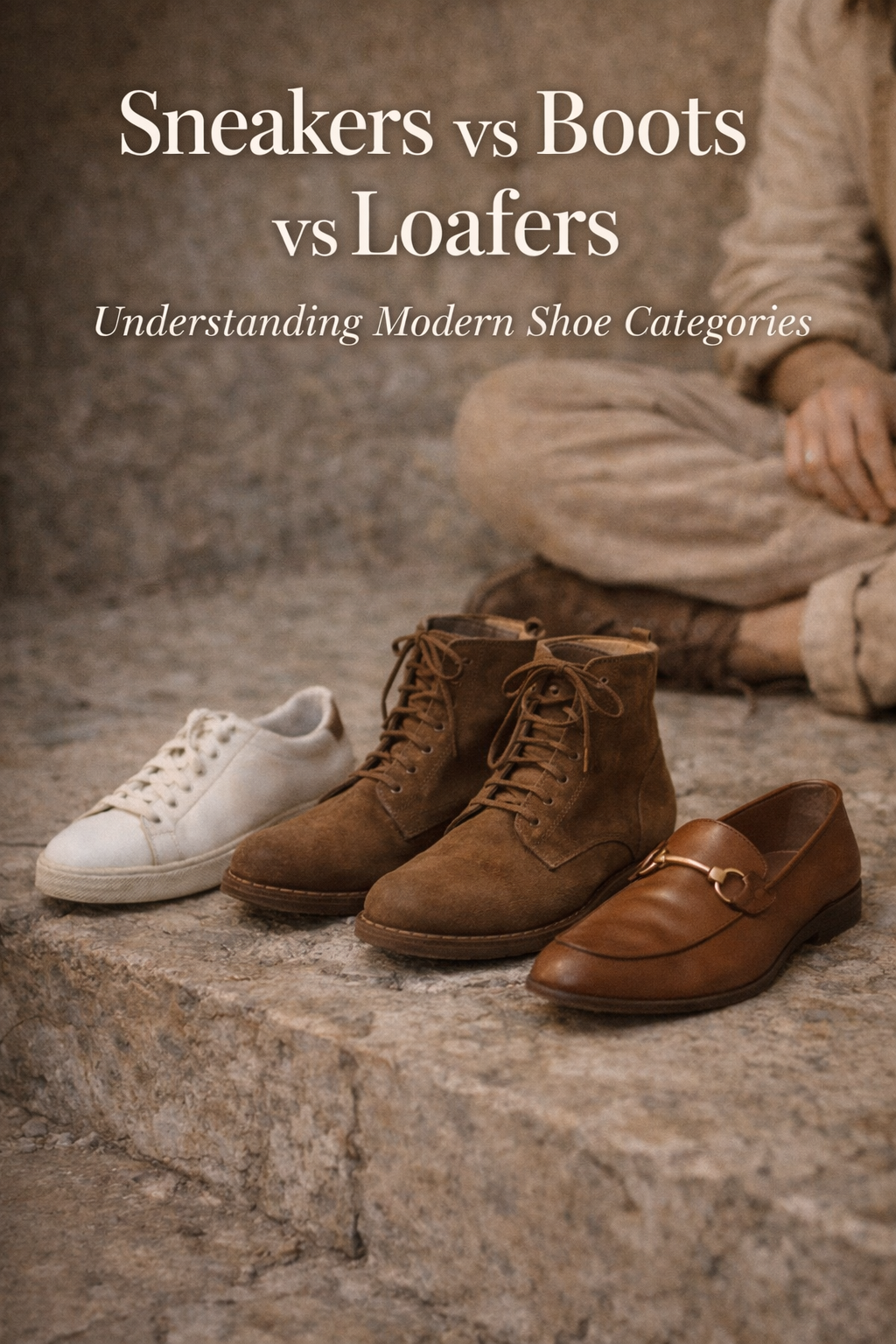
While the modern footwear market is flooded with countless micro-trends, almost every shoe can be traced back to three primary archetypes: the sneaker, the boot, and the loafer. Understanding the distinctions between these categories requires looking beyond the price tag or brand logo. It involves examining the history of their construction, the evolution of their silhouettes, and the specific functional needs that brought them into existence.
Whether you are building a capsule wardrobe or studying the anthropology of fashion, grasping the core differences between these three categories is essential. This guide explores the anatomy, history, and cultural weight of the three pillars of modern footwear.
Read Here: Sneakers vs Loafers vs Boots
Why Shoe Categories Matter
Historically, footwear categories were rigid. A boot was for labor or riding; a leather shoe was for town and business; and early athletic shoes were strictly for the gymnasium. There was very little crossover. However, the democratization of fashion in the 20th century blurred these lines.
Today, we see sneakers worn with suits and boots worn on red carpets. Yet, despite this stylistic fluidity, the fundamental categories remain distinct because of construction. A sneaker offers a specific type of biomechanical support that a loafer does not. A boot offers ankle articulation and protection that a sneaker cannot replicate. Understanding these categories allows us to appreciate the design intent behind the product. It helps us answer the question: Was this object made for speed, for protection, or for ease?
What Defines a Shoe Category?
Before dissecting the specific types, we must establish the criteria used to categorize footwear. It is rarely just about “how it looks.” It is a combination of mechanics and anthropology.
Function vs Style
Every shoe category originated from a specific functional necessity. Sneakers were born from the need for quiet traction. Boots were born from the need to shield the ankle and lower leg from debris, mud, and injury. Loafers were born from a desire for leisure and the removal of restrictive laces. While modern fashion often prioritizes aesthetics, the DNA of a shoe category is always rooted in its original function.
Silhouette and Structure
From a design perspective, the “silhouette”—the outline of the shoe—is the primary identifier.
- Sneakers typically feature a two-part sole unit (midsole and outsole) made of rubber or foam, attached to a flexible upper.
- Boots are defined by the “shaft” height, extending above the malleolus (ankle bone), often utilizing heavier, structured materials.
- Loafers are defined by the absence of a fastening system (laceless) and a low profile that exposes the ankle.
Cultural Influence
Finally, categories are sustained by culture. We associate boots with rebellion, industry, and the military. We associate sneakers with youth culture, hip-hop, and athletics. We associate loafers with Ivy League prep, business casual, and sophisticated leisure. These associations are as important as the leather or rubber used to make them, as they dictate where and how the shoes are worn in society.
Sneakers: The Modern Lifestyle Shoe
The sneaker is perhaps the most dominant footwear category of the 21st century. It is the artifact of the modern age, representing the shift from a formal, agrarian, or industrial society to one that values speed, comfort, and leisure.
Athletic Origins
The sneaker’s journey began in the mid-19th century with the invention of vulcanized rubber by Charles Goodyear. This allowed for a sole that was durable, pliable, and waterproof. By the late 1800s, plimsolls (simple canvas shoes with rubber soles) were being used for tennis and croquet.
The category truly solidified in the early 20th century with the rise of basketball and track. Shoes like the Converse All-Star were purely functional tools designed to grip the court. The defining characteristic of the sneaker is this “silent” step (hence the name “sneak-er”), a sharp contrast to the loud clacking of hard leather heels on pavement.
Casual and Streetwear Influence
Post-1950s, the sneaker migrated from the gymnasium to the street. Icons like James Dean made them a symbol of youthful rebellion. Later, in the 1980s, the explosion of hip-hop culture and the introduction of the Air Jordan transformed sneakers from athletic equipment into collectible assets. Today, the sneaker is the bedrock of streetwear, serving as a canvas for artistic expression and collaboration.
Comfort and Cushioning Design
Technologically, sneakers are the most advanced category. They prioritize the biomechanics of the foot.
- Midsole Technology: Unlike boots or loafers, sneakers almost always feature a distinct midsole made of EVA (Ethylene Vinyl Acetate) or PU (Polyurethane) foam to absorb shock.
- Upper Materials: While originally canvas or leather, modern sneakers utilize engineered mesh and knit technologies (like Flyknit or Primeknit) that offer breathability and a sock-like fit.
- Silhouettes: They range from “low-tops” (below the ankle for range of motion) to “high-tops” (originally for ankle support).
Boots: Protection, Durability and Style
If sneakers represent the modern age, boots represent the enduring history of human survival. For centuries, the boot was the standard footwear for almost all of humanity, designed to withstand the elements.
Work Boots
The industrial work boot is built on the philosophy of over-engineering. Characterized by thick, oil-resistant rubber lug soles and Goodyear-welted construction (where the upper is stitched to the sole via a welt), these boots are designed to be repairable. The silhouettes are bulky to accommodate steel toes or metatarsal guards. While they originated in factories and logging camps, the rugged aesthetic has been co-opted by fashion (e.g., Timberland) to project an image of resilience and grounding.
Chelsea Boots
On the opposite end of the spectrum is the Chelsea boot. Invented by Queen Victoria’s shoemaker, J. Sparkes-Hall, this boot features an elastic side panel instead of laces. It gained massive popularity in the 1960s thanks to The Beatles. The Chelsea boot proves that the “boot” category is not exclusively utilitarian; it can be sleek, sharp, and dressy enough to be worn with a tailored suit.
Combat and Hiking Boots
Combat boots and hiking boots share a lineage of traversing difficult terrain. They utilize a high shaft and tight lacing systems to lock the ankle in place, preventing sprains on uneven ground. In a modern context, these silhouettes have been refined for the city. “Tactical” fashion often uses the visual language of combat boots—straps, heavy buckles, and black leather—to create an aggressive, avant-garde aesthetic.
Read Here: Complete Guide to Types of Shoes
Loafers: Minimalist and Formal Footwear
The loafer is the shoe of the establishment, the bon vivant, and the academic. It sits comfortably between the ruggedness of a boot and the informality of a sneaker. It is the ultimate “smart casual” footwear.
Slip-On Design
The defining feature of the loafer is the lack of laces, buckles, or fasteners. It relies on the “last” (the mold the shoe is formed on) to ensure a secure fit. This creates a streamlined, uncluttered silhouette. The origin of the loafer is often traced to the Norwegian “Aurland” shoe in the early 20th century, which was inspired by Native American moccasins but adapted for European sensibilities.
Smart Casual Styling
Loafers occupy a unique niche. They are formal enough for most business environments (barring black-tie events) but relaxed enough for weekend wear. Because they expose the top of the foot and ankle, they are naturally associated with warmer weather and a relaxed state of mind. They are the antithesis of the work boot; if the boot is for labor, the loafer is for the time after labor.
Structural Simplicity
Construction-wise, loafers are often lighter than boots or traditional oxford shoes.
- Penny Loafers: Characterized by a leather strap across the vamp with a diamond cutout.
- Tassel Loafers: Feature decorative leather tassels, often considered slightly more formal or preppy.
- Horsebit Loafers: Popularized by Gucci in the 1950s, featuring a metal snaffle bit across the front, symbolizing luxury and equestrian heritage.
- Driving Mocs: A soft, unstructured variation with rubber grommets on the heel, designed specifically for pedal control while driving.
Comparing Sneakers vs Boots vs Loafers
When building a wardrobe, understanding the comparative advantages of each category helps in making practical decisions.
Comfort and Cushioning
- Sneakers win on immediate comfort. The foam midsoles and padded collars require zero “break-in” time. They are designed for high-impact steps.
- Loafers offer moderate comfort but often lack arch support. They are ideal for standing or sitting, but less so for walking long distances.
- Boots often require a painful break-in period, especially if made of thick full-grain leather. However, once the leather molds to the foot and the cork footbed settles, a high-quality boot can offer superior long-term ergonomic support compared to a soft sneaker.
Style Versatility
- Boots (specifically Chelseas or sleek lace-ups) are arguably the most versatile for transitional weather, looking equally good with denim or wool trousers.
- Sneakers have gained versatility, but they still struggle in formal settings. A sneaker at a wedding or funeral is often considered a faux pas.
- Loafers bridge the gap perfectly. They can be worn with shorts, jeans, chinos, or a suit. They are the chameleons of footwear.
Seasonal Use
- Boots are the undisputed kings of Autumn and Winter. They provide insulation and water resistance.
- Loafers are generally Spring and Summer shoes. Their low cut invites water to enter, and they offer little thermal protection.
- Sneakers are year-round, though canvas variants are for summer and leather/Gore-Tex variants are for winter.
Read Here: Smart Casual Footwear Guide
Cultural Meaning Behind Different Shoe Types
We wear shoes to tell stories about ourselves. The category we choose projects a specific narrative to the world.
Sneakers project dynamism, youth, and approachability. In the tech world and creative industries, the CEO wears sneakers to signal that they are innovative and unpretentious. They reject the “stiff” hierarchy of the past.
Boots project durability and toughness. The popularity of “heritage” workwear (Red Wing, Wolverine) among urban professionals is a form of costume play—adopting the aesthetic of manual labor to signal authenticity and ruggedness in a digital age.
Loafers project sophistication and ease. There is a concept in Italian fashion called sprezzatura—studied carelessness. The loafer embodies this. It says, “I am dressed up, but I didn’t try too hard.” It implies a life of comfort.
How to Choose Between Sneakers, Boots and Loafers
Choosing between these categories depends on analyzing your environment and lifestyle needs.
Lifestyle Needs
If your day involves walking 10,000 steps on concrete, sneakers are a health necessity. If your day involves client meetings followed by a dinner date, loafers or Chelsea boots offer the requisite polish without sacrificing too much comfort. If you work in creative fields, sneakers are standard currency; if you work in law or finance, the loafer is likely your baseline.
Climate Considerations
Climate is the great dictator of footwear. Those in tropical climates may find boots stifling and impractical, making loafers and canvas sneakers the dominant choices. Conversely, in Northern Europe or the American Northeast, the boot is an essential tool for navigating snow and slush, rendering the exposed ankle of the loafer impractical for half the year.
Personal Style
Ultimately, your choice aligns with your style archetype.
- The Streetwear Enthusiast: Prioritizes sneakers, using limited releases to signal status.
- The Heritage/Rugged Individual: Prioritizes boots, valuing patina and longevity.
- The Classic/Preppy Dresser: Prioritizes loafers, valuing timeless elegance and tradition.
The Future of Shoe Categories
As we move deeper into the 21st century, the rigid walls between these categories are crumbling. We are entering the era of the “Hybrid.”
Designers are increasingly merging these pillars. We see “sneakerboots”—shoes with the rugged upper of a hiking boot but the soft, EVA midsole of a running shoe (like the Nike ACG line). We see “dress sneakers”—leather uppers that mimic an oxford or loafer, welded to a white rubber cupsole (popularized by brands like Common Projects and Cole Haan).
Technology is also reshaping construction. 3D printing is allowing for lattice-structure soles that offer the support of a boot with the weight of a sneaker. As materials science evolves, we may see a future where a single shoe can adapt its thermal properties and rigidity, effectively becoming a sneaker, boot, and loafer all in one.
Understanding Shoes Beyond Labels
While marketing labels help us organize our closets, the true evolution of footwear is about solving human problems. Whether you reach for the rugged protection of a boot, the athletic propulsion of a sneaker, or the effortless slide of a loafer, you are engaging with centuries of engineering history.
Don’t limit yourself to one category. The well-dressed, well-prepared individual understands the value of all three. By appreciating the unique silhouette, construction, and cultural weight of each, you can build a rotation that serves you in every environment, from the boardroom to the pavement.
Leave a Reply