

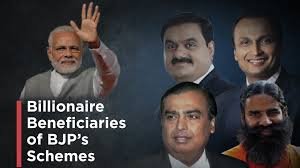
In the discourse of Indian political economy, few debates generate as much heat as the allegation of crony capitalism under Prime Minister Narendra Modi. Since his ascent to power in 2014, the Indian economy has undergone a dramatic transformation, vaulting from the tenth to the fifth largest in the world. Yet, paralleling this national rise is the meteoric expansion of a select few corporate giants, most notably the Adani Group and Reliance Industries, led by Gautam Adani and Mukesh Ambani respectively.
To supporters, these conglomerates are the “national champions” driving India’s infrastructure overhaul and digital revolution. They argue that large-scale capital investment is necessary to pull millions out of poverty and modernise a nation of 1.4 billion people. Conversely, critics view this concentration of economic power as evidence of a systemic rot. They argue it reflects selective favouritism that distorts markets, stifles competition, and exacerbates an already widening wealth gap.
The narrative is not merely academic; it shapes electoral outcomes, investor sentiment, and the daily lives of Indian citizens. This article examines the controversy surrounding crony capitalism in India, assessing the validity of allegations regarding preferential treatment, the economic data behind the headlines, and what this concentration of power means for the future of the world’s most populous democracy.
Understanding Crony Capitalism
To evaluate the claims against the current administration, we must first establish what crony capitalism actually entails. It is an economic system where success in business depends on close relationships between business people and government officials. It is characterised not by a free market where the most innovative or efficient firm wins, but by an environment where success is determined by the ability to secure government favours.
These favours typically manifest as special tax breaks, government grants, preferential access to public contracts, or regulatory intervention that handicaps competitors. In such a system, the dividing line between the state and private enterprise blurs.
Key Traits of a Crony System
Economists generally identify four hallmarks of crony capitalism:
- Opaque Policy Decisions: Policy changes that seem tailored to benefit specific companies rather than the broader industry.
- Preferential Access: The awarding of licences, land, or lucrative public infrastructure contracts without transparent, competitive bidding processes.
- Regulatory Loopholes: Rules that are inconsistently applied, allowing favoured firms to bypass environmental or financial regulations that strangle smaller competitors.
- Concentration of Wealth: A significant accumulation of national assets and wealth within a very small circle of the corporate elite.
Critics argue that the last decade in India has seen an intensification of these dynamics, specifically surrounding the empires of Adani and Ambani.
The Rise of Adani and Ambani: A Decade of Dominance
When Narendra Modi took office in 2014, India’s GDP stood at approximately $2 trillion. By 2023, it had surged to roughly $3.7 trillion. This period of rapid expansion coincided with a shift in the government’s economic strategy, moving away from the welfare-heavy focus of previous administrations toward an infrastructure-led growth model.
The media narrative frequently links Modi’s development agenda—focused on highways, airports, ports, and digital connectivity—with the expanding footprints of the Adani and Ambani groups. These conglomerates have become ubiquitous in Indian life. Reliance Industries, under Mukesh Ambani, disrupted the telecom sector with Jio and dominates retail and petrochemicals. Simultaneously, the Adani Group became the country’s largest private port operator, a major player in airports, and a giant in energy and mining.
Supporters view this as a symbiotic relationship necessary for development. The government sets ambitious targets—such as renewable energy capacity or digital penetration—and these conglomerates have the balance sheets and execution capability to meet them. They leverage policies like the Production-Linked Incentive (PLI) schemes to scale rapidly, contributing significantly to national output. However, detractors argue this is not healthy competition but collusion, where the state acts as a guarantor for the risks taken by a chosen few.
Allegations of Favouritism: What the Data Suggests
The accusations of crony capitalism are not based solely on anecdotal evidence but are often supported by data highlighting market trends and regulatory outcomes.
Market Dominance and Monopolisation
A primary concern for economists is the trend toward monopolisation in key sectors. Critics, including political opposition leaders, assert that rapid corporate acquisitions in cement, ports, and media reflect a decline in competitive health.
For instance, the Adani Group’s aggressive acquisition strategy in the cement sector has raised eyebrows regarding market concentration. Similarly, their dominance in port logistics gives them significant leverage over India’s trade routes. Reports indicate that five large conglomerates, including Adani and Reliance, are building dominant positions across dozens of industries. When a single entity controls the entry and exit points of trade (ports/airports) or the digital pipes of communication (telecom), it can stifle smaller competitors and dictate prices to consumers—classic indicators of an uneven playing field.
Wealth Concentration and Inequality
Perhaps the most potent data point in the debate is the staggering rise in wealth inequality. A recent report highlighted by Bloomberg noted that the richest 1% in India now own roughly 40% of the nation’s wealth. While inequality is a global phenomenon, the pace of accumulation at the top in India has been exceptionally fast.
Historical data reveals that while the average Indian citizen has seen modest income growth, the net worth of India’s richest individuals—specifically those aligned with large infrastructure and commodity conglomerates—has exploded. This concentration correlates strongly with corporate influence. When economic power is hoarded by a small cadre, critics argue it indicates a policy framework designed to funnel wealth upwards rather than distribute it broadly.
The Ambani-Adani Government Link: Narrative vs. Reality
Is this economic partnership a pragmatic strategy for national growth, or is it political cronyism disguised as development?
The Argument for Economic Partnership
Proponents of the “Modi Model” argue that the Indian state has historically been inefficient at running businesses. Therefore, the government’s reliance on private capital to build infrastructure is a necessary evolution. In this view, Ambani and Adani are simply the only players large enough to execute the Prime Minister’s vision.
Reliance’s launch of Jio is often cited as a prime example. While it effectively created a duopoly in the telecom market, it also democratised data access for hundreds of millions of Indians, fueling a digital economy that has spawned thousands of startups. Similarly, the Adani Group’s investments in logistics have arguably improved the efficiency of India’s supply chains. From this perspective, the government isn’t “giving” favours; it is leveraging corporate capacity to solve national problems that the public sector cannot.
The Pushback from Critics
However, the counter-narrative suggests that the “capacity” of these firms is artificially inflated by state support. Critics argue that policy tailwinds—such as fast-tracked environmental clearances for mines or changes in airport privatisation rules—risk state capture.
Allegations have surfaced regarding opaque funding mechanisms and preferential land deals that benefited these conglomerates. The controversy surrounding the Hindenburg Research report on the Adani Group, which alleged stock manipulation and accounting fraud, further fueled these fires. While the Adani Group vehemently denied these claims and the Supreme Court of India found no regulatory failure, the episode highlighted concerns about the robustness of India’s regulatory oversight when it comes to politically connected firms.
Economic Outcomes: Growth vs. Equity
The macroeconomic results of the last decade present a mixed picture, fueling both sides of the debate.
Positive Indicators
Under Modi’s tenure, India has achieved consistent growth rates, often outpacing global peers even amidst global headwinds like the pandemic and geopolitical instability. The tangible evidence of this growth is visible in the physical infrastructure: miles of new expressways, modernised railway stations, and new airports. Foreign Direct Investment (FDI) inflows have reached record highs, signalling global investor confidence in India’s long-term trajectory.
Troubling Patterns
Conversely, the quality of this growth is contested. The “K-shaped” recovery post-pandemic suggests that while large corporations and the wealthy have thrived, the informal sector and small-to-medium enterprises (SMEs) have struggled. Manufacturing employment as a share of the workforce has stagnated or declined, forcing many back into low-productivity agriculture.
If monopolistic pressures continue to rise, the long-term cost could be higher prices for consumers and a lack of innovation. The fear is that India is building an economy that looks impressive from the top down but feels increasingly precarious for those at the bottom.
Policy Decisions That Fueled the Debate
Two specific areas of policy have become lightning rods for the crony capitalism debate: public procurement and tax reform.
Privatisation and Public Assets
The government’s aggressive privatisation drive has been a central pillar of its economic reform. Critics contend that the privatisation of airports and ports often resulted in lucrative contracts being awarded to firms with little prior experience in those specific sectors, leading to perceptions of favouritism. While privatisation can promote efficiency, doing so under questionable competitive conditions risks replacing a public monopoly with a private one, which is arguably worse for the consumer.
Tax and Regulatory Reforms
The corporate tax cut of 2019 was hailed by the industry as a bold move to attract investment. However, critics noted that such reforms disproportionately benefit highly profitable large firms that can capitalise on scale. Similarly, the Production Linked Incentive (PLI) schemes, designed to boost manufacturing, often require a scale of investment that only the largest conglomerates can afford, effectively using taxpayer money to subsidise the expansion of already dominant market leaders.
Public Perception and Political Ramifications
Public opinion in India regarding these developments is deeply divided, often split along partisan lines.
For a significant portion of the electorate, the visible development—better roads, digital access, and a rising global stature—validates the government’s approach. They view the collaboration between the state and big business as essential developmental statecraft.
Conversely, a vocal segment sees it as elite capture. They argue that economic policies are being written to serve the interests of a few billionaires at the expense of ordinary citizens, citing high unemployment and inflation as the price paid for this skewed focus. These perceptions are potent political tools, influencing elections and shaping the national conversation around fairness and opportunity.
Balancing Growth and Fairness: The Path Forward
If India is to sustain its growth trajectory without succumbing to the pitfalls of an oligarchy, a course correction may be necessary.
Strengthening Competition and Transparency
To address concerns about crony capitalism, robust antitrust enforcement is non-negotiable. The Competition Commission of India (CCI) needs the independence and teeth to prevent monopolies and protect the interests of smaller enterprises and consumers. Furthermore, greater transparency in government contracts and the disclosure of political funding would go a long way in reducing the perception—and reality—of undue influence.
Fostering Broad-Based Gains
Ultimately, an economy cannot run on the engines of two or three conglomerates alone. Ensuring that economic expansion benefits the broader population requires a renewed focus on MSMEs (Micro, Small and Medium Enterprises), which are the true job creators of the Indian economy. Policies must pivot from solely championing “national champions” to creating an ecosystem where small businesses can compete fairly.
A Complex Economic Legacy
The debate over crony capitalism under Prime Minister Modi and the alleged favouritism toward Adani and Ambani reflects the deep tensions inherent in India’s rapid modernization. The economic growth and global ambitions are undeniable facts, as are the gleaming new airports and digital networks connecting the nation. Yet, the rising wealth concentration and the symbiotic links between state power and corporate giants raise legitimate questions about the fairness of this trajectory.
Whether this era is remembered as a period of pragmatic alliances that built a superpower, or a time of unchecked cronyism that widened the chasm of inequality, will depend on the regulatory choices India makes next. Understanding these dynamics requires looking beyond the rhetoric to assess the structural health of India’s democracy and its markets.
Ready to Dive Deeper?
If you found this analysis insightful, subscribe to our newsletter for more weekly deep dives into the global economy, political trends, and market analysis.
Leave a Reply