

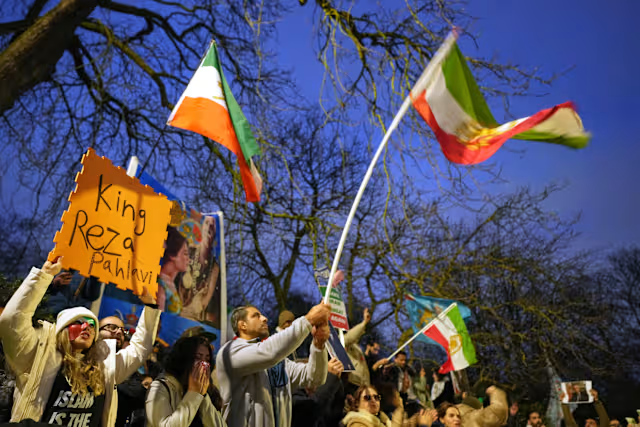
Mass unrest has once again gripped the Islamic Republic of Iran, marking one of the most volatile periods in the nation’s recent history. What began as scattered demonstrations in late December 2025 has rapidly transformed into a nationwide uprising, drawing immediate and lethal responses from state security forces.
As reports flood in from across the country, the situation appears increasingly dire. Streets in major cities and rural towns alike are filled with citizens demanding change, while the government has responded with severe measures, including live ammunition and a near-total communications blackout. The scale of the violence is staggering, with activist groups estimating thousands of fatalities in just a few weeks.
This isn’t just a political disagreement; it is a humanitarian crisis unfolding in real-time. The grievances are deep-rooted, ranging from a collapsing economy to long-standing demands for civil liberties. As the world watches, the flow of information has been severed, leaving millions in the dark and international observers scrambling to verify the extent of the crackdowns.
In this comprehensive report, we examine the timeline of the 2025-2026 protests, analyze the devastating death toll, and explore the global diplomatic fallout of a nation in upheaval.
What Sparked the 2025–2026 Iran Protests?
The current wave of unrest did not happen in a vacuum. While political dissatisfaction has simmered for years, the immediate trigger for the late December 2025 demonstrations was economic desperation.
Economic Collapse and Inflation
By the end of 2025, Iran’s economy faced unprecedented strain. Hyperinflation had rendered the local currency significantly weaker, obliterating the purchasing power of the middle and working classes. Basic staples—bread, fuel, and medicine—became unaffordable for millions. The government’s decision to cut subsidies on essential goods in mid-December proved to be the breaking point.
Initially, chants in the streets were focused on economic reform and the resignation of economic ministers. However, as riot police met hungry protesters with batons and tear gas, the slogans shifted. The narrative moved rapidly from “we cannot eat” to broader, anti-regime sentiments calling for a complete overhaul of the political system.
A Nationwide Movement
Unlike previous movements that were often concentrated in Tehran or specific ethnic regions, the 2025-2026 protests spread with lightning speed to all 31 provinces. From the Kurdish regions in the west to Baluchistan in the southeast, and the industrial hubs in the center, the demographic profile of the protesters is vast. It includes oil workers, students, bazaar merchants, and pensioners, presenting a unified front that the government has found difficult to isolate or contain.
Escalating Death Toll: How Many Have Been Killed?
The human cost of this uprising is already catastrophic. Due to the suppression of information, getting exact numbers is challenging, but independent monitors have provided grim estimates.
According to the Human Rights Activists News Agency (HRANA) and other monitoring groups, at least 2,550 people have been killed since the protests intensified in January 2026. This figure includes hundreds of women and children, marking a significant escalation in the use of lethal force compared to previous years.
The Challenge of Verification
The death toll is likely much higher than reported. The figures provided by rights groups represent only the confirmed cases where bodies have been identified or families have spoken out. The internet blackout has made it nearly impossible for citizen journalists to upload videos or for families in remote areas to report deaths. There are widespread reports of security forces pressuring families to bury their loved ones quickly and without public funerals to hide the scale of the violence.
Fierce Crackdown by Security Forces
The state’s response to the uprising has been characterized by a militarized approach to crowd control. Security forces, including the Revolutionary Guards (IRGC) and the Basij paramilitary forces, have been deployed to major squares and university campuses.
Use of Lethal Force
Eyewitness accounts that have trickled out of the country describe war-zone-like conditions. Security forces have been filmed firing live ammunition directly into crowds in multiple cities. Unlike past strategies that relied heavily on mass arrests and tear gas initially, the 2026 crackdown utilized lethal force almost immediately.
Overwhelmed Healthcare System
Hospitals and clinics report being overwhelmed with the injured. However, seeking medical help has become dangerous. Doctors and nurses have reported that security agents are stationed in emergency rooms to arrest injured protesters. Consequently, many citizens are treating bullet wounds and broken bones in makeshift home clinics to avoid detention, leading to a secondary crisis of untreated infections and critical injuries.
Internet Blackout: Cutting Off Communication
In an effort to curb the spread of protests and hide the extent of the crackdown, the Iranian government imposed a near-total internet and telecommunications shutdown starting on 8 January 2026.
The Digital Iron Curtain
This blackout is more sophisticated and total than previous disruptions. It involves blocking mobile data, disrupting landline connections, and severing international gateways. The objective is twofold: to prevent protesters from coordinating gathering points and to stop footage of state violence from reaching the international community.
Impact on Daily Life
Beyond the political implications, the blackout has paralyzed daily life. Digital banking is offline, forcing a cash-only economy in a country facing a liquidity crisis. Emergency services are difficult to reach, and students cannot access educational resources. The psychological toll of being cut off from the world—and from family members in other cities—has only added to the public’s anger.
Responses from Activists and Rights Groups
Despite the digital darkness, human rights organizations are working tirelessly to document the events. Groups such as Amnesty International and Human Rights Watch have issued urgent alerts, condemning the “unrestrained brutality” of the state response.
Activists in the diaspora are playing a crucial role, acting as voice amplifiers for those inside the country. They are collecting fragmented videos and voice notes that make it through the blackout, verifying them, and broadcasting them to the world. Their primary appeal is for the international community to not look away and to demand immediate transparency regarding the detention centers and the rising death toll.
International Reactions and Diplomatic Tensions
The escalation in Iran has drawn sharp reactions from global powers, highlighting the geopolitical fault lines regarding the region.
Western Condemnation
The United Nations has urged “maximum restraint,” calling for an independent investigation into the reported 2,550+ deaths. The United States and major European nations have issued strong statements condemning the violence. Discussions are currently underway in the EU and US Congress regarding a new package of heavy sanctions targeting the commanders responsible for the crackdown. Several nations have also advised their citizens to evacuate Iran immediately.
Eastern Support and Non-Interference
Conversely, the reaction from the East has been muted or supportive of the Iranian state. China has reiterated its stance on “non-interference,” criticizing Western powers for what it terms “inciting unrest” within Iran’s borders. This diplomatic cover at the UN Security Council complicates efforts to pass binding resolutions against Tehran.
Iran’s Domestic Official Statements
Inside the country, the state media apparatus is presenting a vastly different narrative. Iranian officials have dismissed the protests as “riots” orchestrated by foreign enemies—specifically the US, Israel, and Saudi Arabia.
Government spokespeople claim that the security forces are exercising restraint and are only targeting “terrorists” and “separatists.” They deny the high death toll reported by HRANA, labeling the figures as propaganda. Despite video evidence of chaos, official channels insist that the country is stable and that the “sedition” has been defeated, a narrative aimed at shoring up support among the regime’s ideological base.
The Role of Satellite Internet and Communication Workarounds
With the traditional internet severed, technology has become a battleground. Tech-savvy Iranian youth are employing desperate measures to bypass the digital blockade.
The Starlink Factor
The deployment of Starlink satellite terminals has become a focal point of resistance. While the government has declared the importation and use of these devices illegal, smuggling networks have managed to bring units into the country. These terminals act as vital hotspots, allowing small pockets of connectivity.
However, using them is dangerous. Security forces are reportedly using triangulation technology to locate and raid homes using satellite internet. Furthermore, the government has ramped up jamming efforts, creating electronic noise to disrupt satellite signals. It is a high-stakes game of cat-and-mouse, where accessing the internet can result in imprisonment or worse.
What the Crisis Means for Iran’s Future
The 2025-2026 protests represent a point of no return for the relationship between the Iranian state and its people. The sheer number of casualties has shattered what little public trust remained.
Even if the government manages to suppress the current wave of street demonstrations through brute force, the underlying issues—economic collapse and a desire for freedom—remain unaddressed. The crackdown has radicalized a new generation, suggesting that Iran faces a future of chronic instability. For the region, a destabilized Iran alters the security calculus, potentially affecting energy markets and proxy conflicts across the Middle East.
FAQs About the Iran Protests
Why did the protests start?
The protests began in late December 2025 due to severe economic hardship, including hyperinflation and the removal of subsidies on essential goods. These economic grievances quickly evolved into political demands for regime change.
How many people have been killed?
As of reports from January 2026, activist groups like HRANA estimate that at least 2,550 people have been killed. However, due to information suppression, the actual number may be higher.
What role does the internet blackout play?
The government implemented a near-total internet blackout on 8 January 2026. This tactic prevents protesters from organizing, disrupts the flow of information to the outside world, and hides the scale of state violence.
How is the international community responding?
Responses are divided. The US and European nations are condemning the violence and considering sanctions, while the UN urges restraint. Conversely, China has opposed foreign interference in Iran’s internal affairs.
A Nation in Upheaval
The events unfolding in Iran since late 2025 paint a picture of a nation at war with itself. With a death toll exceeding 2,550 and a population cut off from the digital world, the crisis is deepening by the hour. The bravery of those continuing to march in the face of live fire highlights a desperation that cannot be silenced by blackouts or bullets.
As international tensions rise and the internal crackdown intensifies, the outcome of this uprising remains uncertain. What is clear, however, is that the status quo in Iran has been irrevocably shattered.
Stay informed on this developing story. Subscribe to our newsletter for daily verified updates and analysis on the situation in the Middle East.
Leave a Reply