

The buzzer sounds, the crowd erupts, and confetti rains down on the champions. For the fans, this moment is about glory, legacy, and the emotional payoff of sticking with a team through thick and thin. But for the ownership group watching from the luxury suite, that confetti represents something else entirely: a massive return on investment.
American sports franchises are cultural institutions, weaving themselves into the fabric of cities and families for generations. Yet, behind the mascots and the rivalries, they are sophisticated, multi-billion dollar corporations. The days of a wealthy hobbyist owning a team for fun are largely gone, replaced by private equity firms and conglomerates that demand profitability.
Understanding how these organizations generate revenue reveals that the game played on the field is only a small part of the story. From billion-dollar broadcasting rights to the $18 beer in your hand, the economics of American sports is a high-stakes ecosystem designed to monetize passion. This guide breaks down exactly how U.S. sports franchises turn athletic competition into a financial empire.
Sports Franchises as Businesses
At their core, sports teams in the United States operate differently than their international counterparts. In European soccer, for example, clubs operate in an open system where poor performance leads to relegation—a financial disaster. The U.S. model is a closed system of franchises. This scarcity creates immense value; there are only 32 NFL teams, and no matter how often they lose, they cannot fall out of the league.
This stability allows owners to treat teams as long-term commercial enterprises. They don’t just sell tickets; they sell a lifestyle, a community, and a brand. The primary goal is asset appreciation. An NBA team bought for $450 million in 2010 might sell for $4 billion today. Operational revenue keeps the lights on and pays the players, but the real wealth is generated through the rising value of the franchise itself, driven by the revenue streams we are about to explore.
Major Revenue Streams for U.S. Sports Franchises
While every league has its nuances, the financial pillars remain consistent across the “Big Four” (NFL, NBA, MLB, NHL). Diversification is key. A team relying solely on ticket sales is a team destined for financial trouble.
Media and Broadcasting Rights
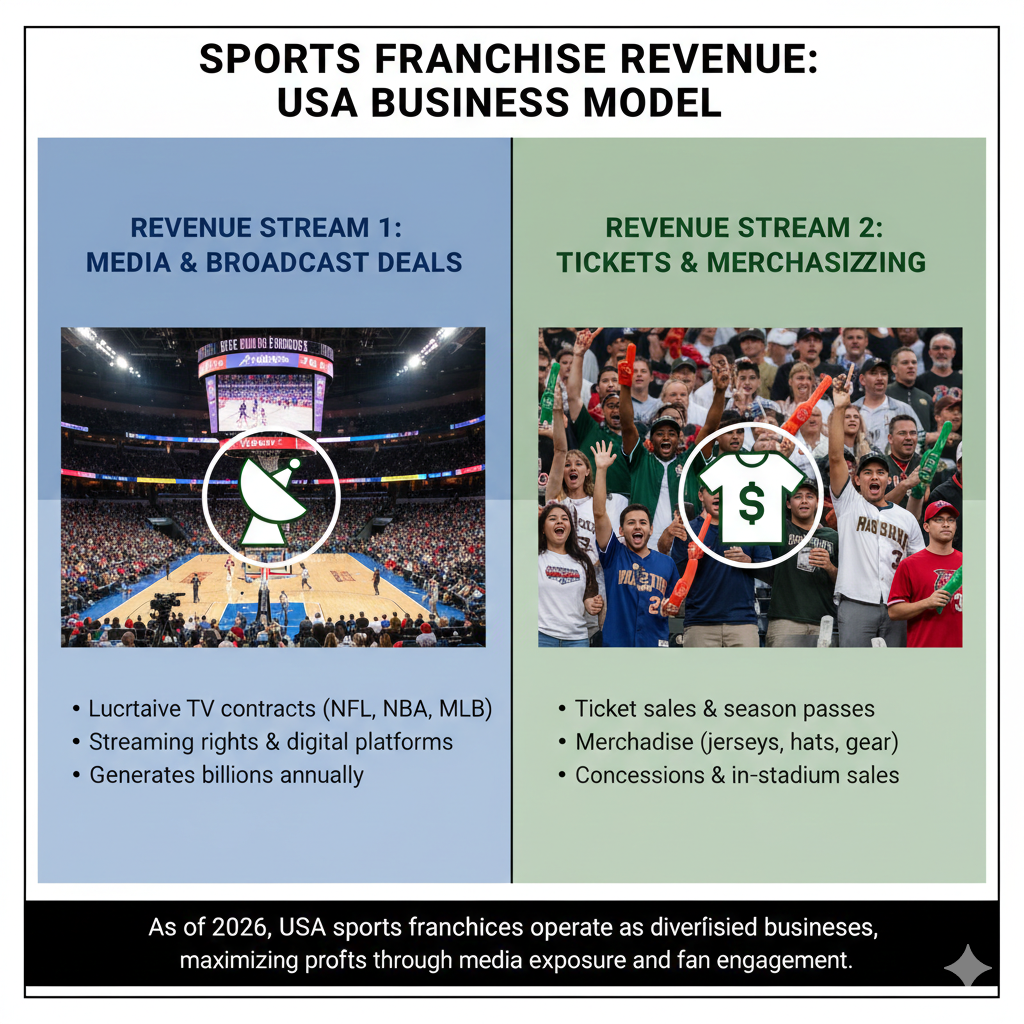
The single largest driver of revenue for modern sports franchises is media rights. We are living in the golden age of live sports broadcasting. As streaming services fracture the entertainment landscape, live sports remain the only “appointment viewing” that guarantees massive, simultaneous audiences. Advertisers know this, and networks pay a premium for it.
National TV Deals
The NFL is the undisputed king of this domain. Their broadcasting contracts with partners like CBS, NBC, Fox, ESPN, and Amazon are worth over $110 billion over a decade. This money is shared equally among all 32 teams, meaning the Green Bay Packers earn the same national TV check as the New York Giants. This revenue floor ensures that every franchise remains profitable regardless of local market size.
Local and Regional Sports Networks
In leagues like the MLB and NBA, teams play significantly more games than in the NFL, creating massive inventory for local television. Teams sell the rights to air these games to Regional Sports Networks (RSNs). This is where large markets have a distinct advantage. The Los Angeles Dodgers, for instance, struck a deal worth billions for their local rights, a figure a team in a smaller market like Milwaukee simply cannot command.
Streaming Partnerships
The landscape is shifting from cable to digital. Major League Soccer’s deal with Apple TV and the NFL’s “Sunday Ticket” move to YouTube TV signal a future where tech giants, not traditional cable networks, fund the leagues. These partnerships allow franchises to reach a global, cord-cutting audience, opening up revenue streams that didn’t exist two decades ago.
Ticket Sales and Game-Day Revenue
Before the TV explosion, “the gate”—revenue from ticket sales—was everything. While its percentage of total revenue has shrunk, it remains vital for cash flow.
Ticket Pricing Strategies
Gone are the days of fixed prices printed on a ticket stub. Teams now use dynamic pricing algorithms similar to airlines. A Tuesday night game against a last-place team might cost $20 to attend, while a Saturday night rivalry game sees that same seat jump to $150. This maximizes revenue for high-demand events while ensuring the stadium doesn’t sit empty during low-demand matchups.
Premium Seating and Suites
The real money in the stadium isn’t in the nosebleeds; it’s in the luxury boxes. Corporate suites are leased for hundreds of thousands of dollars a season. These provide consistent, contractually obligated revenue regardless of how the team performs on the field. The modern stadium is designed specifically to expand these high-margin areas, often shrinking general capacity to add more clubs and lounges.
Sponsorships and Advertising
If you watch a game, you can’t miss the logos. Corporate America views sports as one of the safest and most effective ways to build brand awareness.
Jersey and Venue Sponsorships
For decades, U.S. sports resisted putting ads on jerseys, viewing the uniform as “hallowed ground.” That taboo has shattered. The NBA introduced jersey patches, followed by the NHL and MLB. These patches are prime real estate, often selling for millions annually. Furthermore, venue naming rights turn stadiums into giant billboards. SoFi pays a reported $600 million over 20 years to have its name on the Rams/Chargers stadium in Los Angeles.
Brand Partnerships
Beyond the jersey, teams have “official partners” for everything. An official beer, an official bank, an official truck, an official pizza. These category exclusivities force brands to bid against each other, driving up the sponsorship price.
Merchandising and Licensing
When a fan buys a jersey, a hat, or a video game, the franchise gets a cut.
Apparel, Collectibles, and Royalties
Merchandise revenue is often a mix of local and national money. In the NFL, merchandise revenue is shared. If you buy a Patrick Mahomes jersey, the revenue is pooled and split among all teams (with the exception of the Dallas Cowboys, who have a unique arrangement). This incentivizes the league to market its stars globally.
Online and In-Stadium Sales
While physical team stores are cash cows on game days, e-commerce has expanded the reach. A fan in Tokyo can order a Golden State Warriors hoodie as easily as a fan in San Francisco. Licensing also extends to digital goods, trading cards, and the massive video game market (Madden, NBA 2K), which serves as both a revenue stream and a marketing tool for the next generation of fans.
Revenue from Concessions and In-Stadium Sales
The “captive audience” effect makes concessions incredibly profitable. Once a fan is through the turnstiles, the team controls the food and drink options.
Food and Beverage Profits
The markup on concessions is legendary. A beer that costs the venue $1 to procure might sell for $14. However, the modern fan demands more than a lukewarm hot dog. Stadiums have transformed into culinary destinations featuring local celebrity chefs, craft breweries, and gourmet options. This “premiumization” of concessions encourages fans to arrive earlier and spend more.
Fan Experience Upgrades
Teams now monetize access. Fans can pay extra for field-level access during warmups, fast-pass entry lanes, or commemorative photos. These micro-transactions add up, extracting value from the fan experience beyond the price of the seat.
Digital and Media Revenue
Franchises are now media companies in their own right. They produce documentaries, podcasts, and endless social media content.
Social Media Monetization
A viral clip on Twitter or TikTok isn’t just good for morale; it’s monetization. Teams sell sponsored content series on social media (e.g., “The Verizon Play of the Game”) and earn ad revenue from video views on platforms like YouTube.
Direct-to-Consumer Platforms
Some ownership groups, like the Yankee Global Enterprises (YES Network) or Madison Square Garden Sports, have launched their own streaming apps. They charge fans a monthly subscription to watch games and exclusive content directly, cutting out the cable middleman and keeping all the data and revenue for themselves.
Revenue Sharing and League Distributions
To understand U.S. sports economics, you must understand revenue sharing. Leagues understand that if the same two teams win every year because they have the most money, fans in other cities will tune out.
Shared National Revenues
In the NFL, roughly 60% to 70% of revenue is shared. This includes the massive national TV contracts and licensing deals. This socialist-style revenue sharing ensures that the Green Bay Packers (a small market) can compete financially with the Chicago Bears.
Competitive Balance Goals
Leagues also implement “luxury taxes.” If a team like the New York Mets spends significantly more on player salaries than the league threshold, they must pay a tax. This money is often redistributed to lower-revenue teams, theoretically helping them retain talent and stay competitive.
How Market Size Affects Franchise Revenue
Despite revenue sharing, geography is destiny for certain income streams.
Large-Market vs. Small-Market Teams
A team in New York, Los Angeles, or Chicago has a natural advantage. They have millions more potential ticket buyers and a much larger audience for local TV and radio advertisements. This allows them to generate significantly higher local revenue, which is usually not shared with the league.
Fan Base and Media Reach
This disparity creates a divide. Small-market teams (like the Pittsburgh Pirates or Oklahoma City Thunder) must rely on smart drafting and development because they often cannot afford the massive free-agent contracts that large-market teams can absorb through their higher local revenues.
Playoffs, Championships, and Revenue Boosts
Winning isn’t everything, but it is profitable. Making the postseason is a massive financial windfall.
Postseason Ticket Sales
Players are not paid their regular salaries during the playoffs (they receive a separate league pool bonus), meaning the owners keep a massive chunk of the gate revenue for playoff home games. A deep playoff run can add tens of millions of dollars in pure profit to a team’s bottom line.
Increased Sponsorship Value
A championship team becomes a national brand. The Golden State Warriors dynasty transformed them from a mid-tier franchise into the most valuable team in the NBA. Winning attracts bandwagon fans, drives national merchandise sales, and allows the team to raise ticket and sponsorship prices significantly the following season.
Role of Athlete Star Power
Sometimes, a single human being is the business model.
Merchandise Sales Impact
When the Dodgers signed Shohei Ohtani, or Inter Miami signed Lionel Messi, the financial impact was immediate. Jersey sales skyrocketed. International broadcasting interest surged. These “superstars” pay for themselves by expanding the total addressable market of the franchise.
Ticket Demand and Media Attention
Stars create “must-see” events. The “Caitlin Clark effect” in the WNBA is a prime example, where opposing teams moved games to larger arenas to accommodate the ticket demand created by a single rookie player. Stars create gravity, pulling in casual fans who otherwise wouldn’t spend money.
College Sports vs. Professional Franchise Revenue
It is impossible to discuss U.S. sports revenue without touching on the NCAA, a multi-billion dollar industry disguised as amateur athletics.
Different Funding and Profit Models
While pros rely on owners, college programs rely on boosters and donors. The biggest college football programs (like Alabama or Ohio State) generate revenue that rivals professional teams through massive TV deals and stadium capacities that exceed 100,000. However, they don’t pay salaries in the traditional sense, reinvesting that money into lavish facilities to recruit new talent.
NIL Impact on College Sports
The recent introduction of Name, Image, and Likeness (NIL) rights has blurred the lines. College athletes can now be paid by sponsors. While universities don’t pay this directly, the ability of a school’s donor base to fund these deals has become a critical factor in recruiting, essentially creating a proxy salary cap system.
Challenges to Franchise Revenue Growth
The graph doesn’t always go up to the right. Franchises face significant headwinds.
Rising Player Salaries
As revenue grows, players rightly demand their share. Salary caps rise annually, meaning teams must constantly generate more revenue just to maintain the same profit margins.
Stadium Costs and Fan Affordability
Building modern stadiums costs billions. While owners often seek taxpayer funding, public sentiment has turned against subsidizing billionaires. If owners have to privately finance stadiums, it creates massive debt service. Furthermore, as ticket prices rise to cover these costs, the average family is priced out, threatening the long-term cultivation of young fans.
Future Revenue Trends in U.S. Sports
The industry is evolving rapidly to find new cash flow.
Streaming-First Media Deals
The cable bundle is dying. The future is direct-to-consumer streaming, where leagues might eventually bypass networks entirely to sell subscriptions directly to fans globally.
Global Fan Monetization
The U.S. market is saturated. Growth lies abroad. The NFL playing games in London, Germany, and Brazil is a strategic move to convert international sports fans into customers. If the NFL can capture even a fraction of the global soccer audience, revenues will explode.
Data and Fan Engagement Tools
The integration of sports betting is the new frontier. Teams and leagues are partnering with sportsbooks to integrate betting directly into the broadcast and stadium experience. This gamification keeps fans engaged even during blowouts and opens a massive new category of sponsorship revenue.
The Bottom Line
When you look at the scoreboard, you see the score of the game. When an owner looks at the scoreboard, they see advertising inventory. U.S. sports franchises are masters of monetization, turning emotional attachment into diversified revenue streams that are resilient, scalable, and incredibly lucrative. As technology evolves and the world gets smaller, these franchises will only continue to grow, proving that in America, the business of sports is the undisputed champion.
FAQs – Sports Franchise Revenue
What is the biggest revenue source for sports teams?
For most major U.S. franchises (especially in the NFL), the biggest source is national media and broadcasting rights. These multi-billion dollar TV deals are shared among teams and provide a massive financial safety net.
Do teams make money from ticket sales alone?
No. While ticket sales (the gate) are important, they rarely cover the massive operating costs and player salaries on their own. Teams rely heavily on broadcasting, sponsorships, and merchandise to turn a profit.
How do small-market teams survive financially?
Revenue sharing is the lifeline for small markets. In the NFL, huge national TV contracts are split equally. In the MLB and NBA, richer teams pay into a revenue-sharing pot that is distributed to teams with lower local revenues to ensure they stay afloat.
Do owners profit every season?
Not always in terms of cash flow. Some teams operate at a loss or break even annually. However, the owners almost always profit in the long run because the value of the franchise appreciates significantly over time.
How is revenue shared in U.S. sports leagues?
It varies by league. The NFL shares the vast majority of revenue (TV, licensing, merchandise) equally. The MLB shares less, allowing teams with big local TV deals (like the Yankees) to keep more money, which creates a larger disparity between rich and poor teams.
Leave a Reply