

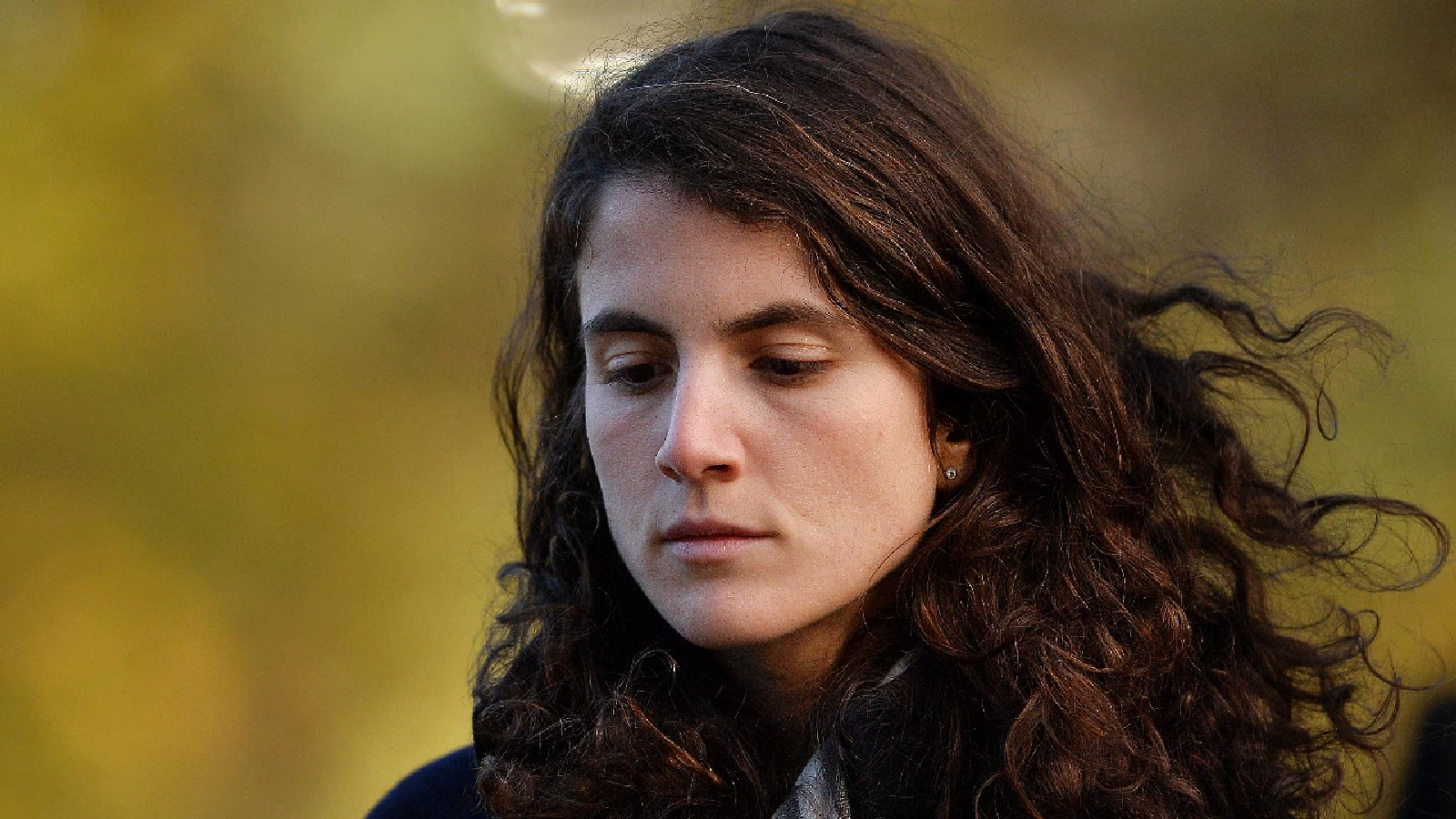
In the landscape of American journalism, few transitions capture the imagination quite like a move between the industry’s two most venerable giants: The New York Times and The New Yorker. These publications represent the pinnacle of their respective forms—the relentless, daily pursuit of fact and the thoughtful, patient craft of narrative. For Tatiana Schlossberg, navigating a path between these two institutions has been more than a career trajectory; it has been a public masterclass in the evolution of modern reporting.
Schlossberg’s name has appeared in bylines that many journalists spend a lifetime chasing. Yet, her rise isn’t just about the prestige of the mastheads she writes for. It is about a distinct shift in how stories are told in the 21st century. She has moved from the high-pressure environment of the Metro and Science desks, where speed and accuracy are currency, to the analytical and literary world of magazine writing.
This evolution mirrors a broader trend in media where the lines between hard news and narrative storytelling are increasingly blurred. Readers no longer just want to know what happened; they want to know how it feels, what it means, and where it fits into the history of our planet. Schlossberg’s work, particularly her focus on climate change and the environment, sits exactly at this intersection. By examining her journey, we gain insight not just into one writer’s career, but into the changing demands of journalism itself.
Who Is Tatiana Schlossberg?
To understand the journalist, one must look past the surname, though it inevitably draws attention. Tatiana Schlossberg is the daughter of Caroline Kennedy and designer Edwin Schlossberg, making her the granddaughter of President John F. Kennedy and First Lady Jacqueline Kennedy Onassis. While this lineage places her firmly in the public eye, her professional reputation has been built on column inches and reporting rigors rather than family legacy.
Brief background and education
Schlossberg attended Yale University, where she honed her writing skills, and later earned a master’s degree in American History from the University of Oxford. This academic background in history is frequently evident in her reporting. She rarely treats a story as an isolated incident; instead, she contextualizes current events within broader historical frameworks. This ability to look backward to explain the present is a hallmark of high-level journalism.
Entry into journalism
Her entry into the field was traditional, favoring the “beat reporter” grind over immediate punditry. She didn’t start with opinion columns or television spots. Instead, she began with internships and early roles that required unglamorous, shoe-leather reporting. This included time at The Bergen Record in New Jersey, a rigorous training ground for local news.
Early interests and reporting style
From the outset, Schlossberg displayed a curiosity about how systems work—and how they fail. Her early reporting style was direct and observational. She developed a knack for finding the human element within dry policy or environmental data. Whether covering local crime or city politics, she approached stories with a detached, observant eye, a necessary skill for the path she was about to take at the “Gray Lady.”
Tatiana Schlossberg at The New York Times
Landing a role at The New York Times is often viewed as the summit of a reporting career. For Schlossberg, it was a crucible that forged her technical skills. Her tenure there was defined by the relentless pace of a daily newspaper, where the morning deadline is absolute and accuracy is non-negotiable.
Roles and responsibilities at NYT
At the Times, Schlossberg worked primarily as a reporter on the Science desk, though she also cut her teeth on the Metro desk. The Metro section of the Times is legendary for being a sink-or-swim environment. It requires reporters to cover everything from subway delays to city hall politics, often filing multiple updates throughout the day. This role demands agility. A reporter must be able to digest complex information instantly and translate it into clear, concise prose for a general audience.
Major beats and notable stories
Schlossberg eventually found her niche covering climate change and the environment. This was a critical beat. During her time there, the conversation around climate change was shifting from theoretical science to immediate crisis. Her stories often highlighted this urgency. She reported on everything from the changing migration patterns of birds to the impact of climate policy on urban infrastructure.
One of her strengths was translating dense scientific studies into readable news. For example, she didn’t just report that temperatures were rising; she reported on what that meant for specific ecosystems and local economies. She made the abstract concrete.
Writing tone and journalistic approach
The Times style guide is specific. It favors the “inverted pyramid” structure—most important information at the top, context at the bottom. It prioritizes objectivity and neutrality. During this phase of her career, Schlossberg’s writing was crisp, authoritative, and fact-forward. There was little room for the first-person “I” or meandering philosophical musings. The goal was to inform the public record.
Skills developed during her tenure
The skills she sharpened at the Times are the foundation of all good non-fiction writing: deep research, interviewing diverse sources, and the ability to synthesize conflicting data points. Perhaps most importantly, she learned the discipline of brevity. When you have a word count limit and a print deadline, every adjective must fight for its life. This economy of language would serve her well even as she moved toward longer formats.
Transitioning From NYT to The New Yorker
The shift from The New York Times to writing for The New Yorker (and eventually writing books) represents a significant pivot in a writer’s creative life. It is a move from the “what” to the “why.”
Why the move matters in media circles
In the media industry, The New York Times is the paper of record, while The New Yorker is the magazine of record. The former drives the daily conversation; the latter shapes the cultural and intellectual understanding of that conversation over time. For a journalist to find success in both arenas is a testament to immense versatility. It suggests an ability to operate at two different speeds: the sprint of the news cycle and the marathon of long-form essays.
Differences between the two publications
The editorial differences between the two are stark.
- Pace: The Times is daily (sometimes minutely). The New Yorker is weekly, with stories often in development for months.
- Voice: The Times traditionally suppresses the writer’s voice in favor of institutional authority. The New Yorker hires writers specifically for their unique voice and perspective.
- Structure: News articles are structured for scanning. Magazine features are structured for immersion.
How her writing evolved with the shift
As Schlossberg began to move away from daily reporting (she left the Times staff in 2017 to write her book, Inconspicuous Consumption), her writing began to breathe. She was no longer constrained by the rigid structure of a news report. She could employ narrative devices, historical tangents, and a more conversational tone. This period marked her transition from a reporter of facts to an interpreter of truths.
Tatiana Schlossberg’s Work at The New Yorker
Schlossberg’s contributions to The New Yorker and similar high-brow publications highlight a matured journalistic identity. Here, she is able to explore the nuance that is often lost in breaking news.
Topics and themes she covers
While her core subject matter—the environment—remained consistent, the angle of approach changed. Instead of simply reporting on a new carbon emission study, she might explore the cultural history of disposability or the psychological burden of climate anxiety. She connects the science to the soul. Her work often looks at the intersection of consumer culture and environmental impact, questioning not just what we consume, but why we consume it.
Long-form storytelling style
Writing for a magazine audience allows Schlossberg to use the tools of a novelist. She can set scenes. She can describe the texture of a room or the cadence of a source’s voice. This immersive style helps readers care about topics that might otherwise feel dry or depressing. By weaving facts into a compelling narrative, she keeps the reader engaged through thousands of words on complex topics.
Editorial depth and narrative focus
The depth of analysis in her later work is significant. In a news brief, a reporter might quote an expert to support a point. in a long-form essay, Schlossberg can interrogate that expert’s point, contrast it with historical data, and offer her own synthesized conclusion. This requires a level of confidence and expertise that takes years to build. It shows a writer who trusts her own command of the subject matter.
How Her Journalism Reflects a Changing Media Landscape
Schlossberg’s career path is emblematic of broader shifts in how we consume information.
Traditional reporting vs narrative journalism
Decades ago, a reporter picked a lane: newspaper or magazine. Today, the most successful journalists are hybrids. The modern reader is bombarded with headlines on social media; they don’t need a newspaper to tell them that a hurricane hit. They need a writer to explain the climatological and sociological factors that made the hurricane so devastating. Schlossberg’s move toward narrative journalism reflects a market that values depth and context over mere speed.
Adapting to modern reader expectations
Audiences today crave authenticity. They are skeptical of the “voice from nowhere” objectivity of the past. They prefer writers who acknowledge the complexity of a situation. Schlossberg’s evolution caters to this. Her work feels researched yet accessible, authoritative yet human.
Role of credibility in legacy media
In an era of misinformation, brand association matters. By establishing herself at the Times, Schlossberg earned her credentials. By writing for The New Yorker, she earned her intellectual stripes. This duality gives her a unique standing. When she writes about controversial environmental topics, she brings the weight of legacy media credibility, which is essential in combating climate denialism.
Public and Industry Reactions to Her Career Path
Watching a member of a high-profile family enter journalism often invites skepticism. Is it nepotism? Is it a hobby? Schlossberg has largely silenced these critics through volume and quality of work.
Media commentary and reader response
The critical response to her work, particularly her book and her feature writing, has been robust. Critics have praised her ability to be “un-preachy.” Environmental writing can often feel scolding; Schlossberg manages to be informative and witty. Readers respond to this. They appreciate being treated as intelligent partners in the conversation rather than subjects to be lectured.
Influence within journalism circles
Among her peers, she is respected for doing the work. The “Metro desk” years at the Times earned her street cred. Journalism is a trade that respects suffering through the small stories to get to the big ones. Because she paid her dues in local and daily reporting, her transition to long-form is seen as earned, not gifted.
Why her career is closely followed
People watch Schlossberg because she represents a bridge between generations. She carries the Kennedy legacy of public service, but she applies it through the lens of a Millennial journalist tackling the existential threat of climate change. She is a modern voice with a historic echo.
What’s Next for Tatiana Schlossberg?
The trajectory suggests that Schlossberg is just getting started. The shift from daily news to books and magazines usually signals a desire to shape the larger cultural conversation.
Potential future beats or projects
It is likely we will see more book-length projects from her. The issues she covers—climate, consumption, sustainability—are too large for 800-word articles. They require the expanse of chapters. We may also see her move into documentary work or multimedia projects, formats that allow for even greater narrative scope.
Long-term impact on American journalism
Schlossberg helps validate the “beat” of climate reporting as a prestige assignment. For years, environmental reporting was niche. Writers like Schlossberg are making it mainstream, cultural, and essential.
Why her career trajectory matters
Ultimately, her journey matters because it shows that journalism is not static. It moves. It adapts. A writer can start with the who-what-where-when of a crime blotter and evolve into the how-and-why of planetary survival.
Conclusion
The evolution of Tatiana Schlossberg from a beat reporter at The New York Times to a nuanced storyteller in the vein of The New Yorker is a study in journalistic growth. It demonstrates the value of foundational skills—fact-checking, sourcing, deadline writing—in building a career capable of tackling the world’s most complex issues.
As the media landscape continues to fracture and change, voices like Schlossberg’s become increasingly vital. She combines the rigor of the old guard with the narrative empathy of the new. For readers looking to understand not just the headlines, but the world behind them, her work remains an essential guide.
If you are interested in keeping up with the latest developments in environmental journalism and storytelling, staying informed is the first step.
Subscribe to our newsletter for weekly insights into the changing world of media and journalism.
FAQ SECTION
Who is Tatiana Schlossberg?
Tatiana Schlossberg is an American journalist and author known for her reporting on climate change and the environment. She is the daughter of Caroline Kennedy and Edwin Schlossberg, and the granddaughter of President John F. Kennedy.
Did Tatiana Schlossberg work at The New York Times?
Yes, Tatiana Schlossberg worked as a reporter for The New York Times. She covered the Metro beat and later worked on the Science desk, focusing on climate change and environmental issues. She left the staff in 2017.
Why did Tatiana Schlossberg move to The New Yorker?
Schlossberg did not “move” in a direct transfer capacity; rather, after leaving the Times to write her book, she began contributing to The New Yorker. This shift allowed her to focus on long-form, analytical storytelling and essays rather than daily breaking news.
What topics does Tatiana Schlossberg write about?
Her primary focus is environmental journalism. She writes extensively about climate change, pollution, consumer habits, and the intersection of science and daily life. She is the author of the book Inconspicuous Consumption.
Leave a Reply