

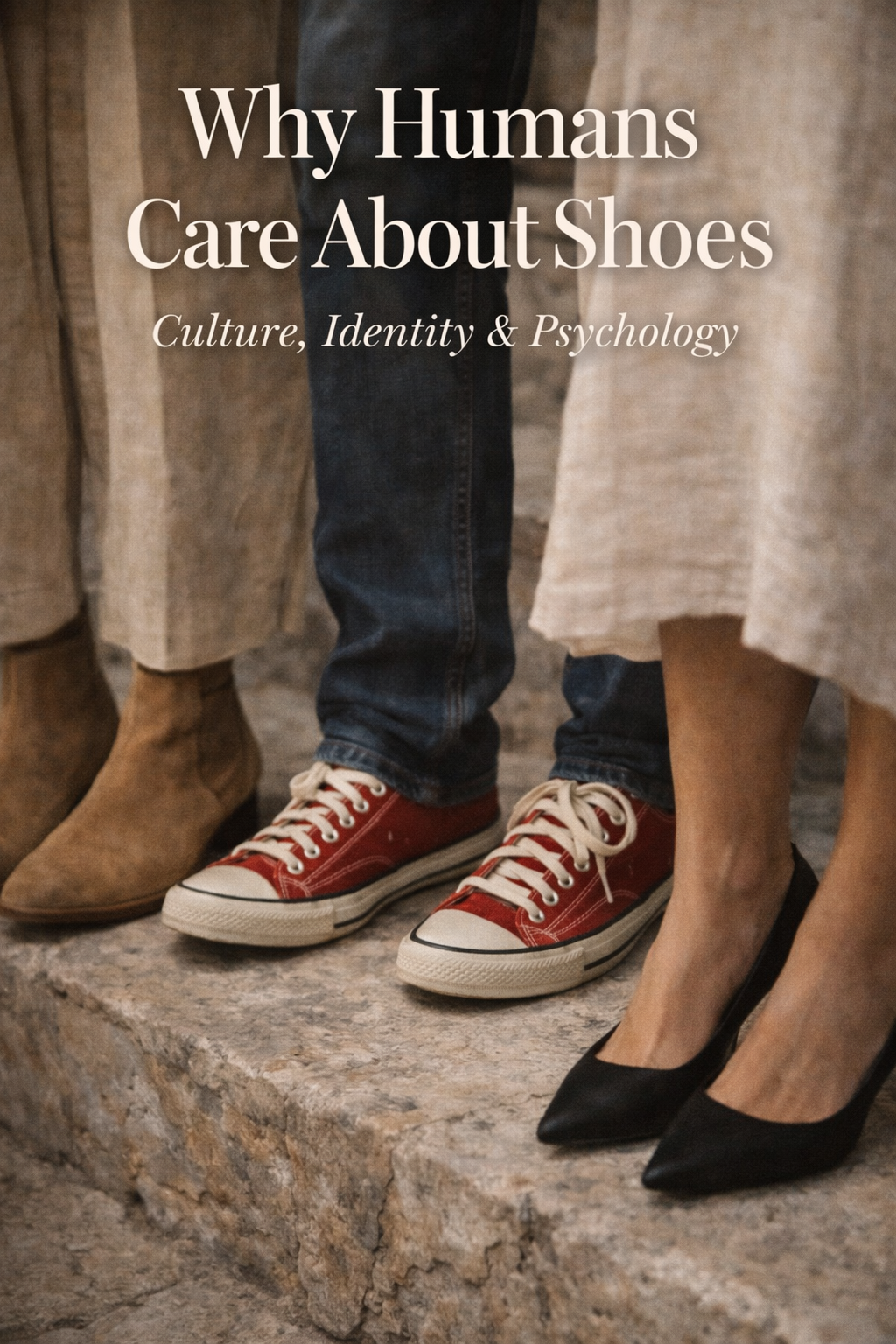
If you were to strip away the complex layers of human civilization, you would find that our basic needs are relatively simple: food, shelter, and clothing. Yet, within the realm of clothing, footwear occupies a unique and often obsessive space in the human psyche. We don’t just wear shoes to protect our feet from jagged rocks or scorching pavement; we wear them to tell the world who we are, where we come from, and where we are going.
From the gilded sandals of Egyptian pharaohs to the limited-edition sneakers dropped in downtown Tokyo, shoes have always been more than functional tools. They are artifacts of culture, markers of status, and profound psychological signals. The history of footwear is, in many ways, the history of human aspiration.
This article explores the deep-seated reasons why humans care so passionately about what they put on their feet. We will look beyond the leather and laces to understand the cultural origins, the psychology of identity, and the modern obsession with silhouettes that define our social landscape. As part of the Human Shoes Evolution Project, this piece serves as the bridge between the historical origin of shoes and the modern silhouettes we recognize today.
Read Here: The Origin of Shoes: When Humans First Started Wearing Footwear
The Cultural Origins of Shoe Meaning
To understand our modern fixation on footwear, we must look back to the moment shoes transcended utility. While the earliest foot coverings were purely for survival—bark sandals in Oregon or leather wrappings in Armenia—civilization quickly assigned them a secondary role: communication.
Early Status Symbols
In ancient civilizations, the foot was often seen as the lowest part of the body, touching the unclean ground. Therefore, elevating the foot was an act of power. In Ancient Egypt, slaves walked barefoot, while commoners wore simple woven papyrus sandals. The elite, however, wore sandals with upturned toes, sometimes adorned with gold or jewels. The very act of wearing a shoe separated the ruler from the ruled.
This dynamic appeared across the globe. In Ancient Rome, the color and style of a calceus (shoe) denoted rank. Senators wore black, while magistrates wore red. To wear the wrong shoe was not a fashion faux pas; it was a violation of social order. This early stratification laid the groundwork for the modern idea that shoes are a primary indicator of socioeconomic status. Even today, we subconsciously assess a person’s standing by glancing at their feet.
Religious and Traditional Footwear
Beyond status, shoes became vessels for spiritual and cultural values. The removal of shoes in many Eastern traditions—such as entering a Japanese home or a Muslim mosque—signifies leaving the impurities of the outside world behind. It is an act of humility and respect.
In China, the painful and now-defunct practice of foot binding was perhaps the most extreme example of culture overriding biology. The “lotus foot” was a symbol of beauty and domesticity, proving that footwear (and the shaping of the foot itself) could dictate a woman’s marriageability and social worth. While we view this with horror today, it underscores the intense power cultural narratives hold over our relationship with our feet.
These historical roots explain why we don’t just “wear” shoes; we inhabit them. They ground us in our culture and history. For a deeper dive into the specific artifacts that started it all, explore our guide on the Origin of Shoes.
Shoes as Personal Identity and Self-Expression
If history gave shoes meaning, psychology gave them personality. Today, footwear is arguably the most powerful accessory for self-expression. Unlike a shirt or trousers, which must conform somewhat to the shape of the body, shoes have a sculptural quality. They can change our height, our gait, and our silhouette, allowing us to physically embody a different version of ourselves.
Streetwear and Sneaker Culture
The rise of sneaker culture is the most potent modern example of shoes as identity. Originating in the athletic pursuit, sneakers were co-opted by hip-hop and skate culture in the 1970s and 80s to signify rebellion, creativity, and belonging.
When a teenager laces up a pair of Air Jordans, they aren’t just looking for ankle support. They are buying into the legacy of Michael Jordan—the excellence, the defiance of gravity, the “cool.” Sneakers allow individuals to signal their specific subcultural allegiances. A pair of beat-up Vans Old Skools tells a different story than a pristine pair of Balenciaga Triple S chunk sneakers. The former signals grittiness and skate heritage; the latter signals high-fashion awareness and irony.
Formal Shoes and Professional Identity
In the professional world, the shoe remains a rigid signifier of competence and conformity. The Oxford and the Derby have changed very little over the last century. Wearing a polished leather shoe signals reliability, attention to detail, and respect for tradition.
For women, the high heel has been a complex symbol of power and restriction. A stiletto alters the center of gravity, accentuating the calves and changing the wearer’s posture. For decades, it was the “power shoe” of the corporate world. However, the recent shift toward comfort and flats in the workplace signals a changing identity—one that values mobility and agency over decorative fragility.
Minimalist vs Bold Style Choices
The silhouette of a shoe speaks volumes before the wearer says a word. Minimalist shoes—think Common Projects or simple loafers—suggest an identity that values understatement, design purity, and perhaps a rejection of overt branding.
Conversely, bold, architectural shoes—like the tabi boots by Maison Margiela or the futuristic designs of Yeezy—signal a risk-taker. These choices are not accidental. We curate our shoe racks to reflect the multifaceted nature of our personalities. We might wear practical boots for the commute (the survivor), loafers for the meeting (the professional), and neon runners for the gym (the athlete).
To understand how these shapes communicate, read our analysis on Shoe Silhouettes Explained.
The Psychology Behind Sneaker Culture
While all fashion taps into psychology, sneaker culture has developed its own unique behavioral economy. It triggers specific cognitive biases and emotional drivers that go far beyond aesthetics.
Collecting Behavior
For many “sneakerheads,” shoes are collectibles akin to art or stamps. This collecting behavior is often driven by the “endowment effect”—the psychological phenomenon where people ascribe more value to things merely because they own them. A collection provides a sense of control and tangible progress. Organizing, cleaning, and displaying shoes satisfies a deep human need for order and curation in a chaotic world.
Limited Releases and Scarcity
Shoe brands have mastered the psychology of scarcity. By releasing shoes in limited quantities via “drops,” they trigger the Fear Of Missing Out (FOMO). This artificial scarcity transforms a consumer good into a treasure hunt.
When a person manages to purchase a rare pair of shoes, the brain releases dopamine—the reward chemical. The difficulty of the acquisition adds to the shoe’s value. It becomes a trophy. If everyone could buy the shoe easily, it would lose its psychological potency. This is why the resale market exists; people are paying not just for the materials, but for the exclusivity the shoe represents.
Community and Belonging
Perhaps the strongest psychological driver is the need for belonging. Wearing a specific shoe can be a secret handshake. It signals membership in a tribe. If you spot someone wearing a rare collaborative sneaker, there is an instant mutual understanding. You speak the same language.
This community aspect is reinforced by online forums, Reddit threads, and conventions like Sneaker Con. The shoe becomes the catalyst for human connection, bridging gaps between people of different backgrounds who share a singular passion.
For a look at the specific models that built these communities, visit our retrospective on Classic Sneaker Silhouettes That Changed Fashion History.
How Shoe Design Influences Human Perception
As humans, we are highly visual creatures. We make snap judgments based on geometry, color, and proportion. Shoe designers understand this implicitly, using the anatomy of the shoe to manipulate how a person is perceived.
Height and Confidence
The most obvious psychological lever is height. Verticality has always been associated with dominance and authority. Platforms, heels, and chunky soles physically elevate the wearer above others. This increase in height can lead to the “embodied cognition” effect, where the physical state of the body influences the state of the mind. Simply put: feeling taller can make you feel more confident and authoritative.
Color and Personality
Color psychology plays a massive role in footwear. Black leather suggests mystery, authority, and seriousness. White suggests cleanliness, leisure (because you can afford to keep them clean), and modernity. Bright, neon colors—often found in athletic gear—signal energy, speed, and aggression.
When a consumer chooses a “colorway,” they are choosing an emotion. A grey New Balance sneaker suggests pragmatism and stability. A red stiletto suggests passion and danger. We use these colors to broadcast our current mood or the mood we wish to embody.
Structure and Movement
The structure of a shoe dictates how a person moves, and movement dictates perception. A heavy combat boot forces a grounded, deliberate stomp. This conveys toughness and resilience. A lightweight running shoe encourages a bouncy, agile step, conveying vitality and youth.
Designers manipulate the “toe spring” (the upward curve at the toe) and the heel drop to change the biomechanics of the wearer. By altering the gait, the shoe alters the wearer’s presence in a room.
For the technical breakdown of how these elements come together, refer to our Parts of a Shoe Anatomy Guide.
Modern Lifestyle and the Meaning of Different Shoe Types
In the modern era, our lives are compartmentalized, and we have developed specific shoe types to navigate these different domains. The categories of footwear we choose are essentially costumes for the various roles we play in society.
Sneakers as Casual Identity
The sneaker has conquered the world because the modern world values comfort and hybrid lifestyles. The democratization of the office (Silicon Valley style) meant that the CEO could wear the same shoes as the intern. Sneakers represent the blurring of lines between work and play. They are the footwear of the “always-on” generation, ready to pivot from a meeting to a social event without a costume change.
Boots as Strength and Protection
Boots have retained their primal association with protection. Whether it’s a Timberland construction boot or a sleek Chelsea boot, the high ankle and sturdy construction signal preparedness. In fashion, boots are often used to add “edge” or “weight” to an outfit. They ground the wearer, suggesting that they are ready for the elements, whether those elements are a muddy field or a gritty city street.
Loafers as Elegance
The loafer represents the ultimate luxury: the absence of labor. No laces, no buckles—just slip on and go. Historically associated with the leisure class, loafers today strike a balance between formal and relaxed. They suggest a person who values elegance but refuses to be uncomfortable. The resurgence of the loafer in streetwear suggests a desire to reclaim “dressing up” without the rigidity of the Oxford.
For a comparative look at these categories, see our Sneakers vs Boots vs Loafers Guide and the Complete Guide to Types of Shoes.
The Evolution of Emotional Connection With Shoes
Our emotional connection to shoes is not static; it evolves alongside technology and society.
From Industrialization to Personalization
During the Industrial Revolution, shoes became mass-produced. While this made them accessible, it stripped them of individuality. Everyone wore the same factory-made boots. The late 20th and early 21st centuries have seen a swing back toward personalization.
Nike ID (now Nike By You) and similar services allow consumers to become co-designers. We can now imprint our names, choose our colors, and select our materials. This customization deepens the emotional bond. The shoe is no longer just a product of a corporation; it is a product of us.
Social Media and Fashion Culture
Instagram and TikTok have accelerated the visual importance of shoes. “Shoefies” (shoe selfies) and unboxing videos focus entirely on the feet. In a digital square crop, the shoe is often the easiest way to flex wealth or taste. You might not see the whole outfit, but the shoe is instantly recognizable. This has led to “hype culture,” where the visual impact of the shoe on a screen is sometimes more important than its comfort on the foot.
To see how we got here, trace the timeline in our article on the Evolution of Shoes Through History.
The Future Psychology of Shoes
As we look forward, the psychology of footwear is entering a strange new phase, blending the physical and the digital.
Digital Fashion Identity
We are entering the era of the “metaverse” and digital fashion. People are now buying NFT sneakers—shoes that do not exist in the physical world—for their digital avatars. This proves that the idea of the shoe (status, identity, aesthetics) is arguably more important to humans than the function of the shoe. We care about shoes even when we can’t wear them.
AI Personalization
Artificial Intelligence will soon allow for hyper-personalization, not just in color, but in fit. Ideally, shoes will be printed to the exact biomechanics of the wearer’s foot. This shifts the psychology from “fitting in” (buying what everyone else has) to distinct individuality (buying what only fits you).
Sustainable Identity
As climate anxiety grows, our identity is increasingly tied to our ethics. The future of footwear psychology will be heavily influenced by sustainability. Wearing shoes made from mushroom leather, ocean plastic, or upcycled materials will become the new status symbol—signaling moral capital rather than financial capital.
For a glimpse into this brave new world, proceed to our forward-looking piece: Future of Shoes: Technology & Innovation.
Shoes as a Mirror of Human Culture
Why do humans care about shoes? Because they are the foundation upon which we stand. They are the meeting point of the human body and the earth, the intersection of biology and culture.
We care about them because they hold our history. We care about them because they project our future. Whether it is a battered pair of work boots that tells a story of hard labor, or a pristine pair of high-fashion heels that tells a story of aspiration, shoes are the silent narrators of our lives. They are mirrors reflecting our values, our insecurities, and our dreams.
As you look down at your feet today, ask yourself: What story are you telling?
To continue exploring the vast world of footwear, visit our Authority Hub: Complete Guide to Types of Shoes.
Leave a Reply