

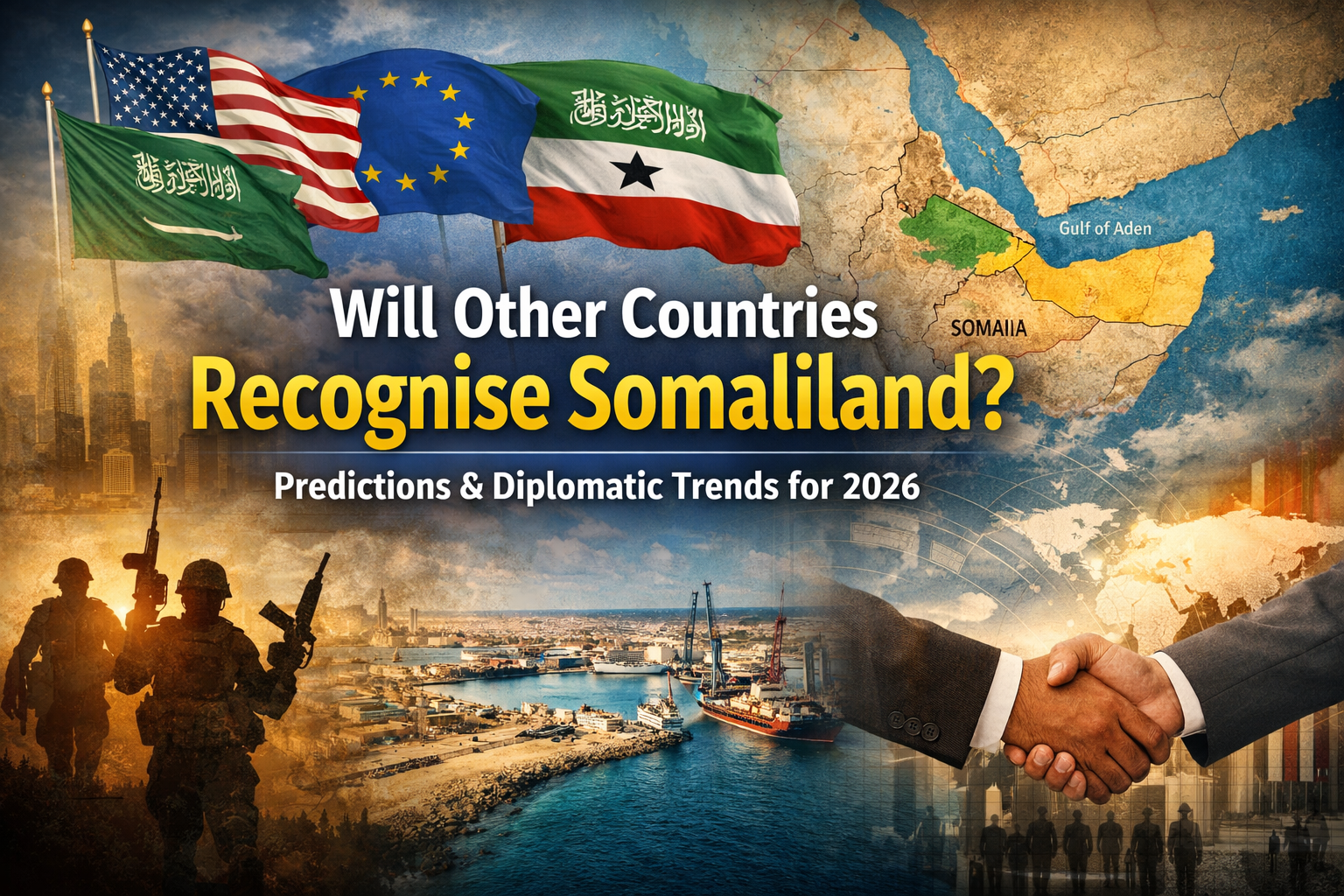
For over three decades, the Republic of Somaliland has existed in a state of diplomatic purgatory. It functions as a sovereign nation—complete with its own currency, passport, military, and democratic elections—yet it has remained invisible on the world map, legally tethered to Somalia in the eyes of the international community. That status quo, however, was shattered late last year.
In a move that sent shockwaves through the African Union and global diplomatic corridors, Israel became the first UN member state to officially recognize Somaliland’s independence in late 2025. This historic decision has fundamentally altered the geopolitical landscape of the Horn of Africa. What was once a theoretical debate about self-determination has now become a tangible diplomatic reality.
As we move further into 2026, the question is no longer if Somaliland can achieve recognition, but who will be next. The taboo has been broken. Now, global powers, regional neighbors, and strategic partners are recalculating their positions. Will this spark a domino effect, or will Somaliland remain an outlier with limited friends? This article explores the diplomatic trends, expert predictions, and key players that will define Somaliland’s path in 2026.
Why Somaliland’s Recognition Matters
To understand the gravity of the current situation, one must look at Somaliland’s unique trajectory. Reclaiming its independence from Somalia in 1991 following a brutal civil war, Somaliland did not descend into anarchy. Instead, it built a homegrown democracy using traditional conflict resolution mechanisms.
While southern Somalia struggled with warlordism, piracy, and Al-Shabaab insurgency for decades, Somaliland maintained relative peace and stability. It has held multiple one-person, one-vote presidential elections—a rarity in the region. This sharp contrast has long been Somaliland’s primary argument for recognition: it is a state that actually works.
Beyond its internal success, Somaliland’s geography makes it a prize in the game of global strategy. Sitting on the southern coast of the Gulf of Aden, it overlooks the Bab el-Mandeb strait, a chokepoint through which a significant portion of the world’s oil and commercial shipping passes. Recognition is not just about correcting a historical anomaly; it is about securing influence over one of the world’s most critical maritime trade routes.
Key Factors Influencing Recognition in 2026
Several converging forces are pushing the recognition agenda forward in 2026. It is a complex mix of great power competition, economic ambition, and shifting regional alliances.
Geopolitical Shifts and Strategic Partnerships
The Horn of Africa has become a crowded theater for global powers. The United States, China, Russia, Turkey, and various Gulf states all maintain military or commercial bases in the region. The desire to secure a foothold in Somaliland is driving a wedge between traditional diplomatic protocols and strategic realism.
Western powers, particularly the U.S. and the UK, are increasingly concerned about China’s dominant presence in Djibouti and its growing influence in the Red Sea. Recognizing Somaliland—or at least deepening ties to the point of de facto recognition—offers a way to counterbalance competing influences without relying solely on Djibouti or the volatile politics of Mogadishu.
Economic and Security Interests
The Port of Berbera is the economic engine driving this diplomatic shift. Managed by DP World (a UAE-based giant), the port has transformed Somaliland into a viable trade corridor for landlocked Ethiopia. For international investors, legal uncertainty is bad for business. Full recognition would allow Somaliland to access international credit markets, World Bank loans, and direct foreign investment with legal protections.
Security is the other side of the coin. With tensions rising in the Red Sea due to proxy conflicts and piracy resurgence, navies require reliable partners. Somaliland’s coast guard has been effective, and its stability offers a safe harbor. Nations looking to secure their shipping lanes are finding it increasingly difficult to ignore the government in Hargeisa.
Regional Politics and African Union Stance
The African Union (AU) has historically been the biggest hurdle. The AU adheres strictly to the 1964 Cairo Declaration, which pledged to respect colonial borders inherited at independence. While Somaliland argues it is respecting colonial borders (as the former British Somaliland protectorate merging with Italian Somaliland), the AU fears that recognizing a separatist region could trigger secessionist movements across the continent.
However, the AU’s grip on this narrative is slipping. With Israel breaking the seal, the argument that “no one else has done it” is no longer valid. In 2026, we are seeing intense debate within the AU, with some member states questioning whether the “Somalia First” policy is sustainable given the realities on the ground.
Countries Most Likely to Recognise Somaliland
Following Israel’s precedent, several nations are currently reviewing their foreign policy. Here are the most likely candidates to make a move in 2026.
United States
Washington has been flirting with closer ties for years. The National Defense Authorization Act (NDAA) for Fiscal Year 2023 famously included provisions for direct engagement with Somaliland. The U.S. military has expressed interest in using Berbera as a contingency hub.
While full recognition is a significant leap for the U.S., the diplomatic friction between Washington and the central government in Mogadishu has grown. If the U.S. feels its strategic interests in the Red Sea are threatened, or if China makes a move to woo Hargeisa, the State Department may fast-track a recognition policy to lock in Somaliland as a pro-Western ally.
Gulf States (UAE, Saudi Arabia, Qatar)
The United Arab Emirates is arguably Somaliland’s most important partner. Through DP World, the UAE has invested hundreds of millions of dollars into Berbera. They have also trained Somaliland’s security forces. The relationship is already there in everything but name.
Now that Israel has formalized ties—a country with which the UAE has the Abraham Accords—the diplomatic cover is available. The UAE generally prefers stability and business efficacy over adherence to old diplomatic norms. Saudi Arabia, eyeing Red Sea security for its Vision 2030 projects, is also watching closely.
European Union Members
The EU acts as a bloc, which makes consensus difficult. However, individual nations like the United Kingdom (the former colonial power) and Denmark have shown independence in their foreign policy regarding the Horn.
The UK holds the “pen” on Somalia at the UN Security Council, making their position awkward. Yet, the pressure from British MPs and the Somali diaspora in the UK is immense. Post-Brexit Britain is looking for new trade partners and strategic alliances. 2026 could see the UK moving toward a “recognition-lite” model, acknowledging Somaliland’s sovereignty in specific areas like trade and security, if not fully diplomatically.
Other African States
Within Africa, Ethiopia has always been the closest to recognizing Somaliland due to its reliance on the Berbera port. However, Ethiopia’s complex internal politics and its relationship with Somalia act as a restraint.
Keep an eye on smaller African nations or those with a history of independent foreign policy, such as Kenya or potentially South Africa. If a coalition of African states decides that the status quo is harming regional development, they may break ranks with the AU consensus.
Countries Less Likely to Recognise Somaliland
Despite the momentum, significant resistance remains.
Somalia will continue to vehemently oppose recognition, viewing it as a violation of its sovereignty. Mogadishu has previously severed ties with nations that encroach on its territorial claims (as seen with Guinea and Kenya in the past). Any country recognizing Somaliland must be prepared to lose its relationship with Somalia.
China is unlikely to support recognition. Beijing is sensitive to issues of sovereignty due to Taiwan. It generally supports central governments and opposes “separatist” movements. Furthermore, Somaliland has established ties with Taiwan, which antagonizes Beijing.
Egypt may also hesitate. Due to its rivalry with Ethiopia over the Nile dam, Egypt has cultivated closer ties with Somalia’s central government to pressure Addis Ababa. Recognizing Somaliland, an ally of Ethiopia, would undermine Cairo’s regional strategy.
Expert Predictions & Diplomatic Trends for 2026
What do the analysts say? We spoke with regional experts to gauge the temperature for the coming year.
The “Domino Effect” is likely to be slow but steady.
“Israel’s move was the icebreaker,” notes Dr. Sarah Ahmed, a specialist in Horn of Africa politics. “But don’t expect a flood immediately. We will likely see a ‘stepping stone’ approach in 2026. Countries will open consulates, upgrade trade offices to liaison offices, and accept Somaliland passports before issuing full diplomatic recognition.”
Transaction-based Diplomacy.
The trend for 2026 is transactional. Recognition will likely be traded for specific assets: a military base, exclusive rights to rare earth minerals, or favorable trade terms. Somaliland knows its value and is becoming a savvier negotiator.
Timeline for movement.
Most experts predict that if a second country recognizes Somaliland, it will likely happen in the second or third quarter of 2026, possibly timed around Somaliland’s Independence Day celebrations in May to maximize political impact.
What Recognition Would Mean for Somaliland
If the dam breaks and recognition flows in, the impact on the ground would be transformative.
Economic Growth and Foreign Investment
Recognition is the key that unlocks the global financial system. Currently, Somaliland cannot access loans from the IMF or World Bank. Its insurance premiums for shipping are high due to its undefined status. Recognition would slash these costs, encourage multinational corporations to set up headquarters in Hargeisa, and potentially kickstart a tourism industry along its pristine coastline.
Security and Regional Stability
A recognized Somaliland would be eligible for official bilateral military aid. This would allow for better equipment and training for its coast guard and army, bolstering the fight against piracy and terrorism in the region. It would also formalize security pacts, integrating Somaliland into the global security architecture.
Internal Governance and Institutional Strengthening
Diplomatic isolation has forced Somaliland to be self-reliant, but it has also limited its capacity. Recognition brings technical assistance, educational exchanges, and development aid that is channeled through government coffers rather than NGOs. This strengthens the state’s ability to deliver services like healthcare, education, and infrastructure to its citizens.
Challenges & Roadblocks to Recognition
The path forward is not without peril. The primary challenge remains the reaction from Mogadishu. Somalia has threatened war in the past over moves that legitimize Somaliland. While a full-scale invasion is unlikely given Somalia’s internal security challenges, proxy conflicts could destabilize the border regions.
Furthermore, the African Union may dig its heels in. If the AU feels sidelined by non-African powers (like Israel and potentially the U.S.) determining the borders of African states, they may harden their stance against recognition to protect the organization’s credibility.
Finally, there is the risk of internal tension. As investment flows in, Somaliland will need to manage resource distribution carefully to ensure that the wealth from recognition benefits all clans and regions, preventing the kind of grievances that cause instability.
Conclusion
The year 2026 is shaping up to be the most consequential year in Somaliland’s history since 1991. The precedent set by Israel has irrevocably changed the conversation. The old arguments for ignoring Somaliland—that it would cause chaos or that legal mechanisms don’t exist—are fading against the backdrop of strategic reality.
While hurdles remain, specifically from the AU and Mogadishu, the momentum is undeniable. The world is waking up to the fact that maintaining the fiction of a unified Somalia may be more dangerous than accepting the reality of an independent Somaliland. Whether through a sudden cascade of recognition or a gradual integration into the international fold, Somaliland is stepping out of the shadows.
Leave a Reply