

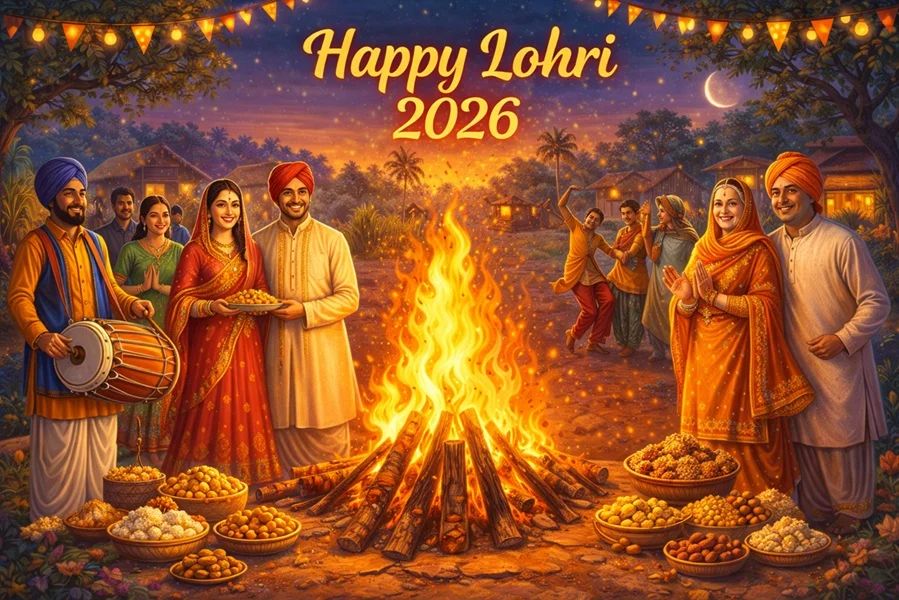
As the winter chill reaches its peak across North India, a distinctive warmth begins to spread—not just from the impending change in weather, but from the spirited preparations for one of the region’s most cherished festivals. Lohri, celebrated annually on the 13th of January, marks the culmination of winter and the harvesting of the rabi crops. It is a time when the night sky is illuminated by the amber glow of bonfires, and the air is thick with the scent of roasted sesame and jaggery.
In 2026, however, the festival represents something more than just an agricultural milestone. It stands at a fascinating crossroads where centuries-old agrarian traditions meet the high-speed demands of the digital age. While the essence of the festival—gratitude, community, and warmth—remains untouched, the expression of these values has transformed dramatically.
For many, the day still begins with a visit to the Gurudwara or temple, but it increasingly ends in settings that our ancestors might scarcely recognise. The humble courtyard gathering has expanded into grand banquet halls, and the handwritten letters of the past have been replaced by instant digital greetings that connect families across continents in seconds. As we look towards Lohri 2026, we see a festival that has successfully bridged the gap between its rustic roots and its modern, global aspirations.
The Shift: From Courtyards to Commercial Luxury
There was a time when Lohri was strictly a community affair, organised within the close-knit lanes of a village or the shared courtyards of urban neighbourhoods. Families would gather wood for days, creating a communal pile that would become the centrepiece of the night’s festivities. The charm lay in the collective effort—the shared resources, the homemade sweets, and the impromptu singing of folk songs by the women of the household.
Fast forward to 2026, and the landscape of celebration has shifted significantly, particularly in urban hubs like Jalandhar, Ludhiana, Chandigarh, and Delhi. The intimacy of the home courtyard is increasingly being swapped for the grandeur of professional banquet halls. This trend is not merely about convenience; it reflects a broader shift in social dynamics where festivals serve as premier networking events.
The Rise of Theme-Based Celebrations
Walk into a high-end Lohri celebration in 2026, and you might find yourself in a meticulously curated “village” that exists entirely indoors. Event planners are now commissioned months in advance to recreate the rustic charm of Punjab within the air-conditioned confines of luxury hotels.
These “luxury-traditional” themes are a paradox of modern celebration. You will see authentic charpais (traditional woven beds) draped in designer phulkari fabrics, and earthen pots that are stylised with LED lights. The food, once simple winter staples like sarson da saag and makki di roti, is now presented at live cooking stations by chefs who offer fusion variations—perhaps a maize tart with mustard greens mousse.
This move towards professional venues has turned Lohri into a significant economic event for the hospitality industry. It allows families to host hundreds of guests without the stress of logistics, transforming a personal family ritual into a status symbol. While purists may argue that the soul of Lohri lies in its simplicity, proponents of this evolution suggest that these grand events keep the tradition alive for a generation that might otherwise find it difficult to connect with rural customs.
The Deep Roots: Dulla Bhatti and the Spirit of Justice
Despite the glitter of banquet halls and the flash of professional photography, the beating heart of Lohri remains the legend of Dulla Bhatti. To understand why Punjabis dance around the fire, one must understand this 16th-century folk hero who lived during the reign of Mughal Emperor Akbar.
Dulla Bhatti is often referred to as the “Robin Hood of Punjab.” He was a rebel who stole from the rich to feed the poor, but his most enduring legacy is his protection of young girls. Legend has it that he rescued two Brahmin girls, Sundri and Mundri, who were being forcibly taken to be sold into slavery in the Middle East. Dulla Bhatti not only saved them but adopted them as his own daughters and arranged their marriages.
“Sunder Mundriye Ho!”
This act of defiance and paternal love is immortalised in the folk song “Sunder Mundriye,” which is sung at every Lohri celebration. The lyrics call out to Dulla Bhatti, recounting the tale of how he married off the girls with a modest dowry of sugar (shakkar) because that was all he had.
Sunder mundriye ho!
Tera kaun vicharaa ho!
Dullah Bhatti walla ho!
Dullhe di dhee vyayae ho!
Ser shakkar payee ho!
In 2026, this song is not just a catchy tune for the DJ to remix; it is a historical anchor. It reminds revellers that Lohri is, at its core, a celebration of valour, justice, and the protection of the vulnerable. It transforms the bonfire from a source of physical warmth into a symbol of spiritual light, burning away social evils. As families throw til (sesame) and rewari (sugar sweets) into the fire, they are metaphorically offering respect to the spirit of Dulla Bhatti and the values he stood for.
Cultural Evolution: Celebrating the “Lohri of Daughters”
Perhaps the most profound evolution of Lohri in recent years is the shift in who is being celebrated. Traditionally, Lohri was a major event for families who had witnessed the birth of a male child in the preceding year. The first Lohri of a son was a grand affair, marked by immense feasting and gift-giving.
However, a quiet but powerful revolution has taken hold of Indian society. The “Lohri of Daughters” or Kudiyan Di Lohri is no longer an exception; it is becoming the norm. In 2026, this shift is more visible than ever. Families are celebrating the birth of baby girls with equal, if not greater, fervour than they do for boys.
This change is a direct response to decades of gender imbalance and a conscious effort to rewrite social narratives. It signifies a move away from patriarchal preferences towards a celebration of the child, regardless of gender. In cities and villages alike, pink-themed Lohri invitations are just as common as blue ones.
The government and various NGOs have also played a role in this cultural shift, using festivals like Lohri as platforms to promote messages of “Beti Bachao, Beti Padhao” (Save the Daughter, Educate the Daughter). But the real change is happening in the living rooms of ordinary families who simply refuse to let their daughters feel any less special. This evolution turns Lohri into a festival of equality, ensuring that the warmth of the bonfire extends to every child in the household.
The Rituals: Bonfires, Bhangra, and Til-Gul
While the venues may have changed and the guest lists grown, the rituals of Lohri provide a comforting continuity. As the sun sets on the 13th of January, the focus shifts to the fire.
The bonfire is central to the festival, representing the sun god, Agni. It is believed to bring vitality and health. As the flames rise, people circle the fire (parikrama), tossing in a mixture of popcorn, peanuts, rewari, and sesame seeds. This offering is a prayer for abundance and prosperity—”Aadar aye, dilather jaye” (May honour come and poverty vanish).
The Rhythm of the Dhol
No Lohri celebration in 2026 is complete without the beat of the dhol. Whether it is a recorded track in a London apartment or live drummers in a Ludhiana farmhouse, the rhythmic beat compels everyone to join in the Bhangra or Gidda. These traditional folk dances are expressions of pure joy, mimicking the movements of farming—sowing, harvesting, and celebrating the yield.
The food, too, remains a crucial link to the past. Winter in North India is synonymous with Sarson da Saag (mustard greens curry) and Makki di Roti (cornmeal flatbread). These dishes are slow-cooked, rich in butter and love, providing the necessary warmth to combat the January frost. Even in the most lavish banquets of 2026, where sushi and tacos might be on the menu, the longest queue is invariably at the stall serving fresh, hot saag.
A Global Festival
The footprint of Lohri has expanded well beyond the wheat fields of Punjab. In 2026, it is a truly global festival. From the IT hubs of Bengaluru and Hyderabad, where diverse communities come together to celebrate, to the snowy streets of Toronto, Vancouver, and London, Lohri is a marker of identity for the Indian diaspora.
In these international settings, Lohri becomes a way to hold onto cultural roots. Community centres abroad organise massive bonfires, where children wrapped in heavy winter coats learn the story of Dulla Bhatti. It is a testament to the resilience of culture—that it can travel thousands of miles and still retain its warmth.
A Balance of Old and New
As we navigate the festivities of Lohri 2026, it is evident that the festival has managed a delicate balancing act. It has embraced the convenience and glamour of the modern world without severing its ties to tradition.
The digital era has added a new layer to the celebration. Today, sharing heartfelt wishes in Hindi or Punjabi via WhatsApp and social media is a primary ritual in itself. It allows the warmth of the festival to travel instantly, reconnecting friends and relatives who might be physically distant.
Yet, beneath the Instagram stories and the banquet hall chandeliers, the primal elements remain. The fire still burns, the sesame seeds still crackle in the heat, and the story of a hero who protected the vulnerable is still sung with gusto. Whether celebrated in a humble village street or a five-star hotel, the message of Lohri remains one of unity, hope, and the triumph of light over darkness.
May the fire of Lohri burn away all sorrows and bring the sweetness of Gur (jaggery) into your lives.
Plan Your Perfect Celebration
Whether you are planning an intimate gathering at home or a grand event, keeping tradition alive is what matters most. Explore our range of festive guides and decor ideas to make your Lohri 2026 truly unforgettable.
Leave a Reply