

The 2026 College Football Playoff National Championship will be remembered not just for the final score, but for the sheer improbability of the matchup. On one sideline stood the Miami Hurricanes, a program synonymous with swagger, five rings, and a desperate hunger to return to the mountaintop. On the other stood the Indiana Hoosiers, the ultimate Cinderella story, looking to cap off a perfect season with the first national title in school history.
While pundits spent weeks debating pedigree versus destiny, the game itself delivered a classic that exceeded the hype. It was a clash of styles and a test of wills that came down to the final minutes. For Miami, it was a chance to prove “The U” was truly back. For Indiana, it was an opportunity to shatter a century of mediocrity and rewrite the hierarchy of the Big Ten.
This wasn’t just a game; it was a changing of the guard. The atmosphere inside the stadium was electric, split between the orange and green of the faithful and the crimson wave of a fanbase witnessing history in real time. By the time the confetti fell, the college football world had been turned upside down. Here is a complete breakdown of how Indiana stunned Miami to claim the 2026 crown.
First Quarter — Fast Start and Early Momentum Shifts
The opening quarter set a frantic pace that defied the defensive expectations of both coaching staffs. Miami won the toss and elected to receive, immediately looking to establish dominance through the air. Their opening drive was a masterclass in tempo, marching 75 yards in under four minutes. However, the Hoosier defense stiffened in the red zone, forcing a field goal that felt like a win for the underdogs.
Indiana’s response was immediate and methodical. Utilizing a heavy dose of run-pass options (RPOs), they neutralized Miami’s aggressive pass rush. The offensive game plan was clear: wear down the Hurricanes’ defensive front. While neither team found the end zone in the first 15 minutes, the physicality was palpable. Missed tackles by Miami and a dropped interception by Indiana highlighted a quarter defined by nerves and adrenaline.
Second Quarter — Special Teams and Tactical Adjustments
As the second quarter began, the tactical chess match between the coaches took center stage. Miami’s defensive coordinator adjusted to Indiana’s ground game, stacking the box and daring the Hoosiers to throw deep. For a moment, it worked, forcing back-to-back three-and-outs.
Then came the spark that ignited the Hoosier sideline. With Miami pinned deep in their own territory, Indiana’s special teams unit executed a perfect punt block. The ball bounced chaotic and loose before being scooped up for a Hoosier touchdown. It was the first major momentum swing of the night.
Stunned but not broken, Miami responded with a methodical drive before halftime, managing to put points on the board. However, the coaching adjustments made in the locker room would prove crucial. Indiana held a narrow lead, but Miami had found a rhythm offensively that spelled trouble for the second half.
Third Quarter — Miami’s Comeback Attempt
The third quarter belonged to the Hurricanes. Coming out of the halftime break, Miami looked like the dynasty of old. Their quarterback found his stride, completing three deep passes that stretched the Indiana secondary to its breaking point. A quick touchdown drive silenced the crimson section of the crowd and put Miami back in front.
Indiana suddenly found themselves responding to pressure they hadn’t felt all season. The crowd noise was deafening, and Miami’s defense began to tee off on pass-rushing downs. Yet, the Hoosiers refused to fold. A crucial third-down conversion—a scramble by the quarterback when the pocket collapsed—kept their hopes alive. It wasn’t pretty, but it extended a drive that allowed the defense to rest and kept the game within a single score heading into the final frame.
Fourth Quarter — Fernando Mendoza’s Defining Moment
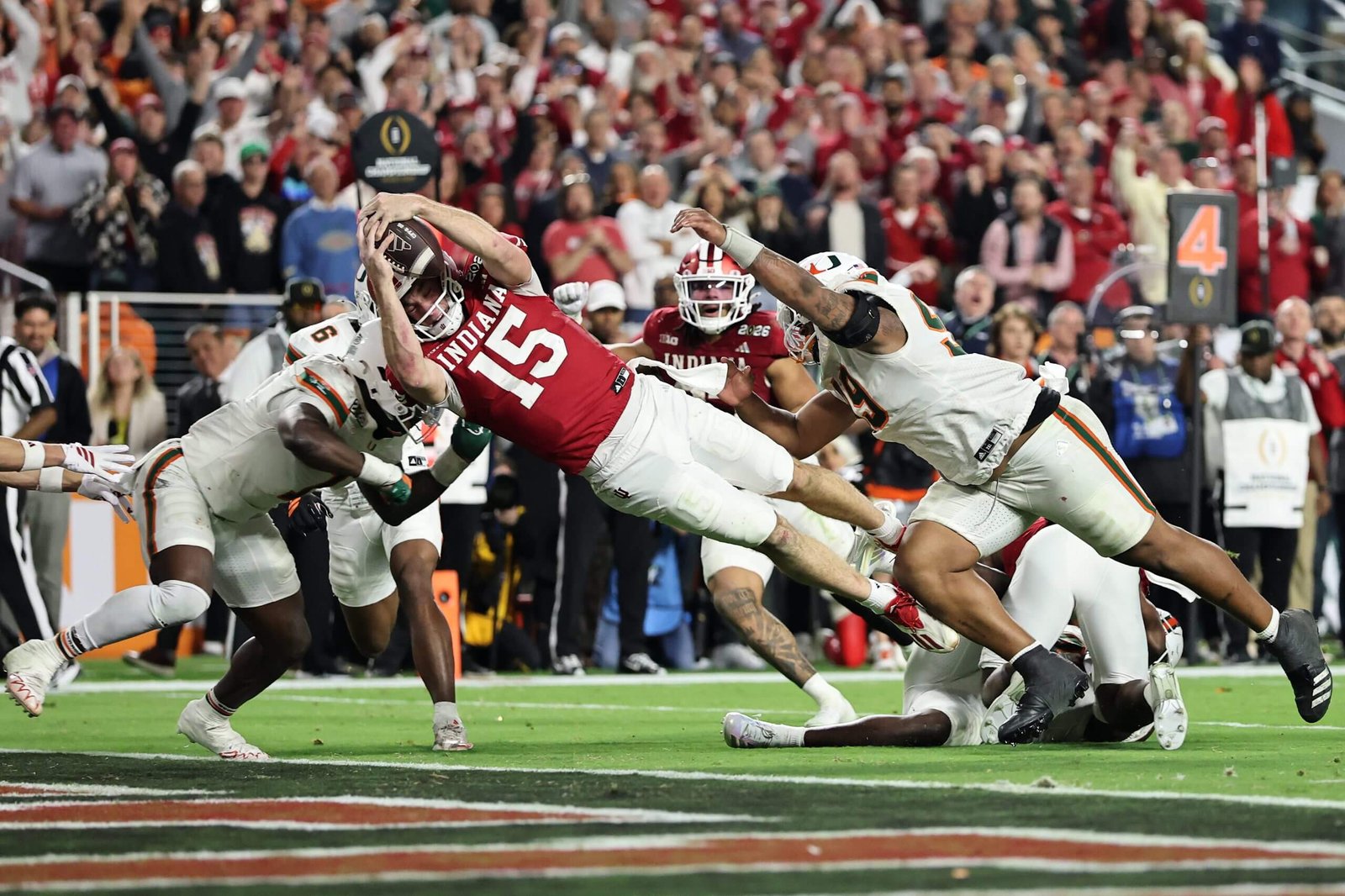
Great games are often remembered for a single play, and the 2026 Championship gave us one for the history books. Trailing late in the fourth quarter, Indiana faced a 4th-and-goal from the four-yard line. A field goal would have tied it, but the coaching staff chose aggression over safety.
Fernando Mendoza took the snap. The play design was a designed rollout, but Miami’s defensive end read it perfectly, cutting off the edge. With no open receivers and a defender bearing down, Mendoza reversed field. In a display of sheer athleticism and will, he broke two tackles and dove for the pylon.
The stadium held its breath as the replay official reviewed the spot. The call stood: Touchdown. It was a play born of desperation and brilliance, execution breaking down into pure instinct. That touchdown didn’t just give Indiana the lead; it broke Miami’s spirit.
Key Turning Points That Decided the Game
1. Fourth-Down TD by Mendoza
The decision to go for it on fourth down rather than tie the game was the boldest call of the season. Mendoza’s scramble converted a likely loss into the game-winning score, cementing his legacy in college football lore.
2. Blocked Punt for a Touchdown
In a game where yardage was hard to come by in the first half, the special teams touchdown provided Indiana with a cushion they desperately needed. It forced Miami to play from behind and take risks they weren’t comfortable with.
3. Late Interception to Seal the Win
With under two minutes left, Miami had one last chance to drive for a win. However, Indiana’s safety read the quarterback’s eyes perfectly, jumping an out-route to intercept the pass and effectively end the game.
Full Game Stats Comparison
| Stat Category | Miami Hurricanes | Indiana Hoosiers |
|---|---|---|
| Total Yards | 410 | 385 |
| Passing Yards | 320 | 215 |
| Rushing Yards | 90 | 170 |
| Turnovers | 2 | 0 |
| Time of Possession | 28:15 | 31:45 |
| Red Zone Efficiency | 2/4 | 3/3 |
Player Performances That Stood Out
Indiana Hoosiers
- Fernando Mendoza (QB): While his passing numbers weren’t eye-popping, his ability to extend plays and his gritty running style earned him MVP honors.
- Defensive Line: The unit collectively held Miami to under 100 yards rushing, forcing the Hurricanes to become one-dimensional.
Miami Hurricanes
- Offensive Standouts: The Miami wide receiving corps was spectacular, making acrobatic catches that kept them in the game until the very end.
- Defensive Leaders: The linebackers played a disciplined game, filling gaps and limiting Indiana’s explosive plays, though they struggled to contain Mendoza in the pocket.
Coaching Decisions That Shaped the Outcome
The contrast in coaching philosophies was evident throughout the contest. Indiana’s aggressive play-calling—specifically the decision to go for it on fourth down in the red zone—ultimately made the difference. They played to win, rather than playing not to lose.
Conversely, Miami’s clock management in the fourth quarter will likely be scrutinized by fans and analysts alike. Two timeouts burned early in the quarter left them scrambling during their final possession, limiting their playbook and forcing predictable throws.
What This Win Means for Indiana Football
For Indiana, this victory is monumental. Securing the first national championship in program history validates the university’s investment in football and permanently alters the perception of the program. They are no longer a “basketball school” trying to play football; they are the kings of the gridiron.
Completing a perfect season in the modern era of the expanded playoff is a rare feat. This championship will likely pay dividends on the recruiting trail for a decade, opening doors in regions where the Hoosiers previously struggled to gain traction.
What’s Next for Miami After the Loss
The loss stings, but the future remains bright in Coral Gables. Reaching the title game proves that Miami has returned to the upper echelon of college football. The roster is loaded with young talent, and the experience of this playoff run will serve as a foundation for next season.
The key takeaway for Miami is that the talent gap has closed. To win the next one, they will need to clean up the operational errors—turnovers and penalties—that plagued them in critical moments against Indiana.
Fan Reactions and Social Media Buzz
Social media erupted the moment Mendoza crossed the goal line. “The run” instantly became a meme, compared to legendary plays like Vince Young’s Rose Bowl scramble.
- “I can’t believe I just watched Indiana win a Natty. What timeline is this?” trended on X (formerly Twitter).
- Miami fans were despondent but acknowledged the grit of the opponent.
- Analysts praised the game as an instant classic, citing the drama and the fresh storyline of a first-time winner.
Frequently Asked Questions (FAQ)
Who won the 2026 CFP National Championship?
The Indiana Hoosiers defeated the Miami Hurricanes to win the title.
What was the final score of Miami vs Indiana?
The final score was Indiana 31, Miami 27.
Why was Fernando Mendoza’s touchdown so important?
It was the go-ahead score on a risky 4th-down play late in the fourth quarter, effectively deciding the outcome of the game.
Is this Indiana’s first national title?
Yes, this victory marks the first national football championship in the history of Indiana University.
Where does this game rank among CFP classics?
Due to the historic nature of the winner and the late-game drama, many analysts are already ranking it as a top-5 finish in CFP history.
A New Era Begins
The 2026 CFP National Championship was more than a football game; it was a statement. Indiana’s victory over a powerhouse like Miami proves that in the modern era of college football, the right culture and coaching can overcome decades of history. The Mendoza run will be replayed in Bloomington for generations, serving as the moment everything changed.
While Miami will surely be back, this night belonged to the Hoosiers. The perfect season is complete, the trophy is coming to Indiana, and the college football landscape will never look quite the same again.
Want to stay updated on the offseason moves for both teams? Subscribe to our newsletter for deep-dive analysis and recruiting updates.
Leave a Reply