

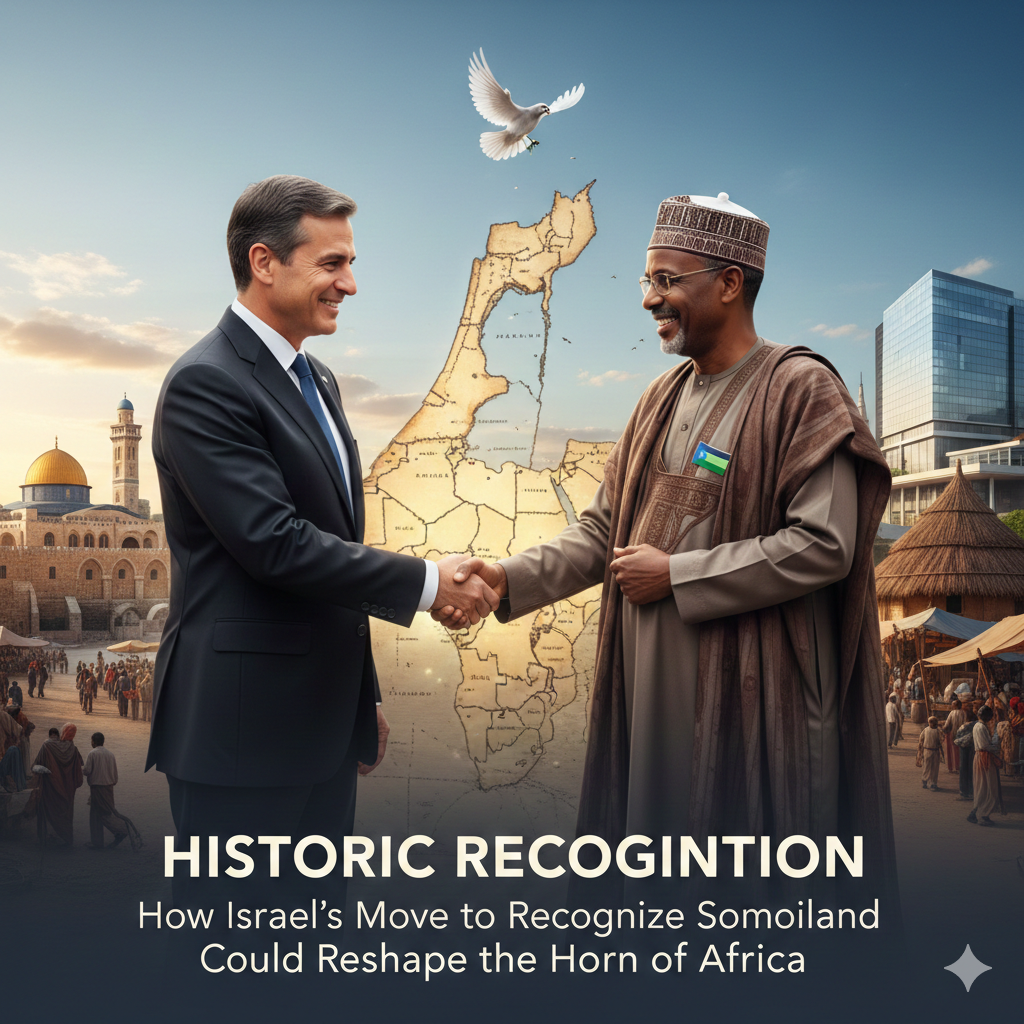
The geopolitical map of the Horn of Africa is constantly shifting, but few events carry the potential to redraw alliances quite like the recent reports surrounding Israel’s move to recognize Somaliland. For over three decades, Somaliland has operated as a de facto independent state—boasting its own government, currency, and security forces—yet it has remained isolated from the formal international community.
Israel’s reported decision to extend diplomatic recognition marks a pivotal moment. It challenges long-standing norms regarding African borders, disrupts the delicate balance of power in the Red Sea, and forces major global players to reconsider their strategies in one of the world’s most strategic maritime corridors.
Why has this move captured global attention? It’s not just about two nations establishing ties. It’s about the precedent it sets. Recognition by a UN member state—especially a significant regional power like Israel—could legitimize Somaliland’s long quest for statehood and encourage other nations to follow suit. This blog explores the history behind this decision, the strategic motivations driving it, and how it could fundamentally reshape the political and security architecture of the Horn of Africa.
Understanding Somaliland’s Quest for Recognition
To grasp the magnitude of this development, one must first understand the unique position Somaliland occupies in international politics.
A Legacy of Independence
Somaliland declared independence from Somalia in 1991 following the collapse of the Siad Barre regime and a brutal civil war. However, this wasn’t a new creation but rather a restoration. For a brief period in 1960, Somaliland was an independent sovereign state (the State of Somaliland) before voluntarily uniting with Italian Somaliland to form the Somali Republic. The union, however, was fraught with marginalization and violence, leading the northern region to reclaim its sovereignty three decades later.
A Beacon of Stability
While its southern neighbor, Somalia, has grappled with decades of insurgency, piracy, and governance challenges, Somaliland has forged a different path. It has successfully held multiple democratic elections, maintained a peaceful transfer of power, and established a functioning government. Its capital, Hargeisa, is often cited as a model of grassroots peacebuilding in a turbulent region.
Despite these achievements, international recognition has remained elusive. The African Union (AU) and the United Nations (UN) have historically hesitated to recognize breakaway states, fearing it would open a “Pandora’s box” of secessionist movements across the continent. This has left Somaliland in a legal limbo—functioning as a state in every practical sense but denied the benefits of sovereignty, such as access to international loans and direct foreign investment.
Why Israel Recognized Somaliland
The decision for Israel to engage with Somaliland is driven by a complex mix of security, economic, and diplomatic interests.
Strategic Location and Security Interests
Geography plays a massive role in this alliance. Somaliland sits on the southern coast of the Gulf of Aden, a critical choke point leading into the Red Sea and the Suez Canal. For Israel, securing this maritime route is a matter of national security.
- Red Sea Security: A friendly partner on the Horn of Africa allows Israel to better monitor maritime traffic and counter threats to its shipping lanes.
- Counter-Terrorism: The Horn is a hotspot for extremist groups like Al-Shabaab. Israel has a vested interest in strengthening stable, secular partners in the region who are committed to fighting terrorism. Somaliland’s effective security apparatus makes it an ideal partner in this regard.
Diplomatic and Economic Motivations
Beyond security, there is a clear diplomatic strategy at play. Israel has been actively working to expand its diplomatic footprint across Africa, seeking new allies to counter diplomatic pressure in international forums.
- The “Periphery Doctrine” 2.0: Historically, Israel sought alliances with non-Arab states on the periphery of the Middle East. Building ties with Somaliland fits a modern version of this strategy, creating a buffer of friendly nations.
- Trade and Infrastructure: The port of Berbera is a jewel in Somaliland’s economic crown. Managed by DP World, it is rapidly becoming a major logistics hub. Israeli technology and investment in agriculture, water management, and infrastructure could find a welcoming market in Hargeisa, while Somaliland offers a gateway to the broader East African markets like Ethiopia.
Immediate Regional Reactions
The announcement has triggered a wave of reactions, ranging from jubilation in Hargeisa to fierce condemnation in Mogadishu.
Somalia’s Response
The Federal Government of Somalia (FGS) views Somaliland as an integral part of its territory. Consequently, Mogadishu sees any direct recognition of Hargeisa as a violation of its sovereignty. Somalia has historically severed ties with nations that encroach on its territorial integrity. This move is likely to freeze any potential thawing of relations between Israel and Somalia and could lead to increased diplomatic friction.
Reactions from African Union and Neighboring States
The African Union finds itself in a difficult position. Its charter strongly emphasizes the sanctity of colonial borders inherited at independence. Recognizing a breakaway state challenges this core tenet.
- Ethiopia: As a landlocked giant relying heavily on the Port of Djibouti, Ethiopia has shown increasing interest in diversifying its port access through Somaliland’s Berbera. While officially quiet, Addis Ababa may privately welcome a move that stabilizes and legitimizes a key economic partner.
- Djibouti: Conversely, Djibouti may view Somaliland’s rise—and the concurrent rise of the Berbera port—as a direct economic threat to its dominance as the primary shipping hub for the region.
Global Community Response
The response from the wider international community is cautious. The United States and the European Union have traditionally followed a “One Somalia” policy, focusing on rebuilding the federal government in Mogadishu. However, pragmatic voices in Washington and Brussels increasingly argue for a dual-track approach that engages Hargeisa directly, especially given Somaliland’s strategic value. Israel’s move forces Western powers to confront whether their policy is outdated.
How This Recognition Could Reshape the Horn of Africa
This is not just a diplomatic formality; it is a catalyst for tangible change on the ground.
Shifting Power Dynamics
Israel’s entry into the Horn of Africa via Hargeisa alters the regional balance. It introduces a new, technologically advanced player into a space traditionally dominated by Arab and African powers. We may see new alliances form, perhaps drawing Somaliland closer to the “Abraham Accords” bloc of nations (like the UAE and Bahrain) that have normalized ties with Israel. This aligns Somaliland with a powerful axis of modernization and security cooperation.
Economic and Trade Implications
Legitimacy breeds investment. Recognition signals to investors that Somaliland is “open for business” and carries lower political risk than previously thought.
- Foreign Direct Investment (FDI): We can expect an uptick in FDI, particularly in sectors where Israel excels: agri-tech, renewable energy, and cybersecurity.
- Berbera Port: The port’s strategic importance will skyrocket. It could become a rival to Djibouti, offering an alternative route for global shipping lines and effectively breaking the existing monopoly on trade routes into the Horn.
Security and Stability Outcomes
On the security front, formal ties allow for intelligence sharing and military cooperation. Somaliland’s Coast Guard, which patrols a long stretch of coastline infested with smugglers and potential pirate threats, stands to benefit from training and equipment. This contributes to a safer Gulf of Aden, benefiting global commerce.
Could Israel’s Move Trigger a Domino Effect?
The biggest question remains: Will others follow?
Countries Most Likely to Follow
Israel is rarely a lone wolf in diplomatic shifts; its moves often coordinate with close allies.
- United Arab Emirates (UAE): The UAE already has a significant presence in Somaliland through DP World and military base agreements. Formal recognition would be a logical next step to solidify their investment.
- United Kingdom: As the former colonial power, the UK has a strong lobby supporting Somaliland. While they have held back to align with US/EU policy, Israel’s move provides cover for London to deepen its engagement.
Risks of Escalation
However, this is a high-stakes game. A “domino effect” of recognition could isolate Somalia, pushing it closer to rivals of the Israel-UAE bloc, such as Turkey or Qatar, effectively importing Middle Eastern rivalries into the Horn of Africa.
Challenges and Controversies
While the strategic logic is sound, the path forward is fraught with challenges.
International Law and Recognition Debates
Critics argue that bypassing the AU and the federal government in Mogadishu undermines international law. It sets a precedent that could destabilize other fragile states in Africa with secessionist movements, such as Cameroon or Nigeria.
Potential Strain on Israel–Somalia Relations
For Israel, the trade-off is clear: gaining a reliable partner in Somaliland at the cost of alienating Somalia. Given that relations with Mogadishu were already virtually non-existent, Jerusalem likely calculated that the benefits of a strategic foothold in Berbera outweigh the diplomatic fallout with a hostile government.
Risk of Increased Regional Tensions
There is a real risk that Somalia could react militarily or through proxy destabilization. The region is already fragile; adding a layer of sovereignty disputes could reignite dormant conflicts along the Somalia-Somaliland border.
Frequently Asked Questions (FAQs)
Why did Israel recognize Somaliland?
Israel’s decision is largely driven by strategic security interests in the Red Sea, the desire to counter terrorism in the Horn of Africa, and the economic potential of the Berbera port. It also aligns with Israel’s broader strategy of building alliances with non-hostile nations in Africa.
Is Somaliland officially recognized by the United Nations?
No. Despite functioning as an independent state since 1991, Somaliland is not a member of the UN. It is legally considered an autonomous region of Somalia by most of the international community, though Israel’s move challenges this status quo.
How does this affect Somalia?
The Federal Government of Somalia views this as a violation of its sovereignty. It weakens Mogadishu’s claim over the northern territory and undermines its efforts to centralize control over the country.
Will other countries recognize Somaliland next?
It is possible. Israel’s move breaks the diplomatic taboo. Countries with significant economic interests in Somaliland, such as the UAE or Ethiopia, may feel emboldened to upgrade their diplomatic ties, though they may wait to see the fallout before granting full recognition.
A New Chapter for the Horn
Israel’s reported recognition of Somaliland is more than a diplomatic handshake; it is a strategic realignment of the Horn of Africa. For Somaliland, it validates a thirty-year struggle for statehood and opens the door to the world. For the region, it introduces new economic opportunities and security partnerships, while simultaneously raising the stakes in an already volatile neighborhood.
As alliances shift and new players enter the Great Game of the Red Sea, the world will be watching Hargeisa closely. The status quo has been broken, and the future of the Horn of Africa is being written now.
Follow our blog for the latest geopolitical developments shaping Africa and the Middle East.
Leave a Reply