

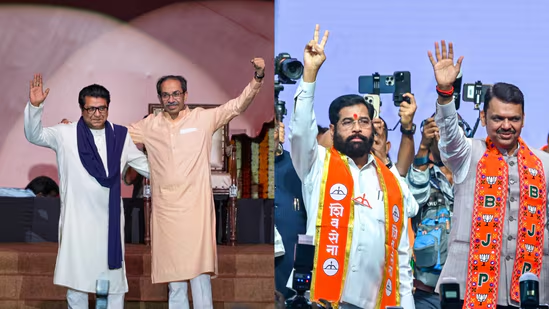
The Brihanmumbai Municipal Corporation (BMC) is distinct among civic bodies. It is an institution that rivals small states in terms of financial muscle and administrative reach. With an annual budget that often exceeds ₹50,000 crore, the BMC is the wealthiest municipal corporation in India, and controlling it is the ultimate prize in Maharashtra politics.
The latest BMC election results have been awaited with bated breath, not just by Mumbaikars, but by political observers across the nation. This election was never going to be just about garbage collection, road maintenance, or water supply. It was a litmus test for the shifting political alliances that have redefined the state’s governance over the last few years. The verdict delivered by Mumbai is complex, offering a fragmented mandate that reflects the city’s diverse and often conflicting priorities.
As the dust settles on the counting centers, the implications of these results are beginning to ripple outward from the island city to the rest of Maharashtra. The BMC election results serve as a barometer for the public mood, a verdict on the legitimacy of current leadership factions, and a preview of the high-stakes battles to come in the state assembly and national elections.
Why the BMC Election Results Carry National Weight
To understand the magnitude of the BMC election results, one must first understand the entity itself. The BMC governs India’s financial capital, a city that contributes a massive chunk to the country’s GDP. The corporation is responsible for critical infrastructure projects, including the ambitious Coastal Road project, major healthcare systems, and the complex water networks that keep the city alive.
A Financial Powerhouse
Control over the BMC is not merely about civic duty; it is about access to immense resources. The party that rules the BMC wields significant patronage power, capable of influencing contracts, development projects, and urban policy. For decades, the Shiv Sena used the BMC as its fortress, a base from which it could project power even when it was out of favor at the state level. The BMC election results, therefore, determine who holds the keys to this treasury.
The Urban Pulse
Mumbai is a microcosm of urban India. Its demographics are a complex blend of regional identities, economic classes, and migrant populations. How Mumbai votes often signals broader urban trends. Are voters leaning towards regional identity politics, or are they prioritizing development and national narratives? The results provide data points that strategists in Delhi and other state capitals study closely. A win here boosts a party’s narrative of urban acceptability, while a loss can signal a disconnect with the aspiring middle class.
A Test of Alliances
Maharashtra politics has been in a state of flux. With the fracturing of the Shiv Sena and the realignment of the NCP, traditional vote banks have been disrupted. The BMC election was the first major electoral test for these new coalitions. The results offer the first concrete evidence of whether the “Maha Yuti” (Grand Alliance) or the “Maha Vikas Aghadi” (MVA) has managed to transfer their votes seamlessly on the ground.
Key Political Players and the Battle for Supremacy
The narrative of this election was dominated by a few key storylines, primarily centering on the battle for the soul of the Shiv Sena and the aggressive expansionism of the Bharatiya Janata Party (BJP).
The Shiv Sena vs. Shiv Sena Battle
Perhaps the most scrutinized aspect of the BMC election results is the performance of the rival Shiv Sena factions. For the faction led by Uddhav Thackeray, retaining the BMC was an existential battle. The corporation has been the party’s lifeline and its emotional connection with the Marathi manoos (common Marathi man). Losing it would essentially strip the faction of its core identity.
On the other side, the faction led by Chief Minister Eknath Shinde sought validation. A strong performance in Mumbai would legitimize their rebellion and prove that the party cadre and the voter base have shifted loyalty. The results indicate a fierce tug-of-war, with voters split between emotional loyalty to the Thackeray legacy and the practical power wielded by the Shinde-BJP combine.
The BJP’s “Mission Mumbai”
For the BJP, the goal has been clear for years: to win the BMC single-handedly or as the dominant partner. They have aggressively courted the non-Marathi speaking populations of Mumbai—the Gujaratis, North Indians, and business communities—while simultaneously trying to make inroads into traditional Marathi strongholds. The BMC election results shed light on the success of this strategy. The BJP’s push was centered on a narrative of development and corruption-free governance, directly attacking the decades-long rule of the Shiv Sena in the corporation.
The Struggle for Relevance: Congress and NCP
While the saffron parties dominated the headlines, the Congress and the Nationalist Congress Party (NCP) fought their own battles. For Congress, Mumbai was once a fortress. Today, they are fighting to remain a significant third pole. The results reveal whether their traditional voter base among minorities and slum dwellers remains intact or if it has drifted towards other options. The NCP, traditionally weaker in Mumbai compared to rural Maharashtra, looked to these elections to expand its urban footprint.
Emerging Trends: Decoding the Mandate
The early trends and final tally of the BMC election results highlight several shifting dynamics in the city’s political fabric.
A Fragmented Mandate
Unlike previous years where a clear winner often emerged or a dominant coalition swept the polls, the current results point towards fragmentation. Several wards saw multi-cornered contests where victory margins were razor-thin. This fragmentation suggests that the electorate is undecided on a single narrative. It reflects the confusion caused by party splits and the fluidity of current alliances.
The Rise of the “Civic Voter”
While identity politics and emotional appeals played their part, a significant trend emerging from the results is the focus on hyper-local issues. In many constituencies, voters bypassed ideological affiliations to vote for candidates with a track record of solving local problems. Issues like chronic waterlogging, the condition of roads, redevelopment of old housing societies, and public transport connectivity were central to the voter’s choice.
This shift challenges the major parties to move beyond rhetoric. The BMC election results indicate that the urban voter is becoming increasingly transactional—demanding tangible returns on their tax money in the form of better livability.
Regional Leaders Holding Fort
Another interesting takeaway is the resilience of local strongmen and women. Irrespective of the party symbol, candidates with strong personal networks in their wards performed well. This suggests that in municipal elections, the “corporator next door” often matters more than the face of the Prime Minister or the Chief Minister.
Impact on Maharashtra’s Political Roadmap
The verdict from Mumbai is not an isolated event; it is a precursor to the larger political battles that lie ahead for the state.
Validating Leadership Claims
The BMC election results will be used to settle scores within parties. For the Shiv Sena factions, the number of seats won is the ultimate argument in the court of public opinion. If one faction significantly outperforms the other, it will likely lead to a consolidation of cadres and funds towards the winner. The loser risks fading into irrelevance. Similarly, within the BJP-Shinde alliance, the results will dictate the power dynamics. A stronger BJP performance relative to the Shinde faction could lead to the BJP asserting more dominance in state-level decision-making.
Realigning Alliance Strategies
These results act as crucial data for the upcoming assembly and Lok Sabha elections. Parties will now pore over ward-wise data to see where their alliances worked and where they failed. Did the Dalit votes transfer to the Shiv Sena (UBT)? Did the North Indian votes stay with the BJP? The answers will determine seat-sharing formulas for future elections. We may see a recalibration of strategies, with parties possibly dumping underperforming partners or aggressively wooing new ones based on the gaps revealed by the BMC verdict.
Mumbai as the Eternal Battleground
Finally, the results reaffirm Mumbai’s status as a perpetual political battleground. The fractured nature of the mandate ensures that no single party can take the city for granted. The “Battle for Mumbai” is not over; it has merely entered a new phase of intense competition. Governing a hung or narrowly divided civic body will require constant negotiation, keeping politics at the forefront of the city’s administration for the foreseeable future.
Reactions: The Political Spin Begins
As expected, the post-result rhetoric has been swift and contradictory. Leaders from the ruling coalition have hailed the results as a “stamp of approval” for their double-engine sarkar (government), citing victories in key wards as proof that Mumbaikars want development aligned with state and central goals.
Conversely, opposition leaders have spun the fragmented mandate as a sign of “growing dissatisfaction.” They point to the losses suffered by ruling party candidates in certain strongholds as evidence that the public is unhappy with the current political maneuvering and splits.
Internal rumbles are also audible. In wards where alliances failed to translate into votes, local leaders are already blaming top leadership for poor candidate selection or confusing messaging. This internal churning is likely to lead to organizational shake-ups in almost all major parties in the coming weeks.
FAQs
Q: What is the annual budget of the BMC?
A: The BMC’s annual budget usually exceeds ₹50,000 crore, making it richer than several smaller Indian states. This budget covers Mumbai’s roads, water supply, health infrastructure, and education.
Q: Why are the BMC election results considered a “semi-final”?
A: Because Mumbai accounts for a significant portion of Maharashtra’s legislative assembly seats and political influence. Winning Mumbai creates momentum that often carries over to the state assembly elections.
Q: How do the Shiv Sena factions impact the results?
A: The split in the Shiv Sena divided the traditional Marathi vote bank. The election results serve as a test to see which faction—Uddhav Thackeray’s or Eknath Shinde’s—commands the loyalty of the party’s core base.
Q: Did local issues matter more than national issues?
A: Trends suggest a mix. While national narratives and party symbols matter, many voters prioritized hyper-local civic issues like potholes, flooding, and redevelopment when choosing their corporators.
The Verdict is In
The BMC election results are a complex tapestry of old loyalties and new aspirations. They reflect a city that is fiercely protective of its identity yet desperate for modernization and better governance. For the political heavyweights of Maharashtra, the message is clear: the voter cannot be taken for granted.
As the parties retreat to their war rooms to analyze the data, one thing is certain—the road to the Mantralaya (State Secretariat) goes through the BMC headquarters. The shifting sands of Mumbai’s politics will undoubtedly shape the future of Maharashtra, influencing everything from infrastructure policies to the very stability of the state government.
If you are a business owner, a resident, or an observer of Indian politics, keeping an eye on these developments is essential. The decisions made in the wake of these results will determine how India’s maximum city functions for the next five years.
Want to stay updated on Maharashtra’s evolving political landscape? Subscribe to our newsletter for deep dives and expert analysis delivered straight to your inbox.
Leave a Reply