

Sports are often described as a diversion, a way to escape the stress of daily life. But for the truly devoted fan, sports are anything but a break from reality. They are a source of intense identity, regional pride, and, occasionally, pure, unadulterated hatred for the guys in the other colored jerseys.
In the United States, sports rivalries are woven into the cultural fabric. They divide households, define cities, and create moments of drama that no scripted television show could ever replicate. When certain teams meet, the records go out the window. It doesn’t matter if one team is undefeated and the other hasn’t won a game in months; the intensity remains at a boiling point.
These rivalries aren’t built overnight. They are forged over decades of playoff battles, controversial calls, fights in the stands, and legends passed down from grandfather to grandson. Whether it is the gritty gridiron of the NFL, the hardwood of the NBA, or the hallowed grounds of college campuses, these matchups represent the pinnacle of American competition.
What Makes a Sports Rivalry Legendary?
A true rivalry requires more than just two good teams playing each other. If two teams are competitive for two or three years, that is a conflict, but it isn’t a legacy. To achieve legendary status, a rivalry needs history, geography, and high stakes.
History provides the narrative backbone. There must be “scars” on both sides—heartbreaking losses that fans never forgive. The Curse of the Bambino wasn’t just a superstition; it was a weapon used by New York fans to torment Boston for nearly a century.
Geography often plays a critical role. Proximity breeds contempt. When opposing fans live and work next to each other, the trash talk doesn’t end when the game clock hits zero. It continues in office break rooms, local bars, and family Thanksgiving dinners.
Finally, there is the element of consistent consequence. The best rivalries usually involve teams that are consistently excellent. When the road to a championship goes through your hated rival, the victory is sweeter, and the defeat is far more bitter.
Biggest Sports Rivalries of All Time in the USA
The United States hosts thousands of competitive matchups, but a select few stand above the rest. These are the games that garner national television slots regardless of the current standings.
Yankees vs. Red Sox (MLB)
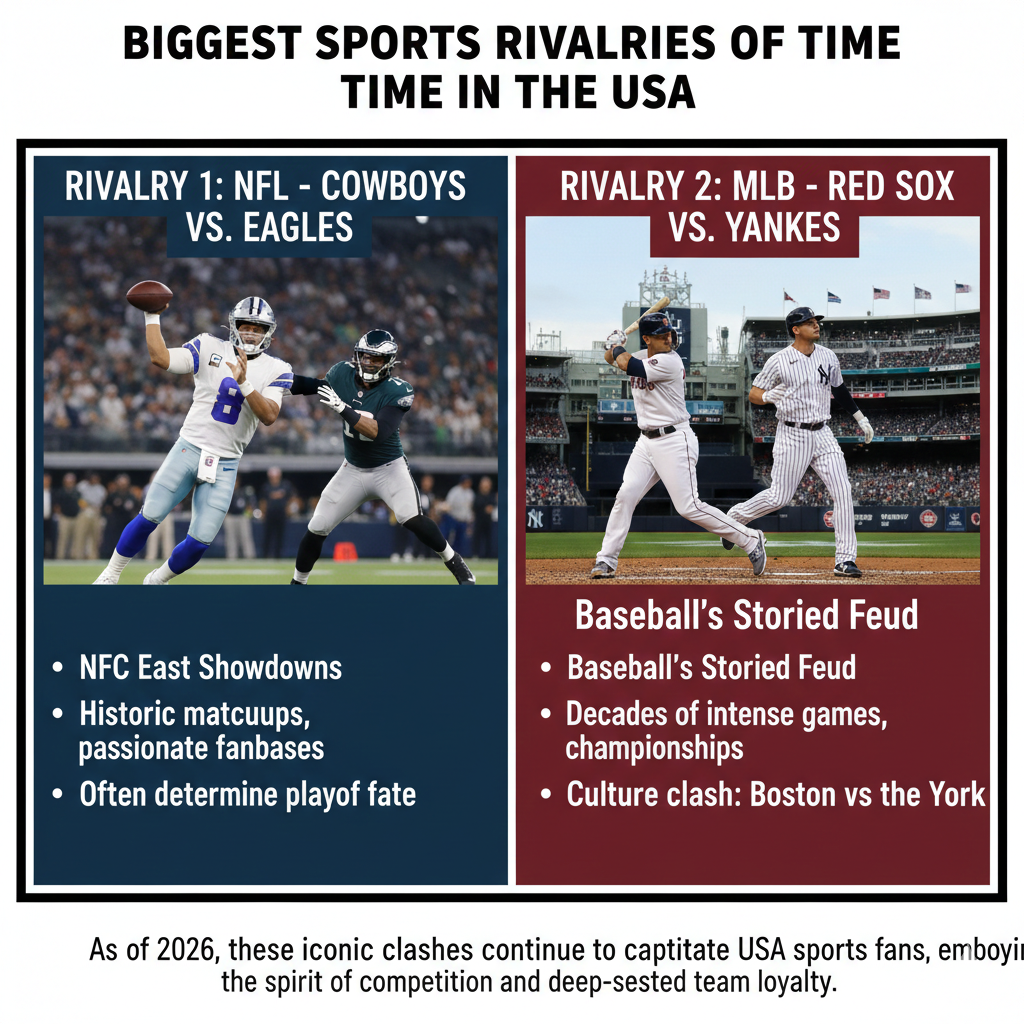
This is the gold standard of American sports hatred. The feud between the New York Yankees and the Boston Red Sox transcends baseball; it is a cultural clash between two major northeastern cities.
The origin of the animosity is famously traced back to 1919, when the Red Sox sold Babe Ruth to the Yankees. New York went on to build a dynasty that lasted decades, while Boston suffered through an 86-year championship drought. For generations, the rivalry was defined by Yankee dominance and Red Sox heartbreak.
However, the dynamic shifted permanently in 2004. Down 3-0 in the American League Championship Series, the Red Sox achieved the impossible, winning four straight games against New York en route to their first World Series title since 1918. Today, the rivalry remains fierce, fueled by big spending, star power, and a century of bad blood.
Lakers vs. Celtics (NBA)
While Yankees-Red Sox is regional, Los Angeles Lakers vs. Boston Celtics is a rivalry that saved the NBA. In the 1980s, the league was struggling for viewership until Magic Johnson and Larry Bird arrived.
This rivalry represents a clash of styles and cultures: the glitz, glamour, and “Showtime” of Hollywood against the gritty, blue-collar toughness of Boston. These two franchises account for nearly half of all championships in NBA history. They have met in the NBA Finals a record 12 times.
The rivalry is unique because it is built almost entirely on excellence. Unlike other feuds born from proximity, this one is sustained by the fact that for large stretches of NBA history, you couldn’t win a title without beating one of them.
Cowboys vs. Eagles (NFL)
The NFC East is perhaps the most hostile division in football, and the animosity between the Dallas Cowboys and the Philadelphia Eagles is its crown jewel. This rivalry is less about championship matchups and more about a visceral dislike between the fanbases.
Dallas, branded as “America’s Team,” often flaunts a polished, corporate image of success. Philadelphia fans, known for their rugged, unapologetic passion, view the Cowboys with deep disdain. The atmosphere at these games is hostile, loud, and electric. Whether it’s the “Bounty Bowl” eras of the past or modern battles for the division title, this matchup guarantees intensity.
Bears vs. Packers (NFL)
The Chicago Bears and Green Bay Packers share the oldest rivalry in the NFL. Starting in 1921, this series has been played over 200 times. Located just a few hours apart along Lake Michigan, these two franchises are the bedrock of professional football history.
The rivalry is characterized by mutual respect veiled in deep hatred. It is a battle of tradition: George Halas vs. Curly Lambeau, Mike Ditka vs. Bart Starr. In the modern era, the rivalry has been tilted by Green Bay’s quarterback play, from Brett Favre to Aaron Rodgers, famously leading to Rodgers telling Chicago fans, “I own you.” Despite the recent one-sided nature, the history keeps the intensity high.
Duke vs. North Carolina (College Basketball)
Separated by only eight miles along “Tobacco Road,” Duke and UNC is arguably the fiercest rivalry in college sports. This isn’t just about basketball; it’s a clash of public vs. private, light blue vs. dark blue.
The consistency of these two programs is staggering. It is rare for a season to go by where both teams aren’t ranked in the top 25. The intensity is amplified by the fact that many of the players know each other from the high school circuit, and the alumni bases share the same workplaces throughout North Carolina. The games are loud, fast-paced, and almost always have ACC Championship implications.
Michigan vs. Ohio State (College Football)
Known simply as “The Game,” the annual showdown between the Michigan Wolverines and the Ohio State Buckeyes is the finale of the regular season and often determines the Big Ten champion.
The hatred here is palpable. During the famous “Ten Year War” between coaches Bo Schembechler and Woody Hayes, the rivalry reached mythical proportions. Woody Hayes famously refused to even say the word “Michigan,” referring to them only as “That Team Up North”—a tradition that persists today. It is a border war in the truest sense, played in late November, often in freezing temperatures or snow, embodying the spirit of Midwest football.
Dodgers vs. Giants (MLB)
This rivalry is unique because it survived a cross-country move. Originating in New York as a battle of boroughs (Brooklyn vs. Manhattan), both teams moved to California in 1958—the Dodgers to Los Angeles and the Giants to San Francisco.
The geographic shift only deepened the divide, transforming it into a Northern California vs. Southern California battle. Both franchises have been historically successful, and the rivalry is marked by iconic moments, such as Bobby Thomson’s “Shot Heard ‘Round the World” in 1951. It is a feud that has run consistently hot for over a century.
College Sports vs. Pro Sports Rivalries
There is a distinct difference in the flavor of rivalries at the collegiate level versus the pros. Professional rivalries are often driven by players and specific eras. When the star players retire or get traded, the heat can sometimes dissipate until the teams meet in the playoffs again.
College rivalries, however, are inherited. They are driven by alumni loyalty and regional pride. In college football, for example, a losing season doesn’t matter if you manage to beat your rival. The “Golden Egg” or the “Paul Bunyan Trophy” means everything. College rivalries feel more permanent because the brand is the school itself, not the players who cycle through every four years.
How Rivalries Shape Fan Culture
Rivalries provide a sense of belonging. Being a fan is about being part of a tribe, and a tribe needs an adversary to define itself against. This cultural impact is visible in the language fans use—”we” won, or “we” lost.
This creates a generational transfer of fandom. A child growing up in Boston learns to dislike the Yankees before they even understand the rules of baseball. It creates a shared language and a shared history that binds communities together. In many ways, the rival is just as important to the fan’s identity as their own team.
Economic Impact of Major Rivalries
The business of sports relies heavily on these grudge matches. Television networks circle dates like Duke-UNC or Cowboys-Eagles months in advance. These games command the highest advertising rates because they draw casual viewers who otherwise might not watch.
Ticket prices for rivalry games can skyrocket to three or four times the face value of a standard game. Merchandise sales also spike, particularly items that mock the opposing team. The “rivalry week” concept in college football is a massive revenue driver for universities and local economies, filling hotels and restaurants with traveling fans.
Iconic Moments That Defined Rivalries
Great rivalries are built on moments that are replayed forever.
- The Tyree Catch (Giants vs. Patriots): While not a traditional historic rivalry, the Giants stopping the Patriots’ perfect season in Super Bowl XLII created instant animosity.
- Aaron Boone’s Home Run (Yankees vs. Red Sox): The walk-off home run in the 2003 ALCS sent New York to the World Series and devastated Boston, adding another chapter to the curse.
- The Kick Six (Auburn vs. Alabama): The Iron Bowl is a fierce college rivalry, and the missed field goal returned for a touchdown in 2013 is perhaps the greatest ending in college football history.
These moments validate the emotional investment fans put into the teams. They prove that in a rivalry game, anything can happen.
Modern Rivalries Gaining Momentum
As leagues expand and players move, new rivalries emerge. In the NFL, the Kansas City Chiefs and the Buffalo Bills have developed a fierce competition defined by supreme quarterback play, reminiscent of the Manning-Brady battles of the 2000s.
In the NBA, the Golden State Warriors and the Cleveland Cavaliers defined the late 2010s, meeting in the Finals four consecutive times. While player movement (LeBron James leaving Cleveland) cooled that specific feud, it showed how quickly a modern rivalry can dominate the sports landscape. Social media amplifies these new feuds, allowing players to exchange barbs instantly, fueling fan engagement in real-time.
Why Rivalries Matter to American Sports
Rivalries are the engine of engagement. They provide the storylines that keep the leagues relevant. Without the narrative of “good vs. evil” or “us vs. them,” sports are simply athletic exhibitions.
Rivalries heighten the emotional stakes. They make the regular season matter. A mid-season baseball game in July can feel like Game 7 of the World Series if it is Dodgers vs. Giants. This emotional engagement drives ratings, sells merchandise, and ensures the long-term health of the leagues.
Are Rivalries as Strong Today as Before?
There is a growing debate that modern sports rivalries lack the vitriol of the past. Free agency means players change teams frequently; a player might be a Celtic one year and a Laker the next. Players are often friends off the court, training together in the offseason and interacting amicably on social media.
However, while the players might be friendlier, the fans certainly are not. The tribalism of the fanbase has not diminished. If anything, the internet has allowed fans to bicker and debate with rivals across the globe 24/7. While the on-field fights might be fewer, the cultural divide remains as wide as ever.
FAQs – Biggest Sports Rivalries in the USA
What is the biggest sports rivalry in U.S. history?
Most sports historians and polls consider the New York Yankees vs. Boston Red Sox to be the biggest. The combination of longevity (over 100 years), the high stakes of postseason clashes, the “Curse of the Bambino” narrative, and the cultural clash between New York and Boston puts it at the top.
Are college rivalries more intense than pro rivalries?
In terms of pure atmosphere and tradition, many argue yes. College rivalries like Auburn vs. Alabama or Michigan vs. Ohio State are deeply rooted in regional culture and family tradition. The passion often feels more personal because it is tied to the fans’ alma maters and hometowns.
Which rivalry has the most championships?
The Lakers vs. Celtics rivalry features the most combined championships. Together, these two franchises account for 35 NBA titles (17 for Boston, 17 for Los Angeles, plus titles from their previous cities/eras), making their head-to-head matchups a battle for history.
Why do rivalries last for decades?
Rivalries persist because they are passed down through generations. They are sustained by proximity (teams playing in the same division or state) and by memorable moments—both wins and heartbreaking losses—that keep the emotional fire burning long after the players involved have retired.
Can new rivalries replace historic ones?
It is difficult to “replace” history, but new rivalries can certainly equal the intensity of older ones for a specific era. For example, the Patriots vs. Colts rivalry in the 2000s was the premier matchup in the NFL due to Brady vs. Manning, even though they lacked the 100-year history of Bears vs. Packers. However, once the key players retire, these modern rivalries often fade, whereas historic ones endure.
The Unending Battle
In the end, sports rivalries are about memory. We remember where we were when the ball went through the uprights, or when the ground ball rolled through the first baseman’s legs. These rivalries give shape to the seasons and meaning to the games. Whether it is the frozen tundra of Green Bay or the manicured grass of Yankee Stadium, these battles remind us that in sports, history is never truly in the past—it’s just waiting for the next kickoff.
Leave a Reply