

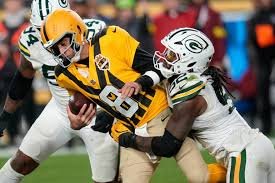
There are few sights in professional sport as compelling, or as melancholy, as a legend raging against the dying of the light. It is a narrative arc as old as the game itself: the conquering hero who refuses to hang up his boots, searching for one last moment of glory to cap a storied career. For Aaron Rodgers, a quarterback whose name is etched into the bedrock of NFL history, the final chapter has become a complex saga of injuries, media storms, and feverish speculation.
Recently, the conversation has shifted toward a fascinating, albeit unexpected, potential landing spot: Pittsburgh. The link between Rodgers and the Steelers represents more than just a transfer rumour. It signifies a collision of two distinct footballing philosophies and a desperate roll of the dice for both parties. For the Steelers, it is a bid to return to immediate relevance; for Rodgers, it is a chance to prove that his arm, and his mind, can still dismantle defences in the brutal AFC North.
This potential union has sparked intense debate across the league. Is this the perfect marriage of a historic franchise and a historic talent? Or are we witnessing the bitter, disjointed end of a journey that should have perhaps concluded sooner? To understand the weight of this moment, we must look at how we arrived here, and what a move to the Steel City would truly mean for Rodgers’ legacy.
How the Aaron Rodgers–Steelers Story Began
The connection between Rodgers and Pittsburgh did not materialise out of thin air. It began as a mutual admiration society, visible to anyone paying attention to sideline interactions. For years, Rodgers and Steelers head coach Mike Tomlin have exchanged nods, smiles, and glowing praise during press conferences. Tomlin, known for his ability to manage big personalities, has never hidden his respect for Rodgers’ game-winning ability. Rodgers, in turn, has often spoken highly of the stability and culture Tomlin has built in Pennsylvania.
However, admiration turned to genuine speculation when the Steelers found themselves in a quarterback limbo following Ben Roethlisberger’s retirement. The subsequent experiments with younger quarterbacks yielded mixed results, leaving a roster built to win now—boasting a ferocious defence and elite skill players—without a conductor.
Rumours intensified as Rodgers’ relationship with his previous organisations fluctuated. NFL insiders began connecting the dots: a franchise desperate for elite quarterback play and a quarterback seeking a stable, historic environment. While trade talks and contract specifics are often the stuff of tabloid fodder, the underlying logic of the move gave the rumours a sense of inevitability. It wasn’t just idle gossip; it was a solution to two very expensive problems.
Rodgers’ Legacy Before the Steelers Question
Before dissecting the twilight of his career, it is essential to remember the brilliance that preceded it. Rodgers did not just play the position of quarterback; he revolutionised how we perceive efficiency.
His tenure in Green Bay produced some of the most breathtaking statistics the sport has ever seen. We are talking about a player who treated interceptions as a personal affront. His touchdown-to-interception ratio is not merely good; it is a statistical anomaly compared to his peers. With multiple MVP awards and a Super Bowl ring that feels like it happened both yesterday and a lifetime ago, Rodgers established himself as the most talented thrower of the football in history.
He gave us the “Hail Mary” miracles in Detroit and Arizona. He delivered surgical drives that left opposing fans heartbroken with seconds on the clock. For over a decade, Rodgers was the inevitable force. This legacy is secure. No matter what happens in Pittsburgh or elsewhere, his place in the Hall of Fame is reserved. Yet, legacy is a living thing, and the final chapters often colour how the earlier ones are remembered. The question is no longer about his greatness, but about his exit strategy.
Why the Steelers Make Sense (On Paper)
If you strip away the drama and look purely at the tactics, the fit is intriguing. Pittsburgh has spent years building a roster that is “a quarterback away” from contention. Their defence, anchored by generational talents, keeps them in almost every game. What they have lacked is an offence that can capitalise on that field position.
Rodgers has spent his career elevating receivers. In Pittsburgh, he wouldn’t need to carry the entire team. He would step into an offensive system that features aggressive, physical receivers who can win 50/50 balls—a dream scenario for a quarterback who thrives on precision and trust.
Furthermore, there is the cultural fit. Mike Tomlin is one of the few coaches in the league with the gravitas to command Rodgers’ respect instantly. The Steelers organisation is known for its patience and lack of panic, traits that contrast sharply with the chaotic environments Rodgers has occasionally found himself in. On paper, it looks like the perfect retirement home for a legend: a place where he is asked to be the final piece of the puzzle, rather than the entire picture.
The Doubts: Age, Injuries, and Declining Windows
However, football is not played on paper. It is played on turf, in the freezing cold, by men half Rodgers’ age running at terrifying speeds. The primary counter-argument to the Steelers experiment is simple: Father Time is undefeated.
Rodgers’ recent seasons have shown cracks in the armour. The mobility that once allowed him to extend plays and demoralise defences has waned. The injuries have piled up, most notably the Achilles issue that robbed him of a season. The AFC North is not a division for the fragile; it is known for physical, punishing defences that relish hitting the quarterback.
We must also consider the history of quarterbacks playing past their prime. For every Peyton Manning, who managed to secure a second ring with Denver despite a failing body, there is a Johnny Unitas in a Chargers uniform or a Joe Namath with the Rams. These images are jarring. They represent a decline that is often painful to watch. Can Rodgers avoid that fate? Can he stay healthy behind an offensive line that will need to be flawless to protect him? These are the gamble’s stakes.
The “Bitter End” Narrative
There is a pervasive fear among fans and pundits alike that we are witnessing a “bitter end.” This narrative suggests that Rodgers, in his pursuit of one last triumph, risks damaging the aura of invincibility he spent decades building.
The media framing of Rodgers has shifted significantly. Once the quirky, intellectually curious superstar, he is now often portrayed as a polarizing figure whose off-field comments and roster demands overshadow his on-field production. If the Steelers experiment fails—if it results in a losing season or another significant injury—the story won’t be about his bravery in trying. It will be about a legend who didn’t know when to walk away.
The NFL is rarely kind to aging superstars. The exit is rarely a parade; it is usually a slow limp off the field or a quiet benching. The “bitter end” narrative suggests that by chasing the perfect ending, Rodgers might be ensuring a messy one. It raises a philosophical question about sports: do we prefer our heroes to retire too early, leaving us wanting more, or do we accept the messy decline as the price of their competitive spirit?
What the Numbers Say
If we detach from the narrative and look at the cold, hard data, the picture is mixed. In his most recent healthy stretches, Rodgers’ efficiency remained high, though his volume stats dipped.
- Completion Percentage: While still respectable, there has been a slight regression from his MVP peaks, often due to a reluctance to throw into tight windows or a lack of chemistry with younger receivers.
- Sack Rate: This is the worrying metric. Older quarterbacks tend to take more sacks as their escapability vanishes. In the AFC North, this stat could be the difference between a playoff run and a losing season.
- Clutch Metrics: Interestingly, the numbers suggest Rodgers is still elite in critical moments. On third downs and in the red zone, his decision-making remains superior to almost any rookie or journeyman the Steelers could draft or sign.
The stats tell us that Rodgers is no longer the athlete who can create magic from nothing, but he remains a grandmaster who can checkmate a defence if given the right pieces.
Fan Reaction and League-Wide Response
The reaction to the Steelers rumours has been a study in contrast. Pittsburgh’s fanbase, the “Steeler Nation,” is famously blue-collar and values humility and grit. A portion of the fanbase views Rodgers as too “Hollywood,” a distraction they do not need. They worry that the media circus following him will disrupt the focused culture of the locker room.
Conversely, another segment of the fanbase is desperate for a return to relevance. They look at the Kansas City Chiefs and the Cincinnati Bengals and realise that in the modern NFL, you cannot compete without an elite quarterback. To them, Rodgers is a necessary risk.
Nationally, analysts are split. Some view it as a brilliant move that instantly makes Pittsburgh a Super Bowl contender. Others see it as a desperate band-aid that delays the inevitable rebuild the Steelers need to undertake. Social media, naturally, is ablaze with memes and hot takes, shaping a perception that the move is destined for either spectacular success or hilarious failure, with no middle ground.
What Comes Next for Aaron Rodgers?
Regardless of how the Steelers chapter plays out—or if it happens at all—Rodgers is nearing the exit. If he suits up for Pittsburgh, it is almost certainly a one or two-year engagement. It is a “Super Bowl or bust” mentality.
If the move doesn’t materialise, or if it fails, retirement looms large. Rodgers has diverse interests outside of football, from media appearances to potential ownership roles in sports franchises. He is not a man who will disappear quietly into the night. However, his post-football career will inevitably be shaped by these final years.
Will he be remembered as the Packer who dominated the North, or will the image be diluted by a nomadic, injury-riddled conclusion? The next moves he makes are about securing the final word in his own biography.
Could This Be the Final Throw?
So, we return to the central question: Is this the final throw? If Rodgers dons the black and gold, every pass will be scrutinised with the intensity of a playoff game.
A “worthy” ending for Rodgers doesn’t necessarily mean a Super Bowl ring. It means playing meaningful football in January. It means leading a team with the poise and precision that defined his prime. If he can take the Steelers on a deep playoff run, he rewrites the narrative of his decline. He proves that class is permanent.
But the worst-case scenario is a season defined by grimaces, sideline arguments, and medical tents. That is the risk of the final throw. It is a gamble on his own immortality. History will remember the MVPs, but it will also remember how it ended. Rodgers is betting that he has one more miracle left in his arm.
A Legacy on the Line
The crossroads moment for Aaron Rodgers and the Pittsburgh Steelers is about more than a contract or a trade. It is a meeting point of desperation and hope. For Rodgers, it is a chance to silence the doubters and end on his own terms. For the Steelers, it is a chance to recapture lost glory.
Whether this chapter ends in a Lombardi Trophy or a quiet retirement press conference, it matters. It reminds us why we watch sports: not just for the victories, but for the human struggle against time, expectation, and the limits of the body. Rodgers is attempting to defy all three.
Are you ready to see how the final chapter ends? Make sure you never miss an update on the NFL’s biggest stories. Subscribe to our newsletter today for exclusive analysis and breaking news delivered straight to your inbox.
Leave a Reply