

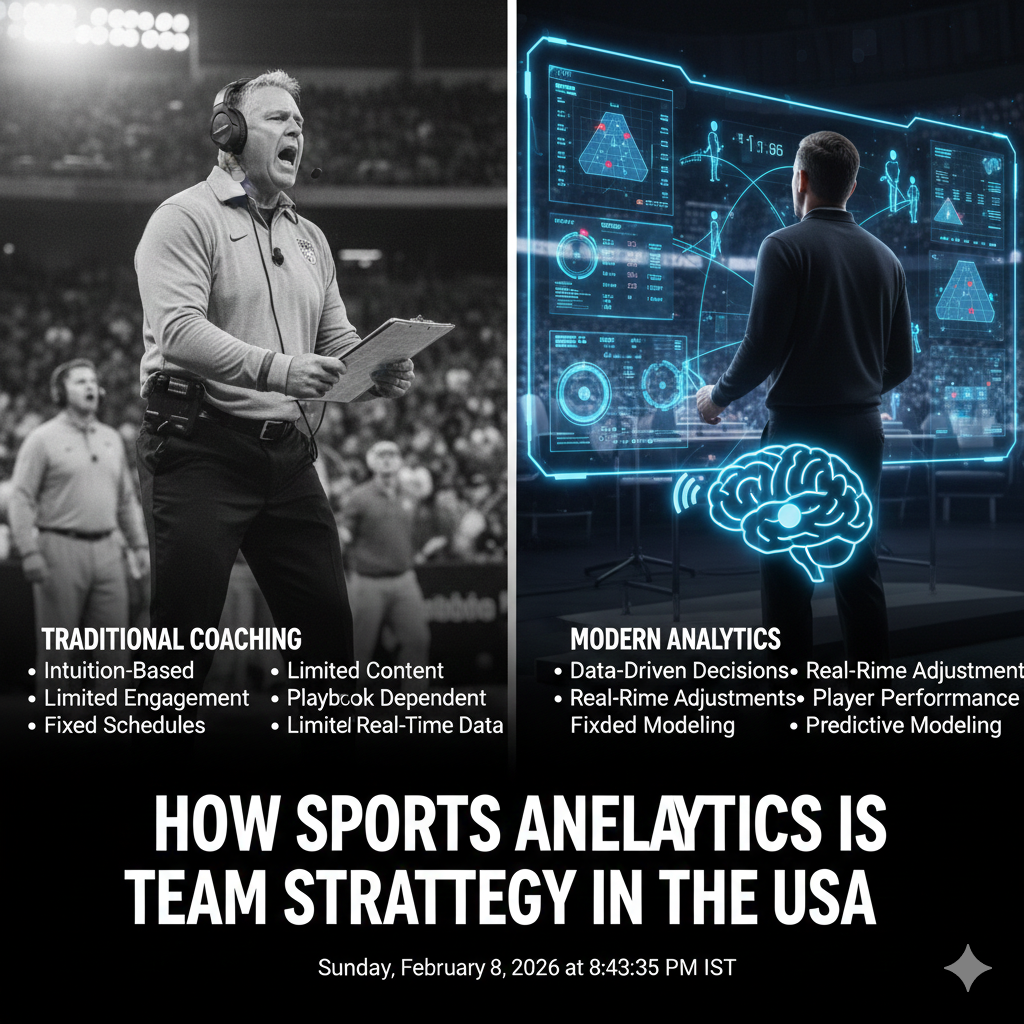
For decades, coaching decisions were driven by gut instinct, tradition, and the “eye test.” A manager might pull a pitcher because he looked tired, or a football coach might punt on fourth down because “defense wins championships.” Those days are rapidly fading.
Today, every major professional sports team in the United States employs departments dedicated entirely to data science. From the front office to the sidelines, analytics has fundamentally shifted how games are played, managed, and won. It isn’t just about counting stats anymore; it’s about predictive modeling, biometric tracking, and efficiency optimization.
This shift hasn’t just changed the backroom conversations—it has altered the product on the field. Why do NBA teams shoot so many three-pointers? Why do NFL teams go for it on fourth down more often? The answer lies in the data. This article explores how sports analytics shapes modern team strategy across the U.S. landscape, blending high-tech insights with the human element of competition.
What Is Sports Analytics?
At its core, sports analytics is the practice of applying mathematical and statistical principles to sports data. The goal is simple: gain a competitive edge. While basic stats like batting average or touchdowns have been around forever, modern analytics digs much deeper to uncover value that traditional metrics miss.
Definition and Core Concepts
Sports analytics is generally divided into two main categories: on-field analytics and business analytics. For the purpose of team strategy, we focus on on-field analytics. This involves measuring player performance and team efficiency to predict future outcomes. The core concept is probability. Instead of asking “Did this work last time?”, analytics asks “What is the statistical likelihood of this working over a large sample size?”
Types of Data Used in Modern Sports
Teams aggregate data from a massive variety of sources:
- Box Score Data: The traditional stats (points, rebounds, yards) but analyzed in new contexts.
- Tracking Data: Using cameras and sensors (like the NBA’s Second Spectrum or the NFL’s Next Gen Stats) to map player movement, speed, and spacing 25 times per second.
- Biometric Data: Heart rate monitors and sleep trackers that assess a player’s physical readiness.
- Video Analysis: AI-driven software that breaks down game film to categorize play types automatically.
Why Sports Analytics Matter in Team Strategy
The margin for error in professional sports is razor-thin. A single play can decide a Super Bowl; a fraction of a second can determine an Olympic gold medalist. In this environment, analytics provides the roadmap to efficiency.
Competitive Advantages
Information is power. If one team knows that an opposing batter struggles hitting curveballs low and away, but only on 0-2 counts, they have a tangible advantage. Analytics allows teams to exploit inefficiencies in their opponents’ strategies while masking their own weaknesses. It turns subjective guessing into objective probability.
Data-Driven Decision-Making
Organizations now build their entire philosophy around data. This ensures consistency. A coach acting on emotion might make rash decisions in the heat of the moment. A data-driven framework provides a “check” on those emotions. It encourages processes that, over time, are mathematically proven to yield better results, even if individual outcomes vary.
How Teams Use Analytics Before Games
The game is often won before the whistle even blows. The week leading up to a match is where the data analysts truly shine, preparing the coaching staff with the intelligence needed to construct a game plan.
Opponent Analysis and Scouting
Gone are the days of scouts just traveling with a notebook. Now, scouting reports are dense data visualizations. Teams analyze an opponent’s tendencies in every conceivable situation. For example, an NFL defensive coordinator receives a report detailing exactly what plays the opposing offense runs on 3rd-and-short from the left hash mark. This allows defenses to call plays that statistically counter the opponent’s favorites.
Matchup and Lineup Optimization
In the NBA, coaches use lineup data to see which five-man units perform best together (Net Rating). They might discover that a specific bench player pairs exceptionally well with a star starter, even if it doesn’t look obvious on the practice court. Before the game, staff will script substitutions to ensure their best lineups are on the floor during critical stretches.
Game Planning Based on Data Trends
Teams identify “win conditions” based on trends. A soccer team might realize their opponent concedes 70% of their goals from crosses entering the right side of the box. Consequently, the game plan will focus heavily on overloading the right flank and delivering crosses, ignoring other traditional attacks to exploit that specific statistical weakness.
In-Game Strategy and Real-Time Analytics
The integration of technology on the sidelines has brought analytics into real-time decision-making. Tablets are now as common as clipboards.
Tactical Adjustments During Games
As the game unfolds, analysts feed data to the coaching staff. If a tennis player is consistently serving wide to the backhand, the opponent’s coach can signal an adjustment. In football, if the data shows the defense is blitzing 60% of the time on second down, the offensive coordinator can adjust play-calling immediately to include more screen passes or quick slants.
Player Rotation and Load Management
Real-time tracking helps coaches know when a player is fatigued before it becomes visible. In basketball and soccer, wearable technology monitors a player’s workload. If a player’s acceleration decreases by a certain percentage, the staff knows they are red-lining and at risk of injury or poor performance, signaling a substitution is needed immediately.
Situational Decision-Making
This is perhaps the most visible impact of analytics. In the NFL, “go for it” models tell coaches whether to punt, kick a field goal, or attempt a fourth-down conversion based on field position, score, and time remaining. These models remove the fear of criticism, allowing coaches to make aggressive calls that improve their win probability.
Player Performance Evaluation
Evaluating talent is the lifeblood of a franchise. Analytics has revolutionized how teams view value, often highlighting contributions that don’t show up in the daily highlights.
Measuring Efficiency and Impact
We have moved past counting total points or yards. Metrics like PER (Player Efficiency Rating) in basketball or WAR (Wins Above Replacement) in baseball attempt to distill a player’s total contribution into a single number. These metrics account for pace of play, defensive impact, and efficiency, revealing that a player scoring 15 points on 6 shots is often more valuable than one scoring 20 points on 20 shots.
Identifying Strengths and Weaknesses
Heat maps show exactly where a basketball player shoots best. Spray charts show where a baseball player hits the ball. This granularity allows coaches to tailor development plans. If a player is elite at driving left but terrible driving right, the team can structure training specifically to address that weakness or design plays that only require them to drive left.
Contract and Roster Decisions
General Managers use predictive models to determine if a player is worth a massive contract. They analyze aging curves to predict when a player’s performance will decline. This helps teams avoid paying for past performance and instead pay for future production. It’s a cold calculation, but it’s essential for salary cap management.
Injury Prevention and Player Health
The most valuable asset for any team is the availability of its players. Analytics has moved from treating injuries to preventing them.
Workload Monitoring
By tracking distance run, high-speed sprints, and total impact load, teams can quantify stress on the body. If a pitcher’s arm angle drops slightly or a runner’s stride length shortens, it’s often a precursor to injury. Analytics flags these anomalies early.
Predictive Injury Analytics
Teams build profiles for injury risk. They know that if a player plays three games in five days and exceeds a certain mileage threshold, their risk of soft-tissue injury spikes. Using this data, teams can preemptively rest players (load management) to ensure they are healthy for the playoffs.
Recovery and Conditioning Optimization
Sleep tracking and hydration monitoring allow strength coaches to tailor recovery protocols. A player who slept poorly might be given a lighter practice load or specific recovery modalities. This personalized approach maximizes physical readiness.
Sports Analytics by League in the USA
While the principles remain the same, the application of analytics varies significantly across the major American sports leagues.
NFL Strategy and Play-Calling
Football is a game of distinct plays, making it perfect for situational analytics. The NFL has seen a surge in aggressive 4th-down decision-making and 2-point conversion attempts, driven directly by win-probability models. Next Gen Stats also tracks “separation” for receivers and “closing speed” for defenders, changing how teams evaluate speed.
NBA Shot Selection and Pace Analysis
The “Moreyball” revolution (named after executive Daryl Morey) changed basketball geometry. Analytics proved that the most efficient shots are 3-pointers and shots at the rim (layups/dunks). Mid-range jumpers, statistically the least efficient shot, have nearly vanished. Defenses have adjusted by prioritizing protecting the rim and the 3-point line above all else.
MLB Sabermetrics and Pitching Decisions
Baseball was the pioneer of sports analytics (Moneyball). Today, “sabermetrics” dictates everything. Defensive shifts (positioning fielders exactly where a batter is likely to hit) became so effective they were recently regulated. Pitchers focus on “spin rate” and “tunneling” rather than just velocity, aiming to deceive batters with physics rather than just power.
NHL Performance Tracking
Hockey analytics was slower to arrive due to the fluid nature of the game, but it has caught up. Teams track “Corsi” and “Fenwick” (shot attempt metrics) to measure possession dominance. If a team controls the puck and generates shots, even if they aren’t scoring immediately, the math says the goals will come eventually.
Role of Technology in Sports Analytics
The data is only as good as the tools used to collect it.
Wearables and Tracking Systems
Devices sewn into jerseys or worn as vests track biometrics. In the NFL, chips in the football and shoulder pads track velocity and rotation. This creates a digital twin of the game, allowing for analysis that the human eye simply cannot process.
AI and Machine Learning Models
Machine learning algorithms digest historical data to predict future outcomes. These models learn and improve over time. For example, an AI model can watch thousands of hours of game film to identify a “tell” in a quarterback’s stance that indicates a pass play, doing the work of ten video coordinators in minutes.
Video and Motion Analysis
Cameras developed for missile tracking are now used in stadiums. Systems like Hawk-Eye (tennis/soccer) and Statcast (MLB) capture the exact trajectory of balls and players. This visual data is converted into hard numbers for analysis.
Benefits and Limitations of Sports Analytics
Like any tool, analytics is powerful but not flawless.
Benefits
Improved Efficiency and Consistency
Analytics removes bias. It stops teams from clinging to strategies simply because “that’s how we’ve always done it.” It forces efficiency, ensuring resources (money, practice time, energy) are spent on high-probability tactics.
Reduced Risk and Guesswork
By relying on large sample sizes, teams reduce the risk of outlier performances misleading them. It provides a baseline of objective truth to anchor discussions.
Limitations
Overreliance on Data
Data cannot measure heart, leadership, or chemistry. A player might have poor metrics but be the emotional leader who holds the locker room together. Strictly adhering to numbers can strip the “soul” from a team.
Human Factors and Unpredictability
Sports are played by humans, not robots. Pressure, weather, and psychology play huge roles that are difficult to quantify. A model might say a kicker has a 95% success rate, but if he’s mentally shaken from a previous miss, the model is blind to that context.
Future of Sports Analytics in the USA
We are only scratching the surface. The next frontier involves integrating the mental side of the game with the physical.
Advanced AI-Driven Insights
AI will soon be able to simulate games before they happen with frightening accuracy, allowing coaches to “test” game plans against a virtual opponent.
Integration with Coaching Decisions
The gap between the “nerds” in the front office and the “jocks” on the sidelines is closing. Future coaches will likely be hybrids—former players who are also fluent in data science.
Ethical and Privacy Considerations
As biometric tracking increases, questions arise about who owns that data. Can a team cut a player because an algorithm predicts a future injury? These ethical battles will shape the next decade of sports labor negotiations.
Conclusion
Sports analytics has moved beyond a buzzword to become the central nervous system of modern American sports. It influences who plays, how they play, and how much they get paid. For the fan, it has changed the viewing experience, providing deeper context to the games we love.
However, the beauty of sports lies in its unpredictability. No matter how advanced the models become, the ball still bounces funny. Analytics provides the probabilities, but the players provide the magic. The winning teams of the future will be those that master the delicate balance between the cold hard numbers and the fiery human spirit of competition.
Leave a Reply