

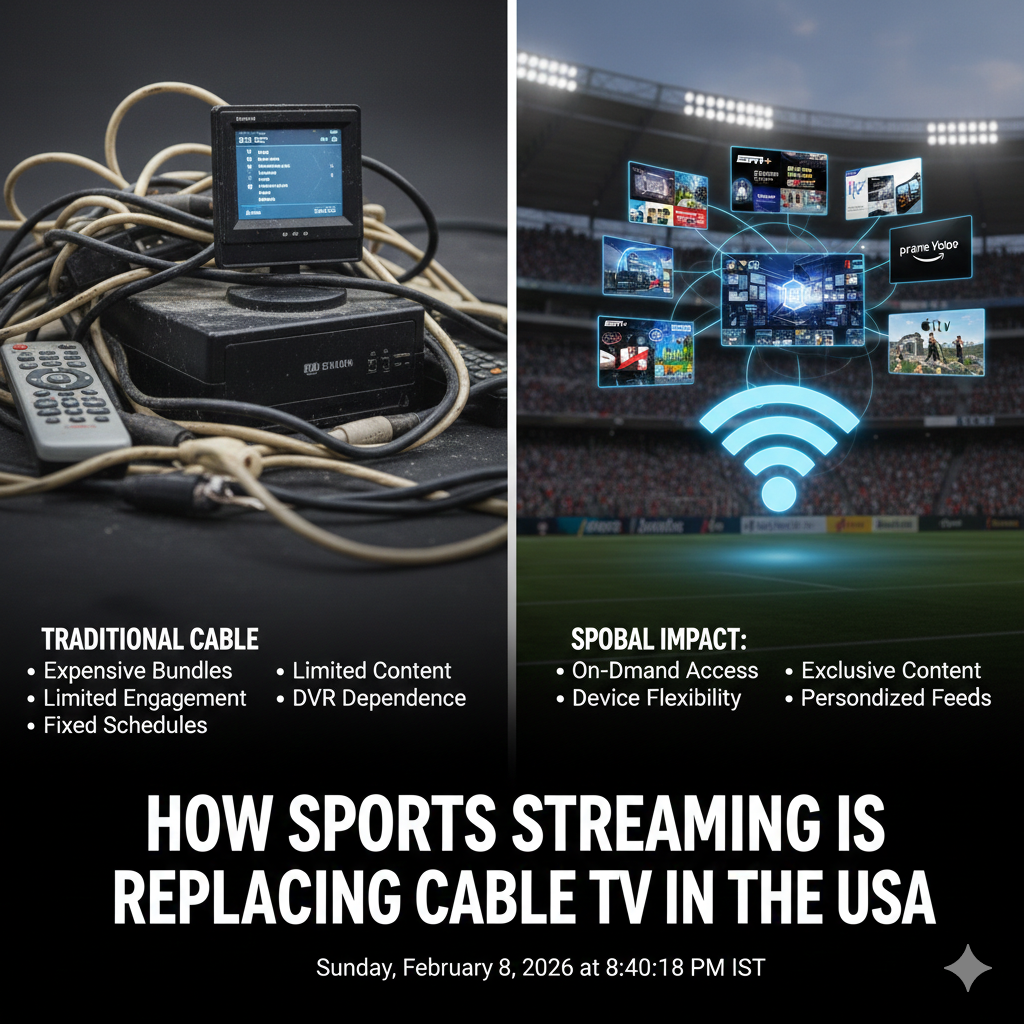
For decades, the equation for American sports fans was simple. If you wanted to watch the Super Bowl, the World Series, or your local NBA team, you paid for a cable subscription. It was an expensive, clunky, but ultimately reliable utility. That era is officially over. We are currently witnessing the most significant disruption in sports media history, as the dominance of traditional cable television gives way to the flexibility of the internet.
This transition isn’t just about technology; it represents a fundamental change in consumer behavior and economic reality. The “bundle”—that massive package of hundreds of channels you likely never watched—is unravelling. In its place, a fragmented but highly customizable landscape of apps and streaming services has emerged.
While this shift offers unprecedented freedom, it also brings new complexities regarding costs, access, and reliability. As tech giants like Amazon and Apple enter the arena previously held by networks like CBS and ESPN, the implications for leagues, advertisers, and, most importantly, the fans, are profound. This guide explores how sports streaming is replacing cable TV in the USA, what is driving the change, and what the future holds for live sports consumption.
Why Sports Streaming Is Growing So Fast
The migration from cable to streaming wasn’t an overnight phenomenon. It is the result of three converging forces that have made digital platforms more attractive than traditional set-top boxes.
Viewer demand for flexibility
Modern lifestyles rarely align with rigid broadcast schedules. The expectation for content consumption has shifted from “appointment viewing” to “viewing on my terms.” Sports fans no longer want to be tethered to a living room couch to catch the kickoff. They want to watch the first quarter on their phone while commuting, the second quarter on a tablet while cooking, and the second half on the big screen. Streaming services offer this portability natively, whereas cable largely struggled to adapt its infrastructure to mobile environments until it was too late.
Cost pressures on cable TV
For years, the price of cable television rose consistently, often outpacing inflation. A significant portion of that cable bill went toward “carriage fees” for sports networks, regardless of whether the subscriber watched sports. As household budgets tightened, the value proposition of paying $100 or more per month for a bundle of unwanted channels collapsed. Streaming services initially entered the market at significantly lower price points, allowing consumers to strip away the bloat and pay only for what they actually wanted to watch.
Rise of mobile and connected devices
The hardware has finally caught up to the software. High-speed internet (broadband and 5G) is now ubiquitous in the USA, and smart TVs are the standard in American homes. With devices like Roku, Apple TV, and Amazon Fire Stick making it incredibly easy to access apps on a television, the barrier to entry for streaming live sports has vanished.
Sports Streaming vs Cable: What’s Changed in the USA
The difference between cable and streaming goes beyond how the signal is delivered. The actual viewing experience has evolved.
Live access vs scheduled programming
Cable TV is linear. If a game runs long, it cuts into the next program, or worse, the network cuts away from the game you are watching to show the start of another. Streaming platforms operate on a dedicated feed basis. A service can host unlimited concurrent live streams. This means a platform like ESPN+ can show dozens of college football games simultaneously without running out of “channel space,” giving fans access to niche sports and lower-tier leagues that never would have made it to cable.
On-demand highlights and replays
On cable, if you missed the game, you had to wait for the replay or catch a highlight show like SportsCenter. Streaming platforms integrate these features directly into the interface. Fans can join a game in progress and select “watch from beginning,” or click on key plays marked on a timeline to see a home run or touchdown immediately.
Personalization and multiscreen viewing
Streaming utilizes data to tailor the experience. If you are a Boston Celtics fan, the algorithm ensures their games are front and center when you log in. Furthermore, features like “Multiview” on YouTube TV or Apple TV+ allow fans to watch up to four games simultaneously on a single screen—a feature that was historically difficult or impossible to implement on standard cable boxes.
Leading Sports Streaming Platforms in 2026
By 2026, the landscape will likely have solidified into a few dominant players, each carving out specific territories in the sports world.
ESPN+ and NFL+
ESPN remains the heavyweight champion of sports media, but its future is digital. ESPN+ has become an essential add-on for fans of UFC, soccer, and college sports. Meanwhile, the NFL has successfully launched its own direct-to-consumer mobile product, NFL+, giving them vertical integration and direct access to their massive fanbase without relying entirely on third-party networks.
Peacock and NBC Sports
NBC’s Peacock has aggressively pursued live sports rights to drive subscriptions. By securing exclusive NFL playoff games and leveraging its massive Olympics coverage, Peacock has proven that premium sports can exist exclusively behind a streaming paywall.
NBA League Pass, MLB.TV, NHL.TV
The leagues themselves have become broadcasters. Services like MLB.TV led the way in offering out-of-market packages.
- MLB.TV continues to be the gold standard for baseball fans living away from their home team’s city, offering comprehensive archives and home/away feed options.
- NHL.TV has seen shifts in rights management. While integrated into ESPN+ in the US, international markets have seen moves to platforms like DAZN.
- NBA League Pass has evolved to include advanced stats overlays and alternative betting-focused streams.
DAZN and global sports services
DAZN has struggled to dominate the US market in the same way it has in Europe, but it remains a powerhouse for combat sports (boxing and MMA). As noted in recent industry shifts, DAZN is also becoming a home for US sports exports (like the NHL) for international viewers, aggregating American leagues for a global audience.
YouTube TV, Hulu + Live TV
These are known as vMVPDs (virtual multichannel video programming distributors). They essentially replicate the cable bundle but deliver it over the internet. YouTube TV, in particular, secured a massive win by acquiring the rights to NFL Sunday Ticket, signaling a major shift of premium assets from satellite (DirecTV) to streaming.
Cable TV Decline and Viewer Shifts
The data paints a clear picture: the cord has been cut, and it is not being repaired.
Cord-cutting stats and trends
Research indicates that pay-TV penetration in the US has dropped to levels not seen since the early 1990s. Major providers like Comcast and Charter are losing millions of video subscribers annually. The “cord-never” generation—adults who have never paid for a traditional cable subscription—is growing, meaning there is no backfill for the older subscribers leaving the ecosystem.
Younger audiences and streaming preference
Gen Z and Millennials display a near-total preference for digital-first consumption. They are less likely to watch a full three-hour baseball game and more likely to consume highlights on social media or watch condensed games on streaming apps. Broadcasters are adapting the presentation style to fit this cohort, with alternative broadcasts featuring influencers or comedy commentary (like the “ManningCast” on Monday Night Football).
Regional sports networks and fragmentation
The most significant casualty of the cable decline has been Regional Sports Networks (RSNs). Companies like Diamond Sports Group (operator of Bally Sports) filed for bankruptcy because their business model relied on forcing every cable subscriber to pay for the channel. As subscribers left, the revenue evaporated. This has forced local teams in the NBA and MLB to scramble for new distribution models, often turning to local over-the-air channels combined with direct-to-consumer streaming apps.
Benefits of Sports Streaming for Fans
Despite the confusion of a changing market, the benefits for the consumer are tangible.
Watch anytime, anywhere
The primary benefit is ubiquity. A fan can watch the first half of a game on their living room TV, switch to their smartphone while walking the dog, and finish the game on a laptop in bed. This eliminates the anxiety of “missing out” simply because you aren’t home.
Lower cost than traditional cable bundles
While costs are rising, a strategic streamer can still pay less than a traditional cable bill. A fan who only cares about the NFL might only need an antenna and a subscription to Peacock or Paramount+ during the season, pausing the subscription in the off-season. This “churn and return” behavior gives consumers power over their monthly spending that cable contracts never allowed.
Better multi-device support
Streaming services are software-based, meaning they update frequently. New features, better user interfaces, and 4K streaming capabilities can be rolled out instantly to millions of devices. Cable boxes, by contrast, often remain stagnant for years.
Challenges with Sports Streaming
The transition has not been painless. Friction points remain that frustrate even the most tech-savvy fans.
Blackouts and regional restrictions
The most confusing aspect of sports streaming is blackout rules. These legacy rules were designed to protect cable channels and ticket sales. A fan living in Chicago might subscribe to MLB.TV to watch baseball, but they will be blocked from watching the Chicago Cubs or White Sox because a local broadcaster holds the exclusive rights. This forces fans to buy expensive cable packages or distinct local streaming services just to watch their home team.
Multiple subscriptions and rising costs
We have moved from one big cable bill to “death by a thousand cuts.” To watch every game in a specific sport, a fan might need Amazon Prime, Peacock, ESPN+, Apple TV+, and a cable replacement like YouTube TV. When aggregated, these costs can rival or exceed the old cable bundle.
Internet quality and latency concerns
Streaming relies on home internet. If the Wi-Fi creates a bottleneck, the picture buffers. Furthermore, streaming feeds are often 20 to 45 seconds behind the live action due to the time it takes to process the data. This creates the “spoiler effect,” where a fan might get a text message from a friend at the stadium celebrating a touchdown before they see it happen on their screen.
How Broadcasters Are Adapting
The legacy media companies are not standing still; they are pivoting aggressively to survive.
Streaming-first deals and rights packages
Leagues are now carving out exclusive packages for streamers. Major League Soccer (MLS) did the unthinkable and sold its entire global inventory to Apple TV+ for ten years, eliminating local broadcasts entirely. This “streaming-first” approach simplifies access (no blackouts) and provides a blueprint for how leagues might operate in the future.
Hybrid cable + streaming offers
Networks like ESPN are currently straddling the fence. They offer some content exclusively on cable and other content exclusively on ESPN+. They are preparing for a flagship direct-to-consumer launch where the entire ESPN channel will be available via an app, effectively severing their reliance on cable providers.
Direct-to-consumer strategies
Teams like the Utah Jazz and Phoenix Suns have rejected the failing RSN model. They have launched their own apps where fans can pay the team directly to stream games. This restores the connection between the team and the fan, removing the middleman.
Impact on Sports Leagues and Advertisers
The economics of sports are being rewritten by Silicon Valley.
New revenue models and sponsorship formats
Tech companies (Amazon, Apple, Google) treat sports rights as “loss leaders” to drive people into their ecosystems. They can afford to pay massive rights fees that traditional TV networks cannot justify. This has led to an explosion in revenue for leagues like the NFL and NBA.
Targeted ads and viewer data
Streaming offers advertisers granular data. Instead of buying a generic commercial during the Super Bowl hoping the right person sees it, advertisers on streaming platforms can target specific demographics based on viewing habits. This makes the ad inventory more valuable and the ads (theoretically) more relevant to the viewer.
Global expansion opportunities
Streaming ignores borders. The NBA and NFL view streaming as the vehicle to grow their games in Europe, Asia, and Africa. A fan in Tokyo can have the exact same viewing experience as a fan in New York, opening up vast new markets for merchandise and fandom.
What the Future Holds for Sports Streaming
As we look toward the latter half of the decade, the technology will continue to blur the lines between watching a game and participating in it.
5G, AR/VR, and interactive viewing
With the release of headsets like the Apple Vision Pro, “spatial computing” will allow fans to sit courtside virtually. High-bandwidth 5G will enable augmented reality overlays, where pointing a phone at the TV screen displays real-time player stats and probabilities.
Consolidation among streaming services
The market cannot support dozens of niche apps. We will see a “great rebundling.” Services will merge, or massive bundles will be created (like the Disney+, Hulu, and Max bundle) to reduce churn and simplify the billing process for consumers.
Potential resurgence of hybrid bundles
Cable companies may pivot to becoming aggregators. Instead of selling channels, they will sell a dashboard that manages all your streaming logins and payments, effectively becoming the “app store” for your television.
FAQs – Sports Streaming vs Cable TV
Is sports streaming cheaper than cable?
Generally, yes, but it depends on how much you watch. If you only subscribe to one or two services, it is significantly cheaper. However, if you try to replicate the entire cable experience by subscribing to every available service, the cost can equal or exceed a traditional cable bill.
Can I watch every major sport via streaming?
Yes, but not on a single app. You will likely need a combination of a live TV service (like YouTube TV or Fubo) and specific standalone apps (like Peacock or ESPN+) to get comprehensive coverage of all major sports.
What internet speed do I need for live sports?
For a reliable High Definition (HD) stream, you generally need at least 5-10 Mbps. For 4K streaming, you should aim for speeds of at least 25 Mbps per device.
Are regional blackouts still a problem?
Yes, they remain the biggest hurdle in the industry. However, the collapse of Regional Sports Networks is forcing leagues to develop non-blackout, direct-to-consumer options, so this issue is slowly improving.
Will cable TV disappear completely?
It is unlikely to disappear completely in the next decade, but it will become a niche product. It will likely serve older demographics and rural areas with poor internet connectivity, while streaming becomes the primary method of delivery for the mass market.
The Final Whistle for Traditional Cable
The shift from cable to streaming is not merely a change in how we receive a signal; it is a change in control. For decades, networks dictated when and how we watched sports. Now, the power lies with the viewer. While the transition brings friction—fragmented apps, confusing rights deals, and latency issues—the trajectory is undeniable.
As connectivity improves and the market consolidates, the sports viewing experience will become more immersive, more global, and more personalized. For the American sports fan, the cord has been cut, and the future is streaming.
Leave a Reply