

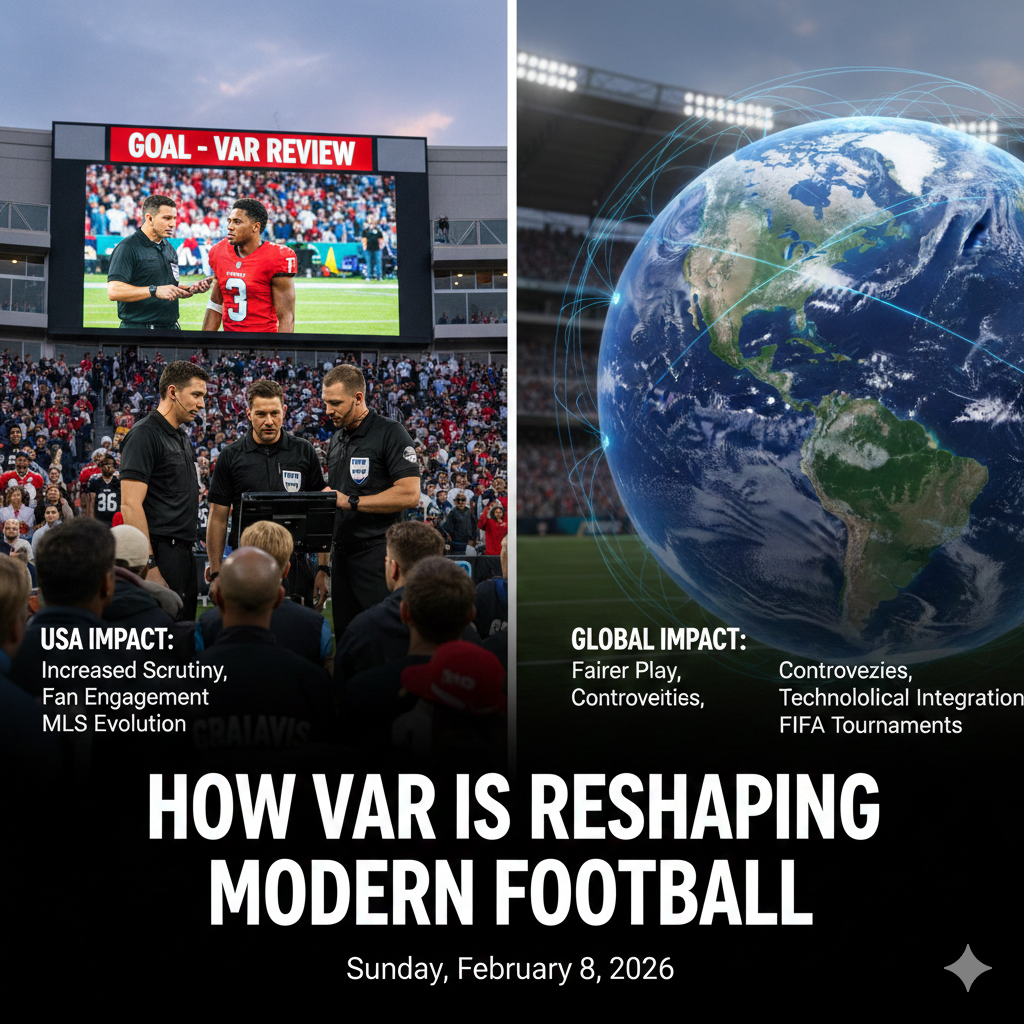
Since its introduction, Video Assistant Referee (VAR) technology has sparked one of the most significant shifts in the history of football. Originally conceived as a tool to correct “clear and obvious errors,” VAR has evolved into a fundamental component of the modern game, influencing everything from referee psychology to tactical coaching. While the technology aims to ensure fairness, its implementation has not been without growing pains.
The debate surrounding VAR is complex. Supporters argue it provides necessary justice in a high-stakes sport where a single decision can cost clubs millions of dollars. Detractors claim it strips the game of its spontaneity and flow. Regardless of one’s stance, the statistical evidence and observational data paint a clear picture: VAR has fundamentally altered the fabric of football, affecting match duration, disciplinary records, and the very way the game is played in the United States and abroad.
This article explores the mechanics of VAR, its measurable impact on game flow and fairness, and what the future holds for officiating technology.
What Is VAR in Football?
The Video Assistant Referee (VAR) system is a supportive tool for match officials. It involves a team of assistant referees monitoring the game via video screens in a dedicated operation room. Their primary role is to alert the head referee to potential “clear and obvious errors” or “serious missed incidents” related to four specific game-changing situations: goals, penalty decisions, direct red card incidents, and cases of mistaken identity.
How VAR Works During Professional Matches
The process begins when the VAR team identifies a potential error or the head referee requests a review. The VAR team communicates with the referee via a headset. From there, the referee can accept the information from the VAR team (often used for factual decisions like offside), or they can review the footage themselves on a pitch-side monitor (known as an On-Field Review or OFR).
Crucially, the final decision always rests with the on-field referee. The VAR team does not re-referee the game; they exist solely to assist in situations where the naked eye may have missed critical details.
Why VAR Was Introduced
The push for video technology in football gained momentum following several high-profile officiating controversies in major tournaments. The primary objective was straightforward: reduce human error in moments that define match outcomes.
Reducing Clear Referee Mistakes
Before VAR, referees had to rely solely on their viewing angle and split-second judgment. In a fast-paced sport, this inevitably led to mistakes. A striker might dive to win a penalty, or a handball leading to a goal might be obscured by a crowd of players. VAR provides a safety net, allowing officials to correct blatant errors that would otherwise stand.
Supporting Key Decisions
The specific focus on goals, penalties, and red cards acknowledges that not all refereeing decisions carry equal weight. A missed throw-in rarely changes the result of a match, but an incorrectly awarded penalty almost certainly does. By limiting reviews to these high-impact scenarios, the governing bodies aimed to balance accuracy with game flow.
Impact on Refereeing Accuracy and Fairness
The most measurable success of VAR is the statistical improvement in decision-making accuracy. According to data released by FIFA and various domestic leagues, the accuracy of key match decisions has risen significantly since the technology’s implementation.
Increased Decision Accuracy
Studies conducted across major European leagues, such as the Premier League and Serie A, indicate that decision accuracy in key categories has jumped from approximately 93-95% to nearly 99% with VAR. While perfection is impossible due to the subjective nature of some fouls, the technology has successfully eliminated the vast majority of factual errors, such as offside goals or fouls committed inside versus outside the penalty area.
Enhanced Perception of Justice
While fans often debate the time taken for reviews, the outcome is generally a fairer result. Historically, tournaments could be defined by a “Hand of God” moment or a ghost goal. Today, while interpretation of the rules remains a point of contention, factual injustices are rare. This contributes to a heightened sense of legitimacy regarding match results, ensuring that the outcome is determined by skill rather than an officiating oversight.
Effects on Match Performance and Game Flow
The introduction of video review has created a ripple effect on match statistics. Analyzing data from leagues before and after VAR adoption reveals distinct trends in how the game is officiated and played.
Reduction in Fouls and Offsides
Interestingly, the presence of VAR appears to act as a deterrent. Statistics from the Italian Serie A and the German Bundesliga showed a decrease in the number of fouls, offsides, and yellow cards in the seasons immediately following VAR implementation. Players, aware that aggressive off-the-ball conduct or simulation (diving) is more likely to be caught, often adjust their behavior. This psychological effect has led to a cleaner, albeit more scrutinized, version of the sport.
Increased Match Duration
One of the most significant criticisms of VAR is its impact on playing time. Reviews take time. A simple check might take 30 seconds, but a complex On-Field Review can halt play for several minutes. Consequently, total match duration has increased. Stoppage time—the time added at the end of each half—has expanded to account for these delays. FIFA’s recent mandate to rigorously calculate lost time, seen prominently at the 2022 World Cup, was partly a response to the time consumed by video reviews.
VAR’s Influence on Football Strategy
Tactical evolution in football is constant, and coaches have had to adapt to the reality of digital officiating. The “risk vs. reward” calculation has shifted for defenders and attackers alike.
Tactical Adjustments
Defensive lines have had to reconsider the offside trap. Knowing that linesmen are instructed to keep their flags down until a play concludes (to allow VAR to review if a goal is scored), defenders must play to the whistle rather than anticipating a call. Conversely, attackers know they can play on the shoulder of the last defender with the assurance that a millimeter-tight onside run will be validated by technology.
Player Discipline
The concept of the “dark arts” of football—shirt pulling in the box, subtle elbows, or simulation—is becoming less viable. In the pre-VAR era, a defender might get away with holding an opponent during a corner kick if the referee’s view was blocked. Now, with multiple camera angles monitoring the penalty area, such risks often lead to penalties. This has forced defenders to rely more on positioning and less on physical interference.
Controversy and Fan Reception
Despite the statistical improvements in accuracy, VAR remains a polarizing topic among supporters. The friction stems largely from the clash between the desire for accuracy and the desire for entertainment.
Disrupting Game Flow and Atmosphere
The emotional release of scoring a goal is the pinnacle of the football fan experience. VAR has introduced a “celebration lag.” Fans and players now hesitate after the ball hits the net, waiting for the confirmation that no infringement occurred. This pause can dampen the spontaneous joy of the moment. Furthermore, long delays while a referee stares at a monitor can kill the momentum of a match, leaving fans in the stadium confused and disengaged if replays are not shown on the big screen.
Subjectivity Persists
Technology cannot solve subjectivity. While VAR can definitively prove if a player was offside (a factual decision), it cannot definitively prove if a tackle was “reckless” or “excessive force.” These remain interpretative decisions. When a referee reviews a subjective call on the monitor and sticks with a controversial decision, fans often feel frustrated that the technology failed to provide clarity, highlighting that the tool is only as good as the human using it.
New VAR Rules and Future Trends
The International Football Association Board (IFAB) and FIFA recognize the current limitations of VAR and are actively testing new protocols to refine the system.
Expanded Scope and Semi-Automated Tech
Looking toward 2026 and beyond, there are discussions about expanding VAR checks to include second yellow cards and corner kick decisions, though this is met with caution regarding further delays. More immediately, Semi-Automated Offside Technology (SAOT) is being rolled out globally. This system uses AI and limb-tracking cameras to determine offside positions in seconds, removing the need for human operators to manually draw lines on a screen. This promises to significantly speed up decision-making.
Alternative Review Systems
FIFA is also trialing “Football Video Support” (FVS), a simplified version of VAR for leagues with fewer resources. Additionally, there is growing interest in a challenge system similar to tennis or the NFL, where coaches would have a limited number of challenges per match. This would shift the strategic burden onto the teams and potentially reduce the number of interruptions initiated by the VAR booth.
VAR Impact in U.S. Soccer (MLS & Beyond)
The United States has been a proactive adopter of video technology in soccer. Major League Soccer (MLS) implemented VAR in 2017, becoming one of the first major leagues globally to do so.
MLS as a Testing Ground
The implementation in MLS has generally been viewed as successful, with the league often used as a testing ground for efficient communication protocols. The Professional Referee Organization (PRO), which manages officials in the U.S. and Canada, has emphasized transparency, occasionally releasing audio of VAR decisions to help fans understand the rationale behind controversial calls.
Influence on Youth and Development
The presence of VAR at the professional level trickles down to player development. Young players in American academies are now being coached with the understanding that their actions are subject to rigorous video scrutiny. This creates a generation of players who are more disciplined regarding physical fouls and more aware of the precise timing required to beat an offside trap.
Conclusion
VAR has irrevocably changed modern football. It has exchanged a degree of spontaneity for a higher standard of accuracy, reducing the number of matches decided by obvious errors. While the transition has been rocky, characterized by confusion and delays, the trajectory is toward faster, more automated, and less intrusive technology.
As AI integration improves and protocols are refined, the friction between game flow and fairness will likely decrease. For now, players, coaches, and fans must navigate a landscape where the game is watched not just by the thousands in the stands, but by the unblinking eye of the camera.
Meta Information
Meta title
How VAR Is Changing Football: Impact on Game Flow & Fairness
Meta description
Is VAR ruining football or saving it? Explore the data on how video review impacts accuracy, game flow, and strategy in the MLS and global leagues.
FAQs – How VAR Is Changing Modern Football
What decisions can VAR review in football?
VAR can only intervene in four specific “match-changing” situations: goals (and offenses leading up to them), penalty decisions, direct red card incidents, and cases of mistaken identity (cautioning the wrong player).
Has VAR made football fairer?
Statistically, yes. Decision accuracy in top leagues has improved from roughly 93% to nearly 99% in key categories. However, subjectivity in foul calls means that debates regarding “fairness” in interpretation still exist.
Why do fans still criticize VAR?
Critics argue that VAR disrupts the flow of the game, kills the excitement of goal celebrations, and leads to excessive stoppages. There is also frustration when subjective decisions remain controversial even after video review.
How has VAR affected the pace of the game?
VAR has increased the total duration of matches due to the time required for reviews. Additionally, stoppages are now more strictly accounted for, leading to longer periods of added time at the end of each half.
Leave a Reply