

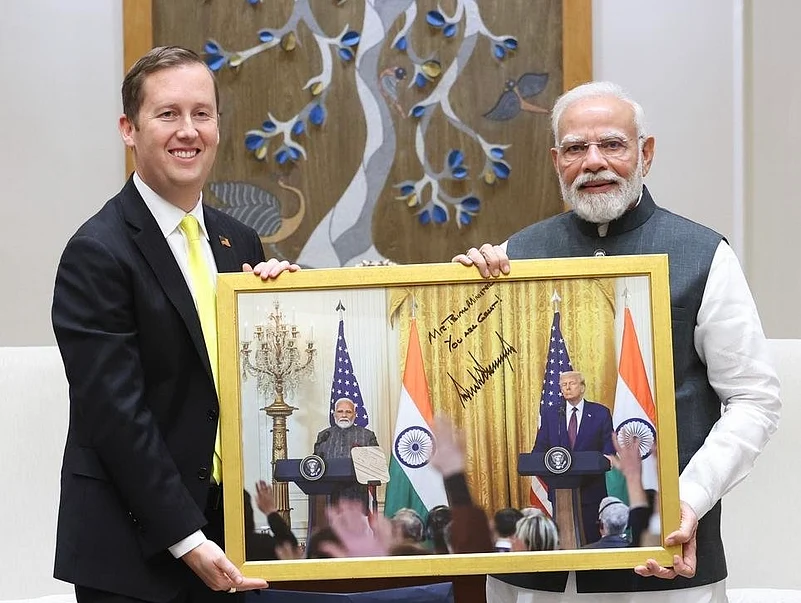
The strategic partnership between the United States and India has arguably never been stronger. From defence cooperation to shared initiatives on critical and emerging technology, the two democracies are aligned on many of the macro issues defining the 21st century. Yet, despite this strategic embrace, one glaring gap remains: a comprehensive trade agreement. For decades, economists and diplomats have argued that the economic relationship punches well below its weight, hampered by protectionist instincts in both New Delhi and Washington.
Negotiations have started, stalled, and restarted more times than most policy experts care to count. However, a new dynamic has entered the equation. With the rise of Sergio Gor as a pivotal figure in the inner circle of US leadership, there is renewed speculation that the deadlock might finally be broken. Gor, known for his ability to navigate complex political landscapes and his proximity to power, represents a shift from traditional bureaucratic plodding to high-stakes, transactional diplomacy.
This article examines whether Sergio Gor has the leverage and the strategy required to push the India–US trade deal across the finish line, or if the structural barriers between these two economic giants are simply too high to surmount.
A Brief History of the India–US Trade Deadlock
To understand the magnitude of the challenge facing Sergio Gor, one must first appreciate the history of friction that characterizes India–US trade relations. While trade volumes have grown—the US is now India’s largest trading partner—the regulatory framework governing this exchange is fraught with tension.
Key Trade Disagreements
The friction points are well-documented. Washington has long complained about India’s high tariffs, which are among the highest of any major economy. Specific grievances have historically centred on agricultural products (such as almonds and walnuts), medical devices, and the iconic Harley-Davidson motorcycles—a frequent talking point in US political rhetoric. On the flip side, New Delhi has consistently raised concerns about US protectionism, particularly regarding the movement of skilled professionals (H-1B visas) and market access for Indian steel and aluminium.
Previous Negotiations and Why They Stalled
Under the first Trump administration, a “mini-trade deal” seemed imminent. Negotiators spent months haggling over specific line items, attempting to trade lower tariffs on American agricultural goods for the restoration of India’s status under the Generalized System of Preferences (GSP), which allows duty-free entry for thousands of Indian goods.
Ultimately, the talks collapsed. The reasons were multifaceted: rigid red lines on data localization, disagreements over certification for dairy products, and a general mismatch in timing. The Biden administration subsequently focused more on strategic alignment through the Quad and the Indo-Pacific Economic Framework (IPEF), leaving the hard questions of a bilateral Free Trade Agreement (FTA) largely on the back burner.
Impact on Bilateral Economic Relations
The absence of a deal has left businesses in a state of uncertainty. Without a formal framework, trade disputes are often handled case-by-case at the World Trade Organization (WTO), creating an unpredictable environment for investors. While trade has hit record highs, experts agree that a formal treaty could exponentially increase volume, unlocking billions in potential value.
Who Is Sergio Gor and Why Does He Matter?
In the world of high-level diplomacy, personnel is policy. Sergio Gor’s emergence as a key player signals a specific approach to governance and international relations that prioritizes results over protocol.
Background and Influence
Sergio Gor is not a career bureaucrat trained in the polite nuances of the State Department. He is a political operator with deep ties to the “America First” movement and a direct line to Donald Trump. His background suggests a pragmatic, deal-focused mindset. In previous roles, he has demonstrated an ability to cut through red tape and facilitate direct communication between stakeholders who might otherwise remain at odds.
A Potential Turning Point
Why is his involvement seen as a catalyst? Simply put, traditional negotiations often fail because low-level bureaucrats lack the authority to make politically sensitive concessions. Gor operates with a mandate that allows for bolder decision-making. His presence suggests that the US administration views the India trade deal not just as an economic item, but as a political priority that requires a “closer” to finalize. If Gor is at the table, it implies that the White House is ready to expend political capital to get a deal done.
The Key Issues Blocking the Trade Deal
For any deal to succeed, negotiators must dismantle a wall of specific, thorny issues. These are not merely economic disagreements; they are deeply tied to domestic politics in both nations.
Tariff Disputes and Protectionist Policies
The US has frequently labelled India a “tariff king,” citing duties that protect domestic manufacturers but frustrate American exporters. Conversely, the US maintains its own protective measures, such as Section 232 tariffs on steel and aluminium, which hit Indian exporters hard. Breaking this deadlock requires a mutual de-escalation that is politically difficult to sell to domestic audiences who fear job losses.
Agricultural and Industrial Market Access
Agriculture remains a sensitive topic. The US demands greater access for its dairy and poultry industries. However, India is culturally and politically sensitive regarding these sectors, largely due to the dominance of smallholder farmers and religious sentiments regarding bovine products. In the industrial sector, the US wants lower barriers for high-end electronics and medical equipment, while India seeks to protect its burgeoning manufacturing sector under the “Make in India” initiative.
Technology, Digital Trade, and Data Regulations
This is the modern battleground. The US is home to the world’s largest tech giants, who crave unfettered access to India’s massive digital market. However, India has moved aggressively towards data sovereignty, demanding that data generated in India stays in India. Reconciling the American desire for the free flow of data with India’s insistence on localization is perhaps the most complex technical hurdle.
Visa, Labour, and Services-Related Concerns
For India, trade is as much about services and people as it is about goods. The H-1B visa programme is a lifeline for the Indian IT sector. Any trade deal that does not address the ease of movement for Indian professionals is likely to be viewed as a failure in New Delhi. However, immigration remains a radioactive political issue in the US, making concessions here incredibly difficult.
What’s Changed in the Current Negotiations?
If the problems are old, the context is entirely new. The geopolitical tectonic plates have shifted, creating a window of opportunity that did not exist five years ago.
Strategic Alignment Amid Global Supply-Chain Realignments
The primary driver of this new urgency is China. Both Washington and New Delhi are eager to reduce their economic dependence on Beijing. The “China Plus One” strategy has moved from a boardroom buzzword to a national security imperative. A trade deal would facilitate the movement of supply chains from China to India, serving American security interests and Indian economic goals simultaneously.
Renewed Urgency Due to Geopolitical Pressures
The war in Ukraine and instability in the Middle East have underscored the need for reliable partners. The US needs India as a counterweight in the Indo-Pacific; India needs US technology and investment to modernize its economy and military. This strategic alignment provides a “top-cover” for trade negotiators—political leaders are now more willing to override domestic protectionist lobbies in service of the broader geopolitical goal.
India’s Position: What New Delhi Wants
Prime Minister Narendra Modi’s government approaches these talks with a clear set of priorities.
Safeguarding Domestic Industries
The “Atmanirbhar Bharat” (Self-Reliant India) campaign is central to Modi’s economic philosophy. Any trade deal must not flood the Indian market with cheap American goods that undercut local manufacturers. India will likely demand phased tariff reductions rather than immediate zero-duty access.
Expanding Exports and Manufacturing
India aims to become a global manufacturing hub. To achieve this, it needs the US market to remain open to Indian textiles, gems, jewellery, and pharmaceuticals. Restoring GSP benefits is a non-negotiable starting point for many Indian negotiators.
Strategic Autonomy
India is wary of trade deals that impinge on its sovereign right to regulate. Whether it is pricing caps on medical stents or rules regarding e-commerce platforms, New Delhi wants to retain the policy space to intervene in markets when necessary.
The US Perspective: Washington’s Expectations
The US approach is driven by a desire to correct imbalances and open new frontiers for American commerce.
Market Access and Regulatory Clarity
American businesses often cite the unpredictability of India’s regulatory environment as a bigger hurdle than tariffs. Washington wants a predictable, transparent, and stable policy regime. This includes stronger intellectual property (IP) protections and consistent tax policies.
Addressing Trade Deficits
While the trade deficit with India is nowhere near the size of the deficit with China, it remains an irritant for “America First” proponents. The US wants to see a tangible increase in American exports to India to balance the ledger.
Can Sergio Gor Break the Deadlock?
This brings us back to the central question. Can Gor succeed where others have failed?
Diplomatic Strategies
Gor is likely to employ a transactional approach. rather than getting bogged down in a comprehensive, 2,000-page document, he may push for a “harvesting” strategy—locking in agreements on 70% of the issues where there is consensus and leaving the most toxic 30% for later. This allows both leaders to claim a victory without crossing their respective red lines.
Potential Compromises
A likely compromise could see the US restoring GSP status and offering limited relief on visa processing in exchange for India lowering tariffs on specific high-visibility American goods (like Harley-Davidsons, apples, and whiskey) and softening its data localization stance for certain sectors.
Risks and Obstacles
The biggest risk is the “all or nothing” impulse. If hardliners in Washington insist that India completely overhaul its agricultural policy, or if New Delhi demands a massive expansion of visa quotas, the talks will collapse again. Gor’s challenge will be to manage expectations and keep the principals focused on the strategic big picture.
What a Successful Trade Deal Would Mean
If a deal is signed, the implications would be profound.
Economic Impact
Bilateral trade, currently hovering around $190 billion, could surge past $500 billion within the decade. It would signal to global investors that India is fully integrated into the Western economic sphere.
Benefits for Business
For startups, it could mean easier access to capital and talent. For consumers, it means cheaper electronics, better access to healthcare devices, and more variety in the marketplace.
Geopolitical Implications
A trade deal would cement the US-India partnership as the defining alliance of the 21st century, creating a formidable economic bloc capable of checking Chinese dominance in Asia.
What Happens If Talks Fail Again?
Failure is a distinct possibility. If Sergio Gor cannot bridge the gap, the consequences will be felt for years.
The relationship would not collapse, but it would remain lopsided—strong on guns, weak on butter. The US might turn its trade focus entirely towards the Americas or Europe, while India might accelerate trade talks with the UK or the EU, leaving the US behind. Worst of all, it would represent a failure of imagination—an inability to translate strategic friendship into economic prosperity.
FAQs
Who is Sergio Gor?
Sergio Gor is a prominent political strategist and diplomat with close ties to the Trump leadership circle. He is known for his influence in personnel and high-level negotiations, often operating as a key conduit for “America First” policies.
Why is the India–US trade deal delayed?
The delay stems from fundamental disagreements over tariffs, market access for agricultural and dairy products, data localization laws, and visa policies for Indian professionals.
What sectors will benefit most from the deal?
The primary beneficiaries would likely be the technology, defence, pharmaceutical, and agricultural sectors. American manufacturers and Indian IT services would see significant gains.
When could the trade agreement be finalized?
While timelines are fluid, the involvement of high-level figures like Sergio Gor suggests a push for a preliminary agreement within the first 12 to 18 months of the new administration’s tenure.
The Final Verdict
The India–US trade deal has long been the “next big thing” that never quite happens. The structural impediments are real, and the domestic political costs in both nations are high. However, the introduction of Sergio Gor into the equation changes the calculus. By injecting high-level political will and a transactional pragmatism into the process, there is a genuine chance to break the deadlock.
The next few months will be decisive. If Gor can navigate the minefield of tariffs and visas, he may well architect one of the most significant economic agreements of the modern era.
Are you looking to navigate the complexities of international trade and policy? Contact our team today for bespoke analysis and strategic guidance.
Leave a Reply