

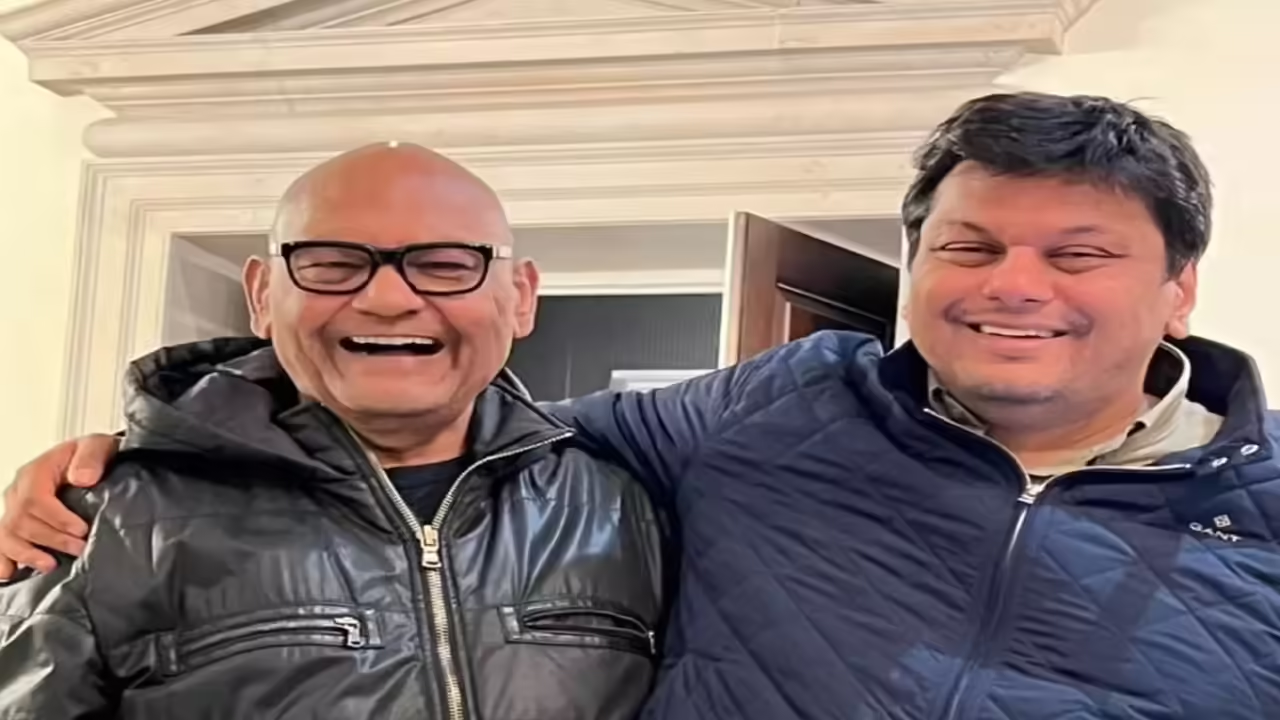
In the high-stakes theater of global business, the spotlight almost always finds the charismatic founder. We are drawn to the visionaries—the individuals who stand on stages, articulate grand futures, and become the face of their empires. In the story of the Vedanta Group, that figure has undeniably been Anil Agarwal. His journey from a scrap metal dealer in Mumbai to a global mining tycoon is the stuff of corporate legend. Yet, monumental success in the conglomerate world is rarely a solo act. Beneath the headlines and the high-profile acquisitions lies a layer of operational leadership that turns ambitious vision into tangible reality.
This is where the story of Agnivesh Agarwal becomes essential.
For years, Agnivesh Agarwal operated as a pivotal figure within the Vedanta ecosystem, particularly during his tenure leading Hindustan Zinc Ltd (HZL). While his father sketched the blueprint for a global natural resources giant, Agnivesh was among the key architects working to ensure the foundation could hold the weight of that ambition. Recently, his name has resurfaced in business and corporate circles, not because of a new scandal or a flashy launch, but because the industry is taking a retrospective look at what constitutes sustainable leadership. As Vedanta navigates new restructuring phases and complex market dynamics, the steady, low-profile leadership style that Agnivesh embodied offers a stark, valuable contrast to the celebrity CEO culture that dominates modern business discourse.
Who Was Agnivesh Agarwal?
To understand the weight of his contributions, one must look past the surname. Being the son of a founder comes with immediate assumptions of nepotism and unearned authority. However, within the corridors of Vedanta, Agnivesh Agarwal’s reputation was built on engagement rather than entitlement.
His entry into the group was not merely ceremonial. He stepped into a complex, heavy industry that forgives few mistakes. Mining and resources are not sectors that can be managed from an ivory tower; they require a granular understanding of geology, commodity cycles, labor relations, and government policy. Agnivesh integrated himself into these realities early on.
Professionally, he carved out a distinct identity. While he held various directorships, his most defining role was as the Chairman of Hindustan Zinc Ltd. Under his stewardship, the company didn’t just survive; it thrived, becoming one of the largest and most profitable zinc-lead producers in the world. His background was shaped by a mix of hands-on operational exposure and high-level strategic oversight, allowing him to bridge the gap between what was happening in the mines and what was being discussed in the boardroom. He developed a reputation as a leader who spoke less but did more—a trait that would define his tenure.
Vedanta’s Growth Years: The Era Agnivesh Agarwal Helped Shape
The period during which Agnivesh Agarwal was most active corresponds with Vedanta’s most aggressive growth phase. This was the era when Vedanta transitioned from an Indian company with global aspirations to a bona fide multinational powerhouse listed on the London Stock Exchange.
The expansion was multi-pronged. The group was simultaneously scaling up in aluminum, venturing into power generation, and consolidating its dominance in zinc and silver. This was not a period of steady-state management; it was a period of volatile transformation.
During these years, the company faced the dual challenge of integrating newly acquired public sector units (like BALCO and HZL) while navigating the volatile swings of global commodity prices. Agnivesh’s tenure at HZL saw the company undergo a massive ramp-up in production capacity. It wasn’t just about digging more ore out of the ground; it was about shifting from open-cast mining to complex underground operations—a technical and logistical feat that required precise execution.
The internal decision-making culture during this time had to evolve. A family-run business can rely on intuition; a global conglomerate relies on systems. Agnivesh was instrumental in professionalizing the management structures within the verticals he oversaw, ensuring that the entrepreneurial spirit of the founder was balanced with the rigorous governance required of a publicly traded giant.
The Role He Played Inside the Vedanta Empire
While the public eye remained on the parent company’s stock price and major acquisition announcements, Agnivesh Agarwal was deeply retrenched in the mechanics of value creation. His contributions can be categorized into three critical pillars.
Strategic Planning and Capital Allocation
In the resources sector, capital allocation is everything. Misjudge a cycle, and you are left with billions in debt and assets that yield nothing. Agnivesh played a significant role in determining where capital should flow. At Hindustan Zinc, the decision to invest heavily in exploration and underground mining technology was not a given—it was a strategic bet. That bet paid off, extending the life of mines and positioning the company as a low-cost producer. His approach was often characterized by prudence, ensuring that aggressive expansion goals were backed by solid financial logic.
Mergers, Acquisitions, and Expansion Moves
The Vedanta Group is built on M&A. However, buying a company is the easy part; making it work is where value is realized or lost. Agnivesh was key in the post-acquisition phase. Turning around former state-run enterprises requires a delicate cultural shift. It involves reassuring unions, optimizing bloated workflows, and introducing private-sector efficiencies without breaking the existing ecosystem. His operational focus helped smooth these transitions, turning sluggish units into profit centers that fueled the group’s broader ambitions.
Operating a mining company in India involves navigating a labyrinth of environmental clearances, changing government policies, and legal hurdles. This is rarely the work of a single figurehead. It requires a leadership team capable of constant vigilance and adaptation. Agnivesh Agarwal operated in an environment where regulatory headwinds were constant. His tenure involved managing these external pressures quietly, ensuring compliance while advocating for the industry’s growth. His ability to steer the ship through policy fluctuations without attracting negative controversy was a testament to his diplomatic and administrative skill.
Leadership Without the Spotlight
Perhaps the most defining characteristic of Agnivesh Agarwal’s leadership was his invisibility. In an era where CEOs hire PR firms to manage their personal brands on Twitter and LinkedIn, Agnivesh remained remarkably offline and out of the press.
This was a deliberate management philosophy. By stepping back, he allowed the professional CEOs and operational heads of the various business units to take ownership. It created a culture where performance mattered more than face time. His style was consultative rather than dictatorial. He was known to listen intently to geologists and engineers, understanding that in mining, the technical experts often hold the real answers.
This approach draws comparisons to other quiet leaders in Indian corporate history, such as N. Chandrasekaran before his elevation to the Tata Sons chairmanship, or the heads of engineering at heavyweights like L&T. These are leaders who understand that their job is to facilitate the work of others, removing obstacles rather than seeking applause.
Industry Voices and Colleague Remembrances
Talk to insiders at Vedanta or analysts who covered the mining sector during the mid-2000s and 2010s, and a consistent picture emerges. Colleagues often described Agnivesh as “approachable” and “grounded.”
There is a distinct respect accorded to him by the “old guard” of the mining industry. They viewed him not as a scion enjoying the view from the top, but as a serious stakeholder who did his homework. In board meetings, he was known for asking questions that focused on long-term sustainability rather than just quarterly numbers.
Stakeholders, including minority shareholders of HZL, often benefited from the dividend policies and cash-rich status of the company under the oversight of the board he led. While he may not have been the one giving the keynote speeches at industry summits, his presence was felt in the healthy balance sheets and the operational metrics that the company reported year after year.
Why Agnivesh Agarwal’s Role Is Being Revisited Now
Why are we looking back at Agnivesh Agarwal today? The timing is significant. Vedanta is currently undergoing a massive strategic overhaul, looking to demerge its businesses to unlock value and manage debt.
As the group looks to the future, there is a renewed appreciation for the disciplined growth of the past. Current leaders and management students are looking back at the “golden years” of Hindustan Zinc to understand how to build a cash cow that can support a diversified empire. The history of the group is being mined (pun intended) for lessons on resilience.
Agnivesh’s era represents a time of focused execution. As the next generation of leaders steps up and new management structures are put in place, the template of the “quiet leader” offers a necessary counterbalance to the high-octane, risk-heavy approach that often characterizes the sector. It serves as a reminder that sustainable growth requires leaders who are willing to do the boring, difficult work away from the cameras.
His Legacy Within Vedanta
The legacy of Agnivesh Agarwal is written in the reserves and resources of the companies he helped lead. The world-class status of Hindustan Zinc is perhaps his most enduring monument. The systems of exploration, the focus on safety standards, and the adoption of technology in underground mining that became standard practice during his time continue to benefit the company today.
Furthermore, he helped instill a culture of asset stewardship. He demonstrated that a promoter’s role is not just to own, but to nurture. This influence persists in how the group approaches its operational challenges. The leaders who worked under him have carried those lessons forward, ensuring that the DNA of operational excellence remains intact even as the faces at the top change.
The Broader Lesson: Unsung Leaders in Indian Corporates
The story of Agnivesh Agarwal points to a broader truth about Indian corporate history: many of its most transformative figures remain largely invisible to the public.
We are culturally conditioned to celebrate the charismatic founder. We love the stories of garage startups and risk-taking billionaires. But the longevity of a corporation depends on the steady hands that steer the ship through the storms that the visionaries sail into. These unsung leaders provide the stability required for innovation to take root. They manage the cash flows that fund the moonshots.
Acknowledging figures like Agnivesh Agarwal matters because it broadens our definition of successful leadership. It teaches aspiring executives that they do not need to be the loudest person in the room to be the most effective. It validates the path of the operator, the strategist, and the quiet executor.
Remembering the Quiet Architect of Growth
Agnivesh Agarwal’s instrumental role in the Vedanta empire serves as a compelling case study in quiet influence. He did not seek to eclipse his father’s legacy, nor did he seek to create a cult of personality for himself. Instead, he directed his energy toward the health of the asset and the stability of the organization.
His leadership style remains relevant because it prioritizes substance over style. In a business environment that is increasingly noisy and performative, the discipline to remain focused on fundamentals is a rare and valuable commodity. As Vedanta moves into its next chapter, the operational fortitude built during Agnivesh’s tenure remains part of the bedrock upon which the future stands.
Leadership is not always about the roar of the lion; sometimes, it is about the strength of the pride. Agnivesh Agarwal played his part with dignity and effectiveness, leaving behind a legacy of growth that speaks louder than he ever chose to.
Leave a Reply