

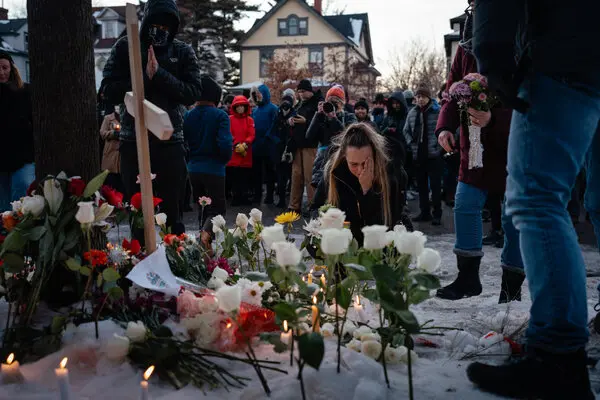
Minneapolis is no stranger to being the epicenter of national conversations on law enforcement and accountability. But the recent shooting involving Immigration and Customs Enforcement (ICE) agents has added a volatile new layer to an already strained relationship between communities and federal power. This isn’t just a local news story; it represents a collision of federal overreach, public distrust, and the desperate need for transparency.
While the details are still being dissected, the immediate aftermath has made one thing clear: this incident is not an isolated anomaly. It is a flashpoint. It forces the nation to confront uncomfortable questions about how federal agencies operate within local jurisdictions and what happens when the narrative provided by authorities conflicts sharply with the evidence seen by the public. We are looking at a potential breaking point in public trust—one that demands we pay attention before the fracture becomes irreparable.
What Happened in the Minneapolis ICE Shooting
To understand the outrage, we must first look at the timeline. The incident unfolded rapidly, transforming a residential street into a crime scene involving federal agents. According to initial reports, ICE agents were conducting an enforcement operation when the confrontation occurred. Unlike standard police encounters, which often involve uniformed officers and marked cars, federal operations can be more opaque.
ICE and federal agents operate under different protocols than local police, often with less immediate oversight. In this case, the confrontation escalated to lethal force within moments. The official statement released shortly after the shooting described a scenario of self-defense—a narrative often used in officer-involved shootings. However, as independent footage and witness testimonies began to surface, cracks appeared in that initial account. The disparity between what was claimed and what was observed has become the central engine of the controversy.
Why This Shooting Feels Different
We have seen police shootings spark unrest before, but the involvement of a federal agency changes the calculus. Local police departments are, in theory, accountable to city councils and mayors. ICE, however, answers to the Department of Homeland Security (DHS) in Washington, D.C., creating a significant gap in local accountability.
This incident also lands in a community still reeling from years of high-profile cases of police violence. The reservoir of public trust is already dry. When you add the involvement of federal agents—who are often viewed with deep suspicion in immigrant-heavy communities—the tension is immediate. Furthermore, the speed at which bystander video spread on social media meant that the official narrative didn’t have time to set before it was challenged. The public didn’t have to wait for the evening news; they saw the aftermath in real-time, fueling immediate skepticism.
Federal Power vs. Local Communities
One of the most friction-heavy aspects of this shooting is the presence of federal enforcement in domestic neighborhoods. ICE’s mandate is immigration enforcement, but their tactical operations often resemble paramilitary raids. This creates a terrifying environment for residents, regardless of their citizenship status.
Minneapolis has become a flashpoint because of the tension between its local leadership, which has often pushed for more progressive policing reforms, and federal agencies that operate with a hardline approach. When federal agents operate in a city that is trying to rebuild trust with its residents, these operations can feel like an invasion. It undermines local efforts to establish community safety and reinforces the idea that federal power can override local concerns with impunity.
Conflicting Narratives and the Truth Gap
Credibility is the currency of law enforcement, and in this case, the account is overdrawn. The federal claim of self-defense is a standard legal defense, but it requires evidence to support it. In the Minneapolis shooting, the “truth gap”—the space between what authorities say happened and what the public believes happened—is widening.
Witnesses on the scene described a chaotic encounter that didn’t match the orderly description of a justified shooting. Video evidence, while often fragmented, provided visual context that contradicted parts of the official report. This dissonance is critical. When the public cannot trust the initial word of law enforcement, every subsequent statement is viewed through a lens of suspicion. This isn’t just about this specific shooting; it’s about the systemic issue of narratives being engineered to protect institutions rather than reveal the truth.
The Human Cost Behind the Headlines
Amidst the political maneuvering and legal arguments, there is a human life lost. The victim was not just a suspect or a statistic; they were a member of a community, a family member, and a person with a history. As details about their life emerge, the story shifts from a tactical error to a tragedy.
Friends and family describe the emotional fallout as devastating. The grief is compounded by the feeling of powerlessness against a massive federal agency. These personal stories drive national empathy because they humanize the abstract debates about policy. They remind us that “enforcement operations” have real, irreversible consequences for families who are left to pick up the pieces.
Political Fallout at the Local and National Level
The political response has been a study in polarization. Minneapolis city leadership faces the difficult task of managing local anger while having limited jurisdiction over federal agents. Their calls for transparency are often met with bureaucratic silence from federal agencies.
On the national stage, the Department of Homeland Security has largely circled the wagons, defending the actions of its agents and criticizing local leaders for not being supportive enough. This disconnect fuels national political polarization. One side views this as a necessary enforcement of law; the other views it as state-sanctioned violence. This incident has become a proxy war for broader political battles, often obscuring the specific need for justice in this individual case.
A Pattern, Not an Exception
Critics argue that treating this as an isolated incident ignores history. There is a documented pattern of use-of-force incidents involving ICE and Customs and Border Protection (CBP) agents that rarely result in disciplinary action. Civil rights advocates point to a lack of independent oversight for these agencies compared to local police departments.
From border shootings to interior raids gone wrong, the history suggests that internal investigations rarely yield accountability. This context is vital. It explains why the community is not willing to “wait and see” what the internal review finds. They have seen this movie before, and they know how it ends. The call for reform is not just about this shooting; it’s about breaking a cycle of impunity.
What Accountability Would Actually Look Like
So, what does justice look like in a case involving federal agents? First, it requires a truly independent investigation—not one conducted by the agency involved or its close partners. It requires the release of all unedited video footage and witness statements.
Advocates are demanding specific policy reforms, such as ending the use of militarized tactics in residential neighborhoods and mandating body cameras for all federal agents. Accountability also means transparency about the chain of command—knowing who authorized the operation and what the rules of engagement were. Without these steps, any “investigation” will be seen as a cover-up.
Why This Is a National Wake-Up Call
The Minneapolis ICE shooting is a warning light on the dashboard of American democracy. It signals that the current model of federal immigration enforcement is on a collision course with civil rights and community safety. If we ignore this moment, we risk normalizing a level of federal violence that has no place in a free society.
This is about more than immigration; it is about the limits of government power and the rights of individuals to be safe in their communities. Trust in federal law enforcement is eroding, and incidents like this accelerate the decay. We need to wake up to the reality that without significant structural reform, Minneapolis will not be the last city to mourn a tragedy at the hands of federal agents.
FAQs
Why is the Minneapolis ICE shooting controversial?
The controversy stems from conflicting narratives between federal agents and eyewitnesses, the involvement of a federal agency with a history of transparency issues, and the backdrop of Minneapolis’s history with police violence.
What role did ICE play in the incident?
ICE agents were conducting an enforcement operation. They were the primary law enforcement presence on the scene and were the ones who discharged their weapons.
Is the shooting under investigation?
Yes, there are typically internal reviews and external investigations following an officer-involved shooting. However, critics often question the independence and transparency of these federal investigations.
Why has this sparked nationwide protests and debate?
The incident touches on deep national nerves regarding police brutality, federal overreach, and immigration rights. It is seen by many as part of a broader pattern of unchecked law enforcement violence.
Moving Forward
This incident marks a breaking point because it exposes the dangerous lack of accountability in federal law enforcement. We cannot afford to look away. The stakes—justice for the victim, safety for our communities, and the integrity of our legal system—are too high.
We must demand transparency. We must support independent journalism and legal advocacy that seeks the truth. And we must keep the pressure on our elected officials to enact meaningful oversight of federal agencies. Do not let this story fade into the news cycle. Demand answers. Demand reform.
Leave a Reply