

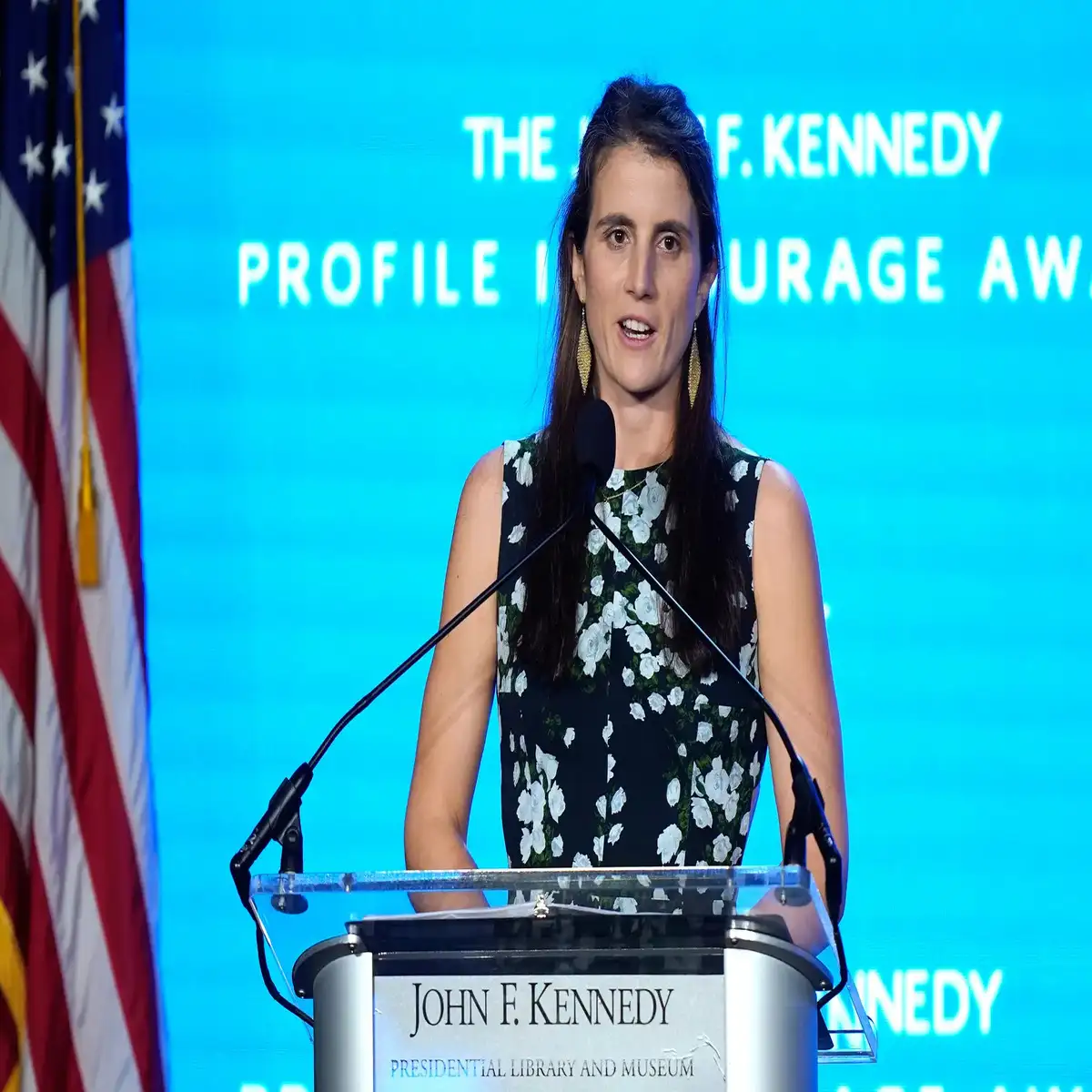
communicator in the 21st century.
Background and Education
To understand Schlossberg’s approach to reporting, one must look at her foundation. Born to Caroline Kennedy and Edwin Schlossberg, she grew up in the public eye but maintained a level of privacy that allowed her to develop her own intellectual interests. While the political pressure on her family was immense, her trajectory suggested a desire to observe and document the world rather than govern it.
Academic Roots
Schlossberg attended Yale University, where she majored in English. This background in literature and narrative structure is evident in her journalism. She doesn’t just present facts; she weaves them into compelling stories. Following her undergraduate studies, she earned a master’s degree in American History from the University of Oxford.
This historical training is a crucial differentiator. Many science journalists come from purely scientific backgrounds. By approaching environmental issues through the lens of a historian and a writer, Schlossberg understands context. She recognizes that climate change and pollution are not just chemical reactions; they are the results of historical industrial shifts, policy decisions, and societal behaviors. This academic blend allows her to report with a depth that connects the past to our current environmental crisis.
Focus on Climate and Environmental Journalism
Schlossberg’s beat is primarily science and climate change, a field that has grown exponentially in importance over the last decade. Her work has appeared in The New York Times, The Atlantic, and Bloomberg, covering everything from the decline of local journalism to the intricacies of plastic pollution.
Translating Complex Science
The defining characteristic of her work is her ability to translate. Climate science is notoriously difficult to communicate. It involves abstract concepts, distant timelines, and data that can feel overwhelming to the average person. Schlossberg tackles this by grounding her reporting in tangible realities.
She moves away from the abstract “saving the planet” rhetoric and focuses on the specific mechanics of how we live. She asks questions that readers might not think to ask: What is the carbon footprint of the internet? How does the cashmere industry impact grasslands in Mongolia? By focusing on these specific, tangible connections, she makes the massive concept of climate change feel personal and understandable.
Storytelling Style and Writing Approach
The way a journalist writes is just as important as what they write about. Schlossberg’s style is distinctively witty, dry, and approachable. She avoids the preachy tone that often plagues environmental writing. Instead, she adopts the persona of a curious investigator who is learning alongside the reader.
Balancing Facts and Narrative
Her writing creates a balance between hard data and narrative engagement. She understands that statistics alone rarely change minds. In her reporting, data points are always anchored to real-world examples. If she is discussing water usage, she doesn’t just give a gallon count; she explains the agricultural processes behind a cotton t-shirt.
This approach respects the reader’s intelligence without demanding they be experts. She uses clear, accessible language to dismantle the barriers that often keep the public from engaging with science news. Her tone suggests that understanding the environment shouldn’t be a niche interest for scientists, but a basic part of civic literacy.
Avoiding the Guilt Trap
A unique aspect of her storytelling is her refusal to rely on individual guilt. Much of contemporary environmental messaging focuses on personal failure—you didn’t recycle enough, or you drove too much. Schlossberg flips this script. She focuses on systemic issues and corporate responsibility, framing individual actions within a larger context. This invites readers in rather than pushing them away with shame.
Journalism Beyond the Kennedy Legacy
It is impossible to discuss Tatiana Schlossberg without acknowledging her heritage, but her professional choices demonstrate a deliberate effort to establish credibility independent of it. By choosing a beat like environmental science—which requires technical knowledge and rigorous fact-checking—she stepped outside the immediate realm of political commentary.
Professional Identity
Her time at The New York Times as a science and climate reporter helped solidify her standing. In the newsroom, credibility is currency, and it is earned through bylines and deadlines, not lineage. Her colleagues and contemporaries respect her for the quality of her prose and the depth of her research.
She has managed to navigate the public fascination with her family by keeping the focus strictly on her work. When she gives interviews or speaks on panels, the topic is invariably the climate crisis, not political gossip. This discipline has allowed her to control her own narrative and ensure that she is viewed first and foremost as a journalist.
Notable Work and Publications
Schlossberg’s most significant contribution to the field so far is her 2019 book, Inconspicuous Consumption: The Environmental Impact You Don’t Know You Have. This work perfectly encapsulates her journalistic philosophy.
Inconspicuous Consumption
The book is an exploration of the hidden environmental costs of digital technology, food, fashion, and fuel. It won the Rachel Carson Environment Book Award, a prestigious honor that validated her status as a serious environmental writer.
In the book, she breaks down complex supply chains to show how remote actions have local consequences. For example, she explores how streaming a movie on Netflix relies on server farms that consume massive amounts of electricity and water for cooling.
The themes of the book highlight her unique voice. It is humorous, self-deprecating, and incredibly informative. She tackles heavy subjects with a lightness that makes the medicine go down easier, proving that serious topics don’t always require a somber tone.
Ethical Journalism and Credibility
In an era of “fake news” and skepticism toward the media, Schlossberg represents a return to traditional journalistic ethics. Her work is characterized by a commitment to accuracy and evidence. She is careful not to overstate claims or make predictions that the science cannot support.
Trust-Building
This cautious approach builds trust. When she writes about a potential environmental solution, she is honest about its limitations. She avoids the sensationalism that drives clicks but erodes credibility. By acknowledging nuance and uncertainty, she treats her readers as adults who can handle the truth, however complex it may be.
Influence on Public Awareness
Schlossberg’s work has played a role in shifting the public conversation regarding sustainability. By highlighting the structural nature of environmental problems, she empowers readers to think like citizens rather than just consumers.
Shaping the Conversation
Her reporting encourages a shift in focus from “green consumerism” (buying the right tote bag) to political engagement and corporate accountability. She helps her audience understand that while personal choices matter, policy changes matter more. This perspective is vital in moving the public discourse from guilt to action.
Her reach extends beyond typical environmentalists. Because her writing is published in mainstream outlets and her book is written for a general audience, she reaches people who might not subscribe to Scientific American or National Geographic.
Comparison with Contemporary Journalists
How does she differ from other voices in the field? Many environmental journalists fall into two camps: the activists and the technical reporters.
The activists often write with intense passion and urgency, aimed at mobilizing a base. The technical reporters write for the scientific community, prioritizing density and precision over readability. Schlossberg occupies a middle ground. She is more objective than the activists but more engaging than the technical reporters.
A Distinct Perspective
She also differs in her patience. Her work often takes the long view, explaining the “how” and “why” rather than just the “what just happened.” While breaking news reporters are chasing the latest hurricane or wildfire, Schlossberg is often writing about the infrastructure or policy failures that made the disaster worse. This long-form, analytical approach adds necessary depth to the media ecosystem.
Why Her Journalism Matters Today
We live in the age of climate change and misinformation. The ability to communicate scientific reality clearly and responsibly is perhaps the most valuable skill a journalist can possess today. Tatiana Schlossberg provides a blueprint for how this can be done effectively.
combating Misinformation
By explaining the mechanisms behind environmental change, she inoculates her readers against misinformation. When people understand how a system works, they are less likely to be swayed by false claims. Her work promotes scientific literacy, which is essential for a functioning democracy in the 21st century.
Long-Term Significance
Schlossberg’s contributions matter because they prioritize understanding over reaction. In a media environment that thrives on outrage, she offers clarity. Her work reminds us that the environment is not a separate sphere of interest but the context in which all other human activity takes place.
A Legacy of Her Own
Tatiana Schlossberg has successfully navigated the weight of her family history to emerge as a singular voice in American journalism. She is a writer who respects her audience enough to explain the hard stuff and a reporter who cares enough to make it interesting.
Her unique blend of historical context, literary flair, and scientific rigor makes her an essential guide for navigating the complexities of the modern world. As the climate crisis continues to unfold, voices like hers—calm, informed, and relentlessly curious—will be our best hope for understanding what comes next.
Leave a Reply