

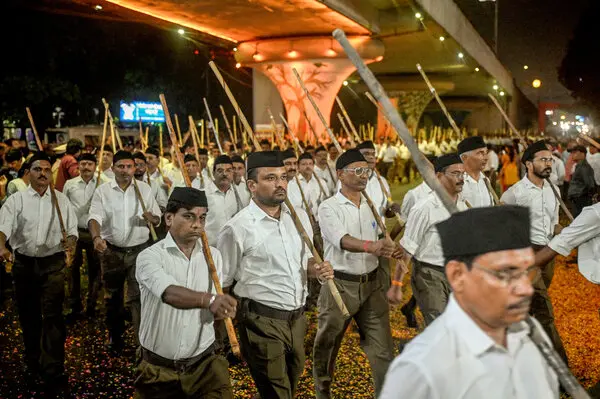
In the modern media landscape, the same event or organization can be portrayed in vastly different lights depending on who is holding the pen. This phenomenon is currently playing out on a global stage regarding the Rashtriya Swayamsevak Sangh (RSS), a prominent Hindu nationalist volunteer organization in India. Recently, a sharp divergence has emerged between how domestic Indian media covers the RSS and how international giants like The New York Times (NYT) approach the same subject.
This contrast isn’t just about editorial style; it represents a fundamental clash of narratives. On one side, domestic outlets often view the RSS through a lens of cultural history, social service, and national identity, particularly as the organization approaches its centenary. On the other, international publications like the NYT are increasingly scrutinizing the organization’s political influence and ideological roots through the lens of investigative journalism.
Understanding this dichotomy is crucial for anyone trying to grasp the current sociopolitical climate in India. It highlights how geography, audience expectations, and editorial priorities shape the news we consume. This analysis explores the “New York Times RSS coverage” alongside Indian media narratives to understand why the story of one organization is being told in two very different ways.
How Indian Media Covers the RSS
To understand the domestic perspective, one must look at the role the RSS plays in Indian society. For decades, the organization has been deeply embedded in social work, disaster relief, and cultural education. Consequently, a significant portion of Indian media coverage reflects this reality.
Cultural and Historical Context
Domestic reporting often centers on the RSS as a cultural body rather than purely a political one. With the organization nearing its 100th anniversary, many Indian outlets are focusing on its historical journey from a small group in Nagpur to a massive cadre-based organization. Articles frequently highlight the RSS’s role in nation-building, its discipline, and its expansive network of schools and charities. The narrative is often one of resilience and integration into the fabric of Indian society.
The Tone of Domestic Coverage
The tone in mainstream Indian media ranges from neutral reporting of events to supportive commentary on the organization’s nationalistic goals. While there are certainly critical voices within the Indian press—particularly in independent digital outlets and left-leaning publications—mainstream television channels and major dailies often frame RSS activities as routine or positive. Coverage of speeches by the Sarsanghchalak (the head of the RSS) is treated with the gravity accorded to high-profile public figures, often focusing on themes of unity, self-reliance, and cultural pride.
Political Realities and Audience
The current political landscape plays a significant role here. With the Bharatiya Janata Party (BJP)—the political offshoot of the RSS—in power, the organization’s ideology has moved from the fringes to the center. For domestic media, the RSS is not a distant, mysterious entity but a familiar, powerful stakeholder in the country’s governance. The audience for these stories comprises millions of people who may have direct or indirect contact with RSS shakhas (branches), making the coverage more nuanced and less prone to viewing the organization as an exotic or dangerous “other.”
What the New York Times Reported
In stark contrast to the routine coverage found at home, The New York Times recently published a deep-dive investigation into the RSS, signaling a shift in how the West views the organization. This wasn’t a standard news report; it was a long-form feature designed to explain the machinery of Indian politics to a global audience.
The Investigative Lens
The NYT report was characterized by months of on-the-ground reporting, interviews, and historical analysis. Unlike daily news cycles that focus on immediate events, this piece aimed to map the structural influence of the RSS. The reporting focused heavily on the organization’s reach into state institutions, its relationship with Prime Minister Narendra Modi, and its ideological commitment to transforming India into a Hindu Rashtra (nation).
Key Themes Highlighted
The “New York Times RSS coverage” emphasized themes that resonate with Western liberal democracies: secularism, minority rights, and democratic backsliding. The article painted a picture of an organization that operates as a “state within a state,” exerting pressure on policy, education, and the judiciary. It highlighted concerns regarding the marginalization of India’s Muslim minority and questioned whether the RSS’s vision is compatible with India’s constitutional secularism.
Global Attention
This reporting gained traction because it framed the RSS not just as an Indian social group, but as a major player in the global trend of rising right-wing nationalism. For international readers, the NYT provided a framework to understand India’s changing political identity, linking local organizational dynamics to broader global anxieties about the health of democracies.
Narrative Framing: Celebration vs. Investigation
The core difference between these two schools of journalism lies in their framing. Is the story about a centenary celebration of a dedicated volunteer force, or is it an investigation into the erosion of secular values?
Commemoration vs. Critique
Indian media, particularly in the run-up to elections or organizational milestones, often adopts a commemorative tone. Special features might explore the “untold stories” of RSS workers or their contributions during crises like the COVID-19 pandemic. The framing suggests that the RSS is a stabilizing force.
Conversely, the NYT approaches the subject with skepticism, a hallmark of Western investigative journalism when covering power structures. The framing is critical by default. The story is not about what the RSS does in terms of daily activities, but what it means for the future of the country’s democracy.
Audience Priorities
Domestic audiences prioritize different information. An Indian reader might be interested in the RSS’s stance on economic policy, caste equations, or local elections. These are tangible, immediate issues. The international reader, however, is looking for a meta-narrative. They want to know: Is India changing? Is it still a secular democracy? The NYT caters to this demand for big-picture analysis, often stripping away the local nuance that Indian media might obsess over.
Institutions, Power & Influence: Media Perspectives
One of the most contentious points of divergence is how the influence of the RSS on state institutions is portrayed.
The Domestic View on Influence
In India, the overlap between the RSS and the ruling party is an open secret, often discussed as a matter of political strategy. Media discussions focus on “coordination meetings” between the government and the Sangh. This influence is often framed as “guidance” or “ideological mentorship.” For a significant section of the pro-government media, this synergy is seen as a strength—a sign of a government that is rooted in indigenous values and has a clear ideological direction.
The International View on State Capture
International media frames this same synergy as “institutional capture.” The NYT and similar outlets portray the placement of RSS-affiliated individuals in universities, ministries, and cultural bodies not as coordination, but as a subversion of independent institutions. They argue that this blurs the lines between a private organization and the state apparatus. This narrative resonates with Western readers familiar with debates about the separation of church and state, or the independence of the judiciary.
Global Perception of India & Its Impact
The “battle of narratives” has real-world consequences beyond just newspaper sales. How the RSS is covered significantly impacts India’s global image.
Shaping the Democratic Image
India has long prided itself on being the “world’s largest democracy.” Reports like those from the NYT challenge this branding. When influential global platforms highlight majoritarianism or religious polarization, it impacts how foreign governments, investors, and human rights bodies view New Delhi. It shifts the conversation from India’s economic potential to its political stability and human rights record.
Soft Power and Diaspora
This media coverage also affects the Indian diaspora. Millions of Indians living abroad find themselves caught between these two narratives. They may consume Indian media that celebrates the country’s rising stature, only to open a local newspaper and read a scathing critique of the ideology driving that rise. This creates a polarized diaspora, where community discussions mirror the media divide back home.
Diplomatic Implications
While foreign governments rarely base policy solely on media reports, consistent negative coverage can create diplomatic friction. It forces foreign leaders to address questions about human rights and democratic values during bilateral meetings, complicating what might otherwise be purely trade-focused relationships.
Media Bias or Media Context?
Is this a case of bias, or is it simply a matter of context? The accusation of “media bias” is thrown from both sides. Supporters of the RSS accuse Western media of a colonial mindset, arguing they lack the cultural context to understand the organization. Critics of the Indian media accuse domestic outlets of being “godimedia” (lapdog media), too afraid or too compromised to speak truth to power.
Understanding Editorial Priorities
The truth likely involves a mix of bias and context. Editorial priorities dictate what gets published. The NYT has a mandate to act as a global watchdog for liberal democratic values. Their bias—if one calls it that—is toward secular liberalism. Indian media has a mandate to serve a domestic audience that recently gave the BJP a massive mandate. Their context is a nation that is undergoing a profound cultural shift that many citizens support.
Distinct Roles
It is possible for both narratives to coexist, albeit uncomfortably. One narrative (domestic) documents the rise and consolidation of a massive socio-political movement. The other narrative (international) documents the costs and consequences of that movement. A complete picture of the RSS likely requires reading across this divide, rather than staying within one echo chamber.
Why This Debate Is Trending Now
The intensity of this media battle is not accidental. Several factors have converged to make the “New York Times RSS coverage” a hot-button issue right now.
- Geopolitical Timing: With India positioning itself as a counterweight to China and a leader of the Global South, scrutiny of its internal politics has increased. The world is paying attention to India in a way it hasn’t before.
- Election Cycles: India is perpetually in election mode. As general elections approach, the role of the RSS in mobilizing voters becomes a critical story. International observers are keen to understand the machinery behind the election results.
- Digital Amplification: Social media platforms like X (formerly Twitter) amplify these contrasting viewpoints. A critical article in the NYT is immediately dissected, rebutted, and shared by thousands of Indian users, creating a digital feedback loop that keeps the controversy alive.
- Rise of Independent Media: The contrast is also highlighted by the rise of independent Indian YouTubers and digital portals who often cite international reports to validate their own critiques of the mainstream Indian narrative, bridging the gap between the two.
Conclusion
The divergence between the New York Times and Indian media regarding the RSS is more than just a difference of opinion; it is a clash of worldviews. One views the organization from the inside out, seeing a cultural movement deeply entwined with the nation’s identity. The other views it from the outside in, seeing a political machine that challenges established democratic norms.
For the discerning reader, the challenge is to navigate these competing narratives without falling into the trap of blind acceptance or reflexive rejection. Understanding the RSS—and by extension, modern India—requires acknowledging the validity of the cultural context provided by domestic media while seriously engaging with the institutional critiques raised by international journalism.
To stay truly informed, we must widen our reading lists. Don’t settle for a single source. Read the critique, read the defense, and find the truth that often lies somewhere in the messy middle.
Ready to dig deeper?
Understanding media narratives is just the first step. If you want to analyze global trends and political movements with better clarity, subscribe to our newsletter for weekly breakdowns of the stories shaping our world.
FAQs
Why did the New York Times write about the RSS?
The New York Times often covers global political movements that impact democracy and international relations. Given the RSS’s close ties to India’s ruling party and its massive influence on Indian society, the publication views it as a critical subject for understanding the geopolitical trajectory of the world’s most populous nation.
How is Indian media coverage different from international media?
Indian media often focuses on the RSS’s social work, cultural initiatives, and day-to-day political coordination, often adopting a neutral or celebratory tone. International media tends to focus on the organization’s ideology, its impact on secularism, and concerns regarding minority rights, often adopting a more critical, investigative tone.
Does international media influence India’s global image?
Yes, significantly. Reports by major outlets like the NYT, The Guardian, or The Washington Post are read by policymakers, investors, and global citizens. Persistent critical coverage can impact India’s soft power, its ranking on democracy indices, and how it is perceived in diplomatic circles.
Why is RSS coverage controversial?
The RSS is a polarizing figure in Indian history. Its vision of a Hindu Rashtra conflicts with the secular ideals enshrined in the Indian Constitution. Consequently, any coverage—whether supportive or critical—touches on deep-seated anxieties about religion, identity, and the future of the Indian state, leading to heated debates.
Leave a Reply