

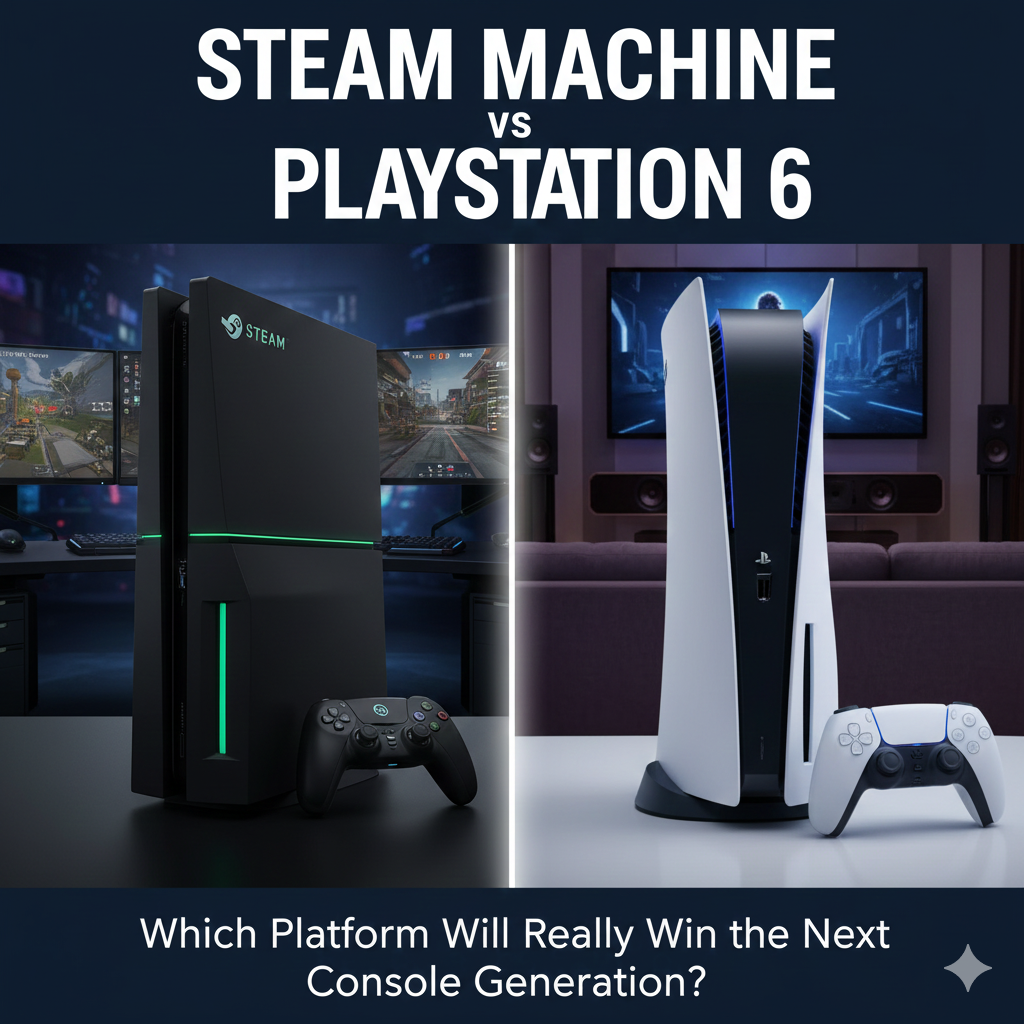
The line between PC gaming and console gaming is blurrier than ever. For years, gamers had to choose between the high-performance, customizable world of PC towers or the streamlined, plug-and-play convenience of a living room console. But with Valve’s hardware resurgence and Sony’s dominance in the home entertainment space, the next generation is shaping up to be a different kind of war.
It isn’t just about teraflops or polygon counts anymore. It’s about ecosystems. On one side, we have the rumors of a new Valve Steam Machine—a spiritual successor to the Steam Deck that aims to bring the full power of PC gaming to your couch. On the other, we have the inevitable PlayStation 6, the next evolution of Sony’s highly successful walled garden, promising exclusive blockbusters and cutting-edge proprietary tech.
Choosing between them isn’t easy. One offers freedom, free online multiplayer, and a library stretching back decades. The other offers polish, simplicity, and some of the best narrative-driven games ever made. If you are on the fence about which hardware deserves the prime spot under your TV, you are not alone. Let’s break down the rumors, the specs, and the philosophies behind these two gaming titans.
What Is the Steam Machine?
You might remember the original Steam Machines from 2015. They were a confused mix of third-party hardware and an unfinished operating system that ultimately failed to capture an audience. However, Valve is a very different company today. Following the massive success of the Steam Deck, leaks suggest Valve is preparing a second attempt at a living room console, often affectionately nicknamed the “GabeCube” by the community.
Valve’s vision for a console-like PC gaming experience
The new Steam Machine is expected to be a standalone, first-party device designed entirely by Valve. Unlike the confusing array of manufacturers involved in the first run, this device aims to offer a unified, consistent experience. The goal is simple: bring the vast Steam library to the television without the headache of Windows updates, driver installations, or keyboard-and-mouse setups.
SteamOS, controller support, and PC flexibility
At the heart of this system is SteamOS 3.0 (or a later iteration). Built on Arch Linux, this operating system uses a compatibility layer called Proton to run Windows games seamlessly. It features a “Big Picture” interface designed for controllers, making navigation feel just like a PlayStation or Xbox. However, unlike a traditional console, it retains PC DNA. You can switch to a desktop mode, install third-party software (like Discord or Spotify), and even tweak graphical settings to prioritize frame rate or resolution—freedom you rarely get on a console.
What We Know So Far About PlayStation 6
While Valve is trying to crash the console party, Sony is looking to defend its throne. The PlayStation 5 has been a massive success, but the industry never sleeps. While Sony hasn’t officially unveiled the PS6, historical cycles and industry leaks give us a strong picture of what to expect.
Expected launch timeline and early leaks
Console generations typically last about seven years. With the PS5 launching in late 2020, most analysts peg the PlayStation 6 release window around 2027 or 2028. This puts it potentially a year or two behind the rumored release of a new Steam Machine, which could give Valve a head start—or leave them with slightly older hardware when Sony finally strikes.
Sony’s next-gen strategy
Sony’s strategy remains consistent: high-end hardware paired with “must-play” exclusives. The PS6 will likely focus on diminishing loading times even further, integrating AI-driven upscaling (similar to DLSS) directly into the hardware, and deepening immersion through haptic feedback. Unlike Valve, which focuses on software openness, Sony will likely double down on its ecosystem, ensuring that your digital library, trophies, and friends list carry over seamlessly.
Hardware and Performance Comparison
When comparing a PC-hybrid to a dedicated console, you are comparing two different architectural philosophies. One is built for raw adaptability, the other for optimized efficiency.
Processing Power and Graphics
The new Steam Machine is rumored to sport custom AMD silicon, likely a Zen 4 CPU paired with RDNA 3 graphics. If rumors of a “Pro” model are true, we could see performance rivaling current high-end gaming laptops, capable of solid 4K gaming.
The PlayStation 6, launching later, will likely utilize newer architecture (potentially Zen 5 or 6 and RDNA 5). Consoles generally have an optimization advantage; because the hardware is fixed, developers can squeeze every drop of power out of the PS6. While a high-end Steam Machine might boast impressive raw numbers, the PS6 will likely deliver better performance-per-dollar due to this optimization.
Storage, Memory, and Upgradability
This is where the divergence is clear.
- PlayStation 6: Will likely feature an ultra-fast, proprietary SSD soldered to the board, with an expansion slot for specific NVMe drives. Memory (RAM) will be unified and non-upgradable.
- Steam Machine: Following the Steam Deck’s philosophy, users can expect more freedom. While the RAM might be soldered for speed, it is highly likely the storage will be user-replaceable. Furthermore, you can plug in external drives to store backups without proprietary formatting restrictions, a huge plus for data hoarders.
Games and Ecosystem
Hardware is useless without games. This section highlights the philosophical split between the two platforms: the “Walled Garden” vs. the “Open Field.”
Exclusive Titles
Sony is the king of the blockbuster exclusive. Franchises like God of War, The Last of Us, and Horizon define the PlayStation brand. While Sony has started porting these to PC, they often arrive years later. If you want to play the next Naughty Dog masterpiece on day one, the PlayStation 6 is the only place to do it.
Steam’s massive PC game library
The Steam Machine counters with volume and variety. It grants access to a backlog of games dating back to the 90s, strategy games that never come to console, and the latest indie darlings. Plus, with Sony releasing games on PC eventually, the Steam Machine technically becomes a place where you can play Halo (Microsoft), God of War (Sony), and Mario (via emulation) all on one device.
Mods, Indie Games, and Community Support
On a PlayStation, you play the game as the developer intended. On a Steam Machine, you play the game however you want. Steam Workshop integration allows for one-click modding, letting you fix bugs, add content, or completely overhaul game mechanics. This community support extends the life of games like Skyrim or Stardew Valley infinitely longer than their console counterparts.
Pricing and Value for Money
Price is often the deciding factor, and the business models here are fundamentally different.
- PlayStation 6: Consoles are traditionally sold at a loss or thin margins, subsidized by game sales and subscriptions. Expect the PS6 to launch between $500 and $600.
- Steam Machine: Valve sold the Steam Deck at aggressive prices, but PC hardware is expensive. A high-spec Steam Machine could easily cost $700–$1000.
However, the long-term cost of ownership often favors Steam. PC games go on sale deeper and more frequently. You don’t pay for “generations” of games; if you bought Half-Life 2 in 2004, you still own it on the new Steam Machine without paying a “remaster” fee.
Ease of Use vs Customization
If you just want to relax after work, the PlayStation 6 will be hard to beat. You press the PS button, the console wakes up, and you are in the game in seconds. Updates happen in rest mode. It is a frictionless appliance.
The Steam Machine, running SteamOS, has bridged this gap significantly. The “Console Mode” is slick and intuitive. But it is still a PC. Occasionally, a launcher might glitch, or a specific game might require you to tweak proton settings. For casual gamers, this friction can be annoying. For enthusiasts, having access to graphical sliders to tweak Field of View (FOV) or disable motion blur is a feature, not a bug.
Online Services and Subscriptions
This is a major point of contention for console gamers. To play online multiplayer on a PlayStation 6, you will almost certainly need a PlayStation Plus subscription. This tiered service (Essential, Extra, Premium) costs upwards of $80–$160 a year. It does offer “free” monthly games and a catalog of titles, but the paywall for multiplayer remains.
Steam offers free online multiplayer. You never pay a cent to play online with friends. Cloud saves are free. Family sharing is free. The absence of a monthly subscription fee can save a gamer over $1,000 over the lifespan of the console generation, which significantly offsets the higher initial hardware cost of a Steam Machine.
Gamer and Industry Reactions
The gaming community is buzzing with anticipation. The original Steam Machine failure made people skeptical, but the Steam Deck proved Valve understands hardware now. Industry analysts see the new Steam Machine not just as a console competitor, but as a bridge device that could finally kill the concept of “exclusive” hardware.
Meanwhile, loyal PlayStation fans argue that no amount of open-source freedom beats the polished, cinematic experience of a Sony first-party studio. They argue that PC gaming, even in a box, lacks the magic of a dedicated ecosystem where hardware and software are built in perfect unison.
Who Is Each Platform Best For?
Still undecided? Here is the verdict based on your gaming style.
The PlayStation 6 is for:
- Console-first gamers: You want simplicity. You want to buy a disc (maybe), pop it in, and play.
- Exclusive hunters: You need to play Spider-Man 3 or The Last of Us Part III the second they launch.
- Physical media collectors: Sony is likely the last bastion for disc drives in the high-end console market.
The Steam Machine is for:
- PC enthusiasts: You want high frame rates, mod support, and total control over your settings.
- Budget-conscious gamers (Software): You hate paying $70 for games and $80/year for online play. You prefer Steam Sales and Humble Bundles.
- The backlog gamer: You have hundreds of Steam games and want to bring them to the living room without rebuying them.
FAQs (SEO-Focused)
Is Steam Machine a console or a PC?
It is a hybrid. It is a PC hardware-wise, running a Linux-based operating system (SteamOS) designed to look and feel like a console interface. You get the ease of a console with the freedom of a PC.
Will PlayStation 6 outperform Steam Machine?
Likely, yes. Because the PS6 will launch later and uses proprietary, optimized hardware, it will probably offer better raw performance for the price. However, the Steam Machine may offer higher frame rates in older titles due to user-tweakable settings.
Which platform is better for exclusive games?
PlayStation 6 wins for high-budget, narrative-driven blockbusters at launch. Steam Machine wins for indie exclusives, strategy games, and early access titles that never make it to consoles.
Is Steam Machine worth it over PS6?
If you hate paying for online multiplayer and want cheaper games, yes. The higher upfront cost of the Steam Machine pays for itself by avoiding the PlayStation Plus subscription fees over 5-7 years.
Which Platform Will You Choose?
The “console war” isn’t just about Red vs. Blue anymore; it’s about Open vs. Closed. Whether you choose the polished prestige of the PlayStation 6 or the liberating flexibility of the Steam Machine, the next generation of gaming looks incredible.
Which platform would you choose—Steam Machine or PS6? Share your thoughts and follow us for next-gen gaming updates.
Leave a Reply